Chatroulette Alternative 2026: 8 Better Sites (Tested & Ranked)
Chatroulette is a ghost town in 2026. Here are 8 alternatives that actually have real people — tested, ranked, and compared on safety and match quality.
By Mark Gjura ·
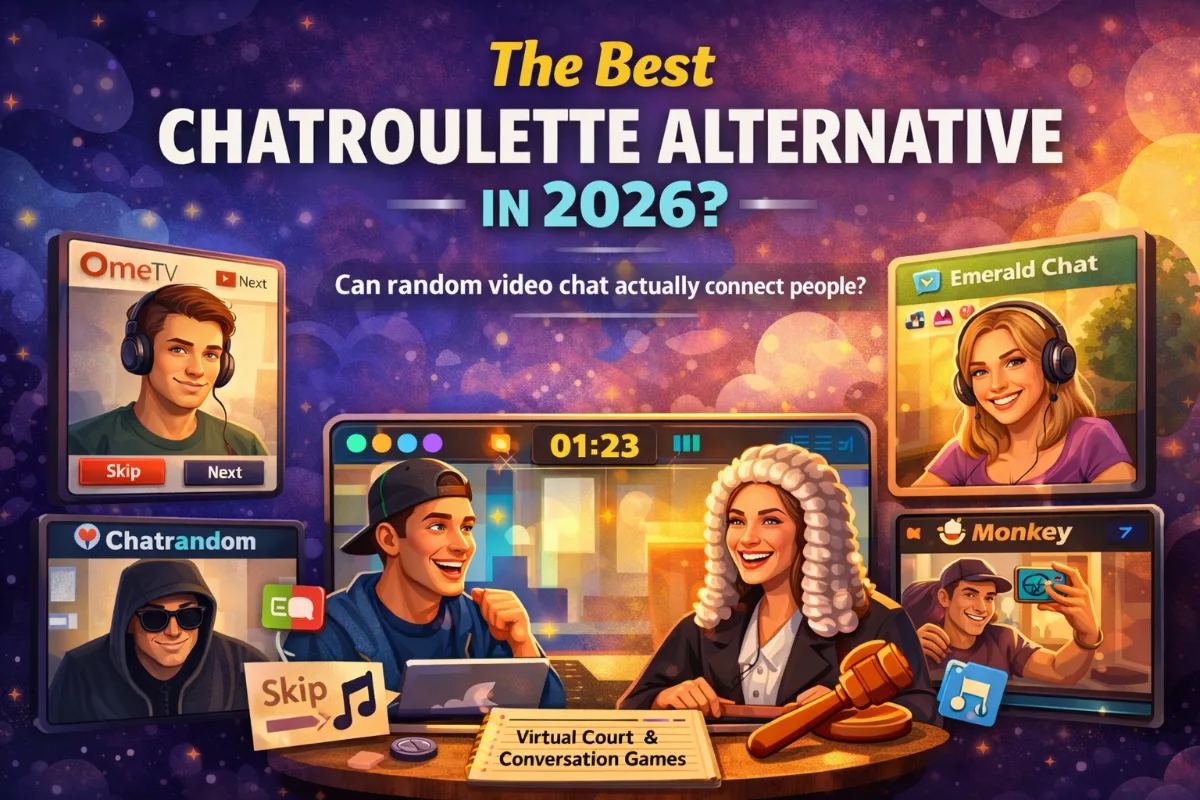
Chatroulette Alternatives in 2026 (And Why Most of Them Still Miss the Point)
Chatroulette launched in 2009 and, for a moment, felt like the future of the internet.
A teenager in Russia built it in just a few days. Ashton Kutcher tweeted about it. Suddenly, millions of people were face-to-face with complete strangers through a screen. It was chaotic, weird, and genuinely new.
Then the experience deteriorated. Abuse became part of the platform’s identity, moderation struggled to keep up, and the novelty that once made it exciting started working against it.
But the core idea never stopped being compelling.
People are still searching for a Chatroulette alternative in 2026 because the original concept was real: spontaneous, face-to-face conversation with someone completely outside your normal social circle. That kind of interaction still has a strange kind of magic.
The problem is that most platforms calling themselves Chatroulette alternatives haven’t really rethought the experience. They’ve mostly rebuilt the same format with cleaner design, better mobile support, or slightly improved moderation.
That may make the product more usable. It doesn’t necessarily make it more engaging.
---
Why Chatroulette Broke Down — And Why So Many Alternatives Repeat the Same Pattern
Chatroulette didn’t collapse for just one reason.
Moderation failures mattered. Abuse mattered. The internet changed, and user expectations changed with it.
But there was also a deeper product problem: the interaction model itself was fragile.
When you drop two strangers into a live video chat with no shared frame, no prompt, and no built-in reason to engage, the conversation has to create itself instantly. Sometimes that works. Most of the time, it doesn’t.
That’s where the whole experience starts to fall apart.
One person hesitates. The other feels awkward. Someone skips. Then it happens again. And again. This is the same pattern we’ve described as the skip cycle — the loop that has quietly defined random video chat for years.
That problem doesn’t get solved by a cleaner interface alone. It doesn’t get solved by filters alone. And it doesn’t get solved by simply removing the worst behavior.
It gets solved by giving the interaction enough structure to actually go somewhere.
Most Chatroulette alternatives improve the surface. Very few change the underlying dynamic.
---
The Main Chatroulette Alternatives Right Now
OmeTV
OmeTV is one of the most active platforms in the category. It’s mobile-friendly, widely used, and generally feels cleaner than many older random video chat sites.
If you want the most polished version of the traditional one-on-one random chat model, it’s probably the strongest option.
Its limitation is that it still relies on the same core setup: you land in front of a stranger with no context and have to generate chemistry from scratch.
Chatrandom
Chatrandom has been around for a long time and remains one of the better-known names in the space. Features like country and gender filters can make the experience feel more targeted, which is useful if you’re trying to narrow who you meet.
But targeting who you meet is not the same as improving what happens after the match begins. Even with better filtering, the conversation still starts from a blank slate.
Emerald Chat
Emerald Chat made a stronger effort than most to improve the category through interest matching, moderation systems, and anti-bot features.
That gives it a cleaner feel, and shared interests can help reduce some of the friction at the start.
But common interests only solve part of the problem. They may explain why two people were matched, but they still don’t necessarily give either person something concrete to do once the chat begins.
Monkey App
Monkey appeals to a younger audience and leans into a faster, more social-media-native style of video chat. It has strong name recognition and tends to attract users who want quick, rapid-fire interactions.
That speed can make it feel energetic, but it also reinforces the same core weakness: the interaction is still built around immediate performance. If the vibe isn’t there instantly, people move on just as fast.
Omegle
Omegle is no longer active — it shut down in November 2023 — but it still matters in this conversation because it shaped how people think about the category.
Understanding why Omegle failed is useful because its collapse wasn’t just about one platform making bad decisions. It exposed structural problems in the classic anonymous random-chat model that many “alternatives” still haven’t really solved.
---
What Most of These Platforms Still Have in Common
Even when the branding changes, the interaction model often stays the same:
random match → blank screen → awkward opener → hope something clicks → skip
That format sounds simple, but in practice it creates a strange kind of pressure.
The spotlight effect helps explain why. People tend to overestimate how much others are watching, judging, or evaluating them. In a blank-screen video chat, that pressure shows up immediately. Before anyone has said anything, both people are already deciding how they’re being perceived.
That makes the whole interaction feel performative before it has a chance to feel natural.
And when the first few seconds feel high-pressure, most chats never get enough momentum to become interesting. Instead of creating authentic connection, the format often creates guarded, self-conscious, disposable interactions that end almost as quickly as they begin.
That’s the real issue most “Chatroulette alternatives” still haven’t addressed.
---
What Actually Makes a Better Chatroulette Alternative
The best Chatroulette alternative isn’t just the one that recreates the old format with fewer problems.
It’s the one that keeps the spontaneity of meeting a stranger while giving the interaction enough structure to become engaging.
That’s the thinking behind What’s The Vibe.
Instead of dropping people into an empty interaction and hoping chemistry appears out of nowhere, WTV gives each conversation a built-in frame: a game, a shared prompt, or a vibe that gives both people something to do together from the start.
The randomness is still there. You still don’t know who you’re about to meet.
But when the match happens, the conversation already has a reason to begin.
WTV is built around three things traditional Chatroulette-style platforms usually overlook:
Conversation games.
Games like Virtual Court — where one person defends themselves against an absurd accusation while the other plays judge — and Walking Red Flag — where people reveal funny or revealing dealbreakers in a playful format — work because they remove the pressure of the forced opener. Instead of trying to invent a personality in the first five seconds, both people step into something immediately.
Vibe-based matching.
Before matching, users can choose a category like Comedy, Gaming, Music, or Fitness. That preserves spontaneity while reducing total contextlessness. You’re still meeting a stranger — just not a completely random stranger with no shared direction at all.
Less incentive to skip.
When a conversation starts with a built-in activity, there’s a reason to stay for another minute. The interaction has momentum. Instead of judging the other person instantly and deciding whether they’re “worth” the effort, both people already have something to react to together.
That small design change makes a bigger difference than most platforms realize.
---
The Bottom Line
If you want the closest thing to a traditional Chatroulette replacement, OmeTV is probably the safest choice right now. It’s established, active, and one of the cleaner versions of the classic format.
But if what you actually want is not just random faces — but a conversation that can become something — then the best Chatroulette alternative may not be a direct Chatroulette clone at all.
What’s The Vibe takes the original appeal of random video chat — spontaneity, surprise, and meeting someone outside your world — and rebuilds the interaction around something more durable than awkward small talk.
It asks a better question than most of the category ever did:
What if random video chat were designed not just to match strangers, but to help them connect?
That answer looks a lot less like blank screens and instant skipping — and a lot more like shared momentum, absurd games, and conversations that actually have somewhere to go.
---
Related Guides
- Is random video chat safe? An honest 2026 guide — the real risks, ranked, and how to avoid them
- Uhmegle alternative in 2026 — why faithful Omegle clones inherit Omegle's problems
- Chatroulette vs Omegle — the full story of both pioneers
Frequently asked questions
What is the best Chatroulette alternative in 2026?
If you want the closest replacement for the classic Chatroulette experience, OmeTV is one of the strongest options because it is active, relatively polished, and widely used. If you want something built more intentionally for conversation instead of instant skipping, platforms like What’s The Vibe offer a different model centered around prompts, games, and shared interaction.
Why are people still looking for Chatroulette alternatives?
People are still searching for Chatroulette alternatives because the original idea was compelling: spontaneous face-to-face conversation with a random stranger. Even though Chatroulette became known for moderation issues and low-quality interactions, the appeal of meeting someone outside your usual social circle never disappeared.
Are Chatroulette alternatives actually better now?
Some are cleaner, more stable, and better moderated than older random video chat sites. But many still use the same basic formula: random match, blank screen, awkward opener, then quick skipping. That means the core conversation problem often remains, even when the platform itself looks more modern.
Is What’s The Vibe different from other Chatroulette alternatives?
What’s The Vibe takes a different approach by focusing on conversation games, vibe-based matching, and more structured interaction. Instead of relying entirely on random face-to-face chemistry, it gives users a shared frame that helps the conversation start faster and continue more naturally.
Try it yourself
Start a vibe-matched video chat on What's The Vibe — free, no sign-up.
Related reading
- Is Random Video Chat Safe? An Honest 2026 Guide
- Is the Monkey App Safe? An Honest 2026 Breakdown
- The Dead Internet Field Guide: Verify Real Humans Online
- Uhmegle Alternative in 2026: Honest Look at the Omegle Clone
- Chatroulette vs Omegle: What Happened to Both (2026)
- How to Make Friends Online as an Adult (2026 Guide)