The Evolution of Video Chat: Skype to WebRTC (2003–2026)
The 20-year history of video chat — how Skype, FaceTime, Zoom, and Omegle each won a lane, why random video chat broke, and what comes after Omegle in 2026.
By Mark Gjura ·
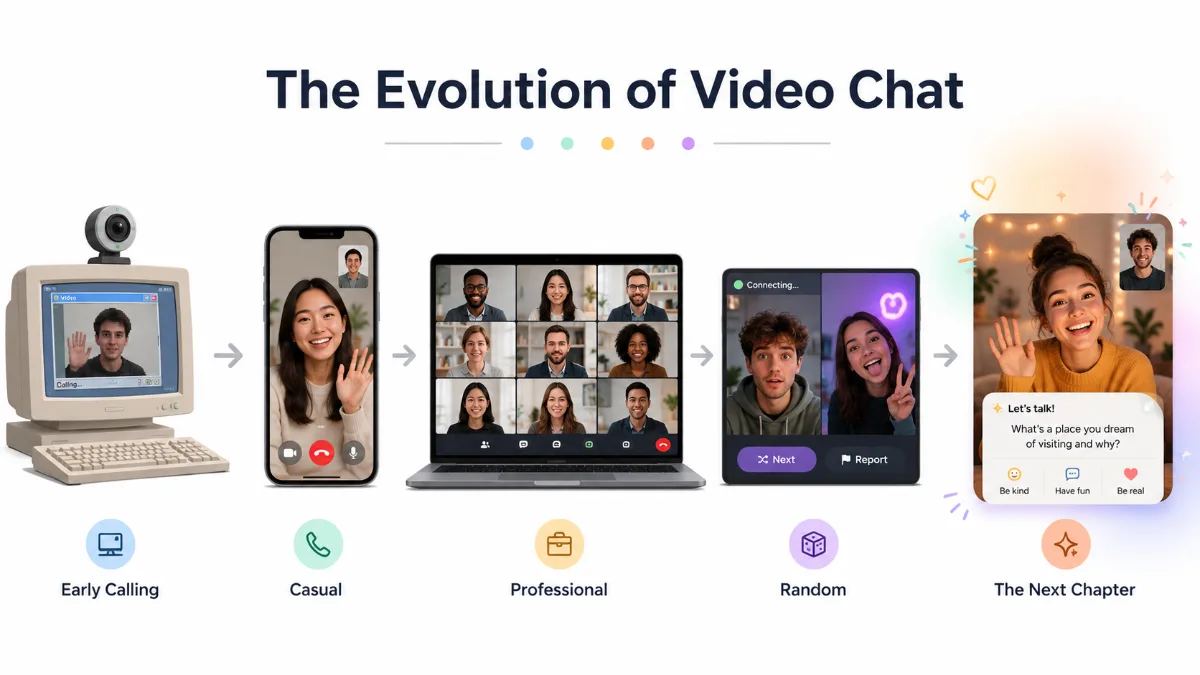
Before video calls were normal, they felt like magic.
There was a time when seeing somebody's face through a computer screen felt futuristic. Not "join the meeting, you're on mute" futuristic. Real futuristic. Like you were hacking distance itself.
Then video became normal.
Then it became boring.
Then it became awkward.
Then it became work.
Then it became random chaos.
The evolution of video chat spans twenty years and four giants — Skype, FaceTime, Zoom, and Omegle — and somehow, after all of it, the most obvious thing is still missing:
A live video chat platform where strangers actually have a reason to talk.
That's where What's The Vibe comes in.
But to understand why that matters, you have to understand the full history of video chat — and how we got here.
Skype: The First Video Chat Platform That Felt Real (2003)
Skype was the original giant.
Launched in 2003, Skype turned internet calling into something normal people could actually use. Before FaceTime. Before Zoom. Before Google Meet. Before every app on your phone had a video button buried in a corner.
Skype made long-distance feel smaller.
Families used it. Couples used it. Friends used it. People overseas used it. Businesses used it before "remote work" became a personality trait.
And technically, Skype was different from today's browser-based video chat platforms. It wasn't WebRTC. It was its own thing — a proprietary peer-to-peer system built for voice and video over an internet that wasn't really ready for either.
That was the genius of Skype. It made internet calling feel possible before the web itself could handle real-time video.
But Skype had a problem.
It was built for a different internet.
The early internet was desktop-heavy. Download the app. Make an account. Add a contact. Schedule a call. Hope the connection holds. Amazing for its time — but the world moved.
Smartphones took over. Browsers got stronger. Social media changed how people discovered each other. Video stopped being a special tool you opened on purpose.
Video became everywhere.
FaceTime: Video Calling Goes Casual (2010)
When Apple introduced FaceTime in 2010, video calling changed emotionally.
Skype felt like something you opened.
FaceTime felt like something your phone just did.
That difference matters.
FaceTime made video calling casual. No software to think about, no usernames, no downloads. You tapped someone you already knew.
That was the lane Apple won.
Not strangers. Not meetings. Not discovery.
People already in your contacts. Your mom. Your friend. Your cousin. Your group chat. The people already in your real life.
FaceTime didn't make video social in the discovery sense. It made video personal. It made video native.
And once that happened, Skype started losing the casual internet — because why open Skype when your phone already had FaceTime?
Zoom: Video Chat Becomes Work (2013)
Zoom did something different.
Zoom didn't try to be cool. Zoom didn't try to be social. Zoom didn't try to be chaotic.
Zoom just worked.
Founded in 2011 and released publicly in 2013, Zoom became the clean answer for professional video. Meetings, webinars, classrooms, interviews, remote teams, sales calls, therapy sessions, investor calls — Zoom became the room.
Then the pandemic poured gasoline on it.
Suddenly video wasn't optional. It was school. It was work. It was church. It was birthdays. It was court. It was everything.
Zoom became a verb the way Skype used to be a verb.
But Zoom's win proved something bigger:
Video communication is not one category. It's a medium.
The same way text can be texting, tweeting, blogging, or emailing, video can be work, dating, entertainment, education, performance — or pure chaos.
Zoom took the professional lane. FaceTime took the casual lane. Skype faded between both.
But video still had other lanes coming.
Live Video and the Attention Economy
This part gets skipped in polite tech history. It shouldn't.
The adult industry has always been one of the fastest movers on new media. Streaming video, payments, subscriptions, parasocial relationships, tipping, private rooms, creator monetization — the cam industry understood most of the creator economy before the mainstream wanted to admit it existed.
And the lesson was bigger than adult content.
Live video is not just communication. Live video is presence.
It's attention. It's performance. It's emotional reaction in real time.
People don't only pay for content. They pay for access, energy, validation, connection — the feeling that something is happening right now.
That matters because live video chat is one of the only formats online where the moment can't be fully faked.
A post can be edited. A photo can be filtered. A profile can be curated.
But live video has pressure. It has timing. It has awkwardness. It has chemistry. It has risk.
That's why live video keeps coming back.
Omegle and Chatroulette: Random Video Chat Goes Full Chaos (2009)
Around 2009, the internet got bored of polished profiles.
Omegle and Chatroulette brought back something raw:
What if you could click a button and instantly be face-to-face with a stranger?
That idea was powerful.
No followers. No algorithm. No feed. No fake perfect profile. Just you, a webcam, and the next person.
For a moment, it felt like the internet had opened a trapdoor into humanity. You could meet someone across the world. You could see something hilarious. You could have a weird conversation at 2 a.m. You could run into a musician, a troll, a lonely person, a genius, a menace, or someone who had absolutely no business being online.
That randomness was the product.
It was also the problem.
Because random without structure turns into roulette. Sometimes funny. Sometimes interesting. Sometimes disturbing. Sometimes just empty.
What Happened to Omegle?
Omegle shut down in November 2023 after years of serious safety failures — we broke down exactly why Omegle failed at safety and what video chat platforms in 2026 have to do differently. Chatroulette became internet legend, but also a warning label.
The format proved people want spontaneous video chat with strangers. It also proved that "connect two random people and hope for the best" is not a product. It's a gamble.
Random video chat had energy.
It didn't have direction.
Why Random Video Chat Keeps Failing
The problem was not the camera.
The problem was the reason.
Most random video chat platforms made the same bet: put two strangers together and maybe something happens.
Sometimes it did. Most of the time it didn't.
Because strangers need context. They need a frame. They need a reason to stay past the first awkward three seconds — and when there's no reason, the skip button wins every time. That reflex has a name now: skip culture, and it quietly killed every platform that treated "random" like the whole product.
But random is not the product.
Random is the spark. The product is what happens after the match.
Do you have something to talk about? Do you know why you're there? Is there a vibe? Is there a game? Is there a prompt? Is there a reason not to instantly hit next?
We've written before about what happens when you drop two strangers into a video chat with no context — the conversation dies before it starts. Not because the people are boring. Because the format gave them nothing to work with.
That's the missing piece. And it's a psychological problem, not a technical one. The psychology behind meaningful video chat is well understood — strangers connect fastest when there's shared structure, not open-ended pressure.
WebRTC: The Technology That Changed Who Could Build Video Chat
While the consumer apps fought for their lanes, the web itself was changing underneath everything.
WebRTC gave browsers real-time communication powers. Voice, video, and data could run directly inside web apps — no heavy desktop download, no install friction.
That changed the game for builders.
Video was no longer reserved for giant companies with massive native apps. A startup could build real-time video chat directly on the open web. Social products, telehealth, education, live support, creator platforms, games — all of it could use live video as infrastructure.
But infrastructure is not a product.
WebRTC gives you the camera. It does not give you the culture.
It gives you the connection. It does not give you the reason people should care.
That's the difference.
The next wave of video communication will not be won by whoever can turn on a webcam. Everybody can turn on a webcam now.
The next wave will be won by whoever gives the webcam a point.
What's The Vibe: The Video Chat Lane Nobody Finished
Run the scoreboard:
Skype made video calling real. FaceTime made it casual. Zoom made it professional. The cam industry proved live video could monetize presence. Omegle and Chatroulette proved strangers still crave spontaneous connection. WebRTC made real-time video buildable on the open web.
But the internet still needs a better version of random video chat.
Not another empty roulette wheel. Not another awkward stranger lobby. Not another "next, next, next" machine. If you've compared the current options — and we have, in our full guide to the best Omegle alternatives in 2026 — you already know most Omegle alternatives aren't actually alternatives. They're the same slot machine with a new coat of paint.
What's The Vibe is built around a different idea:
Random video chat is better when people show up with a reason.
Pick a vibe. Comedy. Music. Rabbit Hole. Roast Roulette. Second Opinion. The Veto.
Then step into live conversations, debates, games, stories, and actual moments. (If you're wondering why comedy is the default door for most people — there's a reason comedy is the fastest way to connect with strangers.)
And when talking isn't enough, the conversation games give the interaction structure:
Walking Red Flag. Virtual Court. Who Dis?
Now the stranger is not just a stranger.
They're your opponent. Your judge. Your teammate. Your bad-take defendant. Your roast target. Your co-conspirator at 2 a.m. explaining why the moon landing discourse is somehow back again.
That's the shift. That's why conversation games beat random video chat every time the two go head to head.
WTV is not trying to bring back old random video chat. Old random video chat had no seatbelt.
WTV is building the version that should have existed next.
Live. Random. Human.
But with a point.
The Future of Video Chat Is Not More Meetings
We already have enough meetings.
We have Zoom for work. We have FaceTime for people we already know. We have livestreaming for audiences. We have creator platforms for fans. We have dating apps pretending profile swiping is still exciting.
But where do you go when you just want to talk to someone new?
Where do you go when you want a debate, a laugh, a weird theory, a second opinion, a live game, or a conversation that wasn't planned by an algorithm three weeks ago?
That space is still open. It's not a feature gap — it's a whole genre video chat hasn't invented yet.
Because humans don't only want content.
They want moments. They want chemistry. They want unpredictability without complete chaos.
They want a reason to talk.
That's the next chapter.
Not Skype. Not Omegle. Not another meeting room.
Random video chat finally got a point.
Frequently asked questions
When did video chat start?
Consumer video chat went mainstream with Skype in 2003, which used proprietary peer-to-peer technology to make internet voice and video calling accessible to everyday users. Earlier video calling existed in labs and enterprise systems, but Skype was the first video chat platform regular people actually adopted at scale.
What replaced Omegle?
Dozens of clones tried — OmeTV, Monkey, Chatrandom, Emerald Chat — but most copied the same random-matching model that made Omegle fail. The real replacement isn't a clone; it's a structural redesign. Platforms like What's The Vibe replace pure randomness with vibe-based matching and conversation games, giving strangers an actual reason to talk instead of a reason to skip.
What is WebRTC and why does it matter for video chat?
WebRTC (Web Real-Time Communication) is the open technology that lets browsers handle live voice, video, and data without downloads or plugins. It's the reason modern video chat platforms run instantly in your browser — and the reason startups can now build real-time video products that once required the resources of a tech giant.
Try it yourself
Start a vibe-matched video chat on What's The Vibe — free, no sign-up.
Related reading
- Is Random Video Chat Safe? An Honest 2026 Guide
- Is the Monkey App Safe? An Honest 2026 Breakdown
- The Dead Internet Field Guide: Verify Real Humans Online
- Uhmegle Alternative in 2026: Honest Look at the Omegle Clone
- Chatroulette vs Omegle: What Happened to Both (2026)
- How to Make Friends Online as an Adult (2026 Guide)