Random Video Chat With Games That Start Real Conversations
Looking for random video chat with games? See why board games and icebreakers fall short—and how conversation games help strangers actually connect.
By Mark Gjura ·
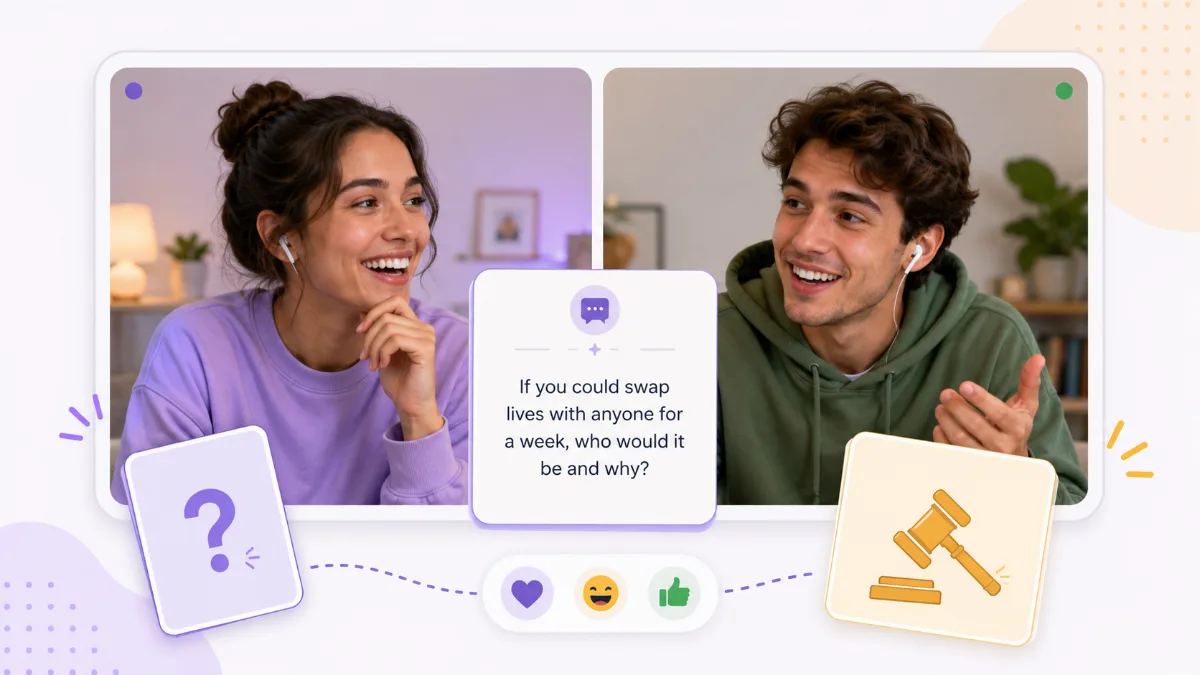
Random Video Chat With Games That Start Real Conversations
If you search for random video chat with games, most of what you'll find is chess, Pong, Connect Four, and Tic-Tac-Toe bolted onto a webcam feed.
That's not really video chat with games. That's two people playing a board game while occasionally remembering there's a camera on.
The real game is figuring out the person across from you. What are they like? What do they believe? Would you actually get along? A well-designed conversation game is built to answer those questions. A chess widget is built to avoid them.
Here's the quick answer, then the full argument.
Video Chat With Games: The Quick Version
What it is: platforms that match you with strangers on video and give you something to play together, right inside the call. No downloads, no separate app.
The three types you'll find:
| Type | What happens | Best for |
|---|---|---|
| Board/arcade games | Chess, Pong, Connect Four beside the video feed | Passing time, playing with friends you already know |
| Icebreaker prompts | The platform fires a question at both of you | Getting one beat of conversation started |
| Conversation games | Roles, decisions, judging, guessing — talking is the gameplay | Strangers who want the conversation to actually go somewhere |
What's on What's The Vibe: conversation games only — Virtual Court, Walking Red Flag, Who Dis?, Around the Vibe, Roast Roulette, Rabbit Hole, The Veto, and more. You pick a vibe, get matched, and launch a game from inside the call. Free to use, 18+, nothing to install.
If that answers your search, go try one. If you want to understand why the three types produce completely different conversations, keep reading — because the difference decides whether you have a conversation or just kill time near a stranger.
The Three Kinds of "Games" in Video Chat
Every platform claiming to offer video chat and games falls into one of these categories. They are not remotely the same thing.
1. Board games beside a video call
Chess, checkers, Pong, Connect Four. The game runs in a window next to the video feed, and the conversation is optional.
This is closer to parallel play: two people sharing a screen while focusing on separate activities. You can finish an entire chess match with a stranger and know exactly one thing about them: whether they castle early.
The game gives your hands something to do. It gives the conversation nothing. When the match ends, you're back at the same blank wall every random chat starts at: two strangers, no context, nothing to say. Most people skip.
Board games beside a call aren't bad — with friends, they're great. They're just not solving the stranger problem. The hard part of talking to someone new was never boredom. It's that neither of you knows what to say. A chess board doesn't answer that. It postpones it.
2. Generic icebreakers
The next tier up: platforms that fire a question at you. "What's your favorite food?" "Where would you travel if you could go anywhere?"
Icebreakers are better than nothing, and worse than they sound. The problem is structural: an icebreaker is one question with one answer. You answer, they answer, and then the prompt is spent. There's no second move. Nothing in the format creates a follow-up, a reaction, or a reason to disagree.
So the conversation gets exactly one beat of momentum and then stalls out — which, on a random chat platform, means someone hits next. We've written about why this happens: contextless questions produce performed answers, not real ones. You give the travel answer you think sounds interesting. So do they. Nobody learned anything.
An icebreaker breaks the ice and then hands you back the same empty conversation, thirty seconds later.
3. Conversation games
This is the category that actually works, and almost nobody builds it.
A conversation game gives people roles, forces decisions, and makes reactions part of the gameplay. You're not answering a question next to someone. You're arguing a case against them. Getting judged on your dating takes. Acting out a character while they try to guess it.
The critical design difference: in a conversation game, the conversation is the game. There's no game window and chat window. Talking, reacting, performing, and pushing back is how you play.
That's what we built What's The Vibe around. Not games as a feature on top of video chat — games as the reason two strangers have anything to say at all.
What That Looks Like in Practice
Four of ours, and what each one is engineered to cause.
Virtual Court
One of you is prosecuting. One of you is defending. The case is something petty and universal — pineapple on pizza, texting back immediately, showing up early to parties.
Notice what the format does. You've both been handed a role, which means neither of you has to be "yourself" for the first two minutes — the single most paralyzing demand random chat makes of people. You have a position to argue whether you believe it or not. And arguing a position you were assigned reveals more personality than answering "what's your favorite food" ever could, because how someone argues is who they are.
Virtual Court manufactures the thing strangers can't produce on their own: a reason to disagree that nobody takes personally.
Walking Red Flag
A host-and-contestant format built around dating takes. Contestants respond to dating prompts, and the host judges each answer with a green, yellow, or red flag.
The engine here is judgment with stakes that don't matter. Every answer gets a verdict, and every verdict is a conversation — you're either defending your yellow flag or gloating about your green one. The format hands people material instead of asking them to be interesting on command, which is why it naturally makes people funny.
It also does something subtle: it lets strangers talk about dating — the topic everyone's curious about and nobody knows how to bring up — inside a frame where it's a game, not an interrogation. Full rules and 50 prompts here if you want to see how it's built.
Who Dis?
Our take on character guessing. One player acts out or gives clues for a character — celebrities, athletes, public figures, jobs, regions, and more — and the other player has to guess who it is.
The mechanic that matters: performance replaces small talk. Acting out a character in front of a stranger sounds terrifying for about four seconds, and then it's the fastest wall-breaker on the platform — because you can't do an impression of a famous athlete and maintain a guarded first-conversation persona at the same time. The guessing side is just as active: every wrong guess is a reaction, every clue is a choice that shows how the other person thinks.
Charades has survived every generation for a reason. Who Dis? puts it between strangers, where it works even better — because there's no reputation to protect.
Around the Vibe
A group format with rotating timed turns. There's a topic, a host keeping things moving, and scoring — and everyone gets a turn.
The mechanic that matters: nobody gets to be a spectator, and nobody has to fight their way in. In an unstructured group call, one or two personalities dominate and everyone else watches. Around the Vibe hands the turn to you — which sounds like pressure until you realize it's the opposite. You don't have to find an opening in the conversation. The structure gives you one, and the timer means it ends before it gets uncomfortable.
Games Don't Distract From the Conversation. They Cause It.
Here's the objection we hear: "I don't want games, I just want to talk to people."
We built an entire platform on the belief that this objection has it backwards.
Pure open-ended talking is what Omegle offered for fourteen years, and it produced skip culture, not conversation. When two strangers face each other with no structure, the honest answer to "what should we talk about?" is nothing — there's no shared context to draw from. So people skip, hunting for a magic match where conversation happens effortlessly. That match is rare, so they keep skipping, and skipping becomes the whole product.
A conversation game doesn't get in the way of talking. It removes the reason talking wasn't happening. It answers the paralyzing opening questions — what do we talk about, who am I supposed to be right now, is it okay to disagree — before either person has to ask them.
Structure creates freedom. It sounds like a paradox until you see the format in action. Give two strangers a role and a decision to fight over, and a few minutes later they've often abandoned the game entirely — because the argument turned into an actual conversation. The game did its job: it got them past the wall. Nobody skips mid-argument.
That's the test that matters. Board games beside a call fill time. Icebreakers fill one beat. Conversation games start something that outlives them.
How to Start Playing Games With Strangers on WTV
1. Go to whatsthevibe.co — it runs in the browser, nothing to download.
2. Pick a vibe, so you're matched with people looking for the same kind of energy.
3. Get matched and start talking — or launch a game right from inside the call.
4. Play, argue, guess, get flagged. Skip the game whenever the conversation takes over. That's the point.
It's free to use and 18+, with AI moderation keeping the platform focused on actual conversation.
Where WTV Fits
If you want chess with a webcam, several platforms do that fine — we compared the major ones honestly here.
If you want the conversation itself to be the game, that's the category we build in. Vibe-based matching gets you in the room with the right people. Conversation games — Virtual Court, Walking Red Flag, Who Dis?, Around the Vibe, and more — are designed so that strangers always have something to do, a role to play, and a reason to react to each other.
The matching gets you in the room. The game is why you stay in it.
Frequently asked questions
What games can you play on random video chat?
It depends on the platform. Most sites that advertise games offer board and arcade games — chess, Connect Four, Pong, Tic-Tac-Toe — that run beside the video feed. A smaller category offers conversation games, where the talking itself is the gameplay: debate formats, character guessing, and judged dating prompts. What's The Vibe focuses entirely on conversation games like Virtual Court, Walking Red Flag, Who Dis?, and Around the Vibe.
How do you play games with strangers online?
On platforms with built-in games, you get matched with a stranger and the game launches inside the chat — no downloads, no separate app. On What's The Vibe, you pick a vibe, get matched, and can start a conversation game from inside the call. The game gives everyone roles and prompts, so you're never staring at each other wondering what to say.
Are conversation games better than regular icebreakers?
For sustaining a conversation between strangers, usually. An icebreaker is one question with one answer — it creates a single beat of conversation and then stalls. A conversation game creates roles, decisions, and reactions, which means every round generates follow-ups. Icebreakers work fine among people who already have things to talk about. Between strangers, you need a format that keeps producing things to respond to.
Why do video chat platforms add games?
The honest reason: open-ended talking between strangers usually fails. Two people with no shared context don't know what to say, so they skip. Games give strangers shared context instantly. The better platforms treat games as the core conversation engine, not a side feature — because a game that runs beside the conversation doesn't fix the conversation.
Is What's The Vibe free to play games with strangers?
Yes. Matching and conversation games are free to use. What's The Vibe is 18+ and uses AI moderation to keep the platform focused on actual conversation.
Try it yourself
Start a vibe-matched video chat on What's The Vibe — free, no sign-up.
Related reading
- Is Random Video Chat Safe? An Honest 2026 Guide
- Is the Monkey App Safe? An Honest 2026 Breakdown
- The Dead Internet Field Guide: Verify Real Humans Online
- Uhmegle Alternative in 2026: Honest Look at the Omegle Clone
- Chatroulette vs Omegle: What Happened to Both (2026)
- How to Make Friends Online as an Adult (2026 Guide)