Chatrandom Alternative: What's The Vibe
Tired of Chatrandom's skip loop? See why it happens and the free Chatrandom alternative that matches you by vibe, with games built in.
By Mark Gjura ·
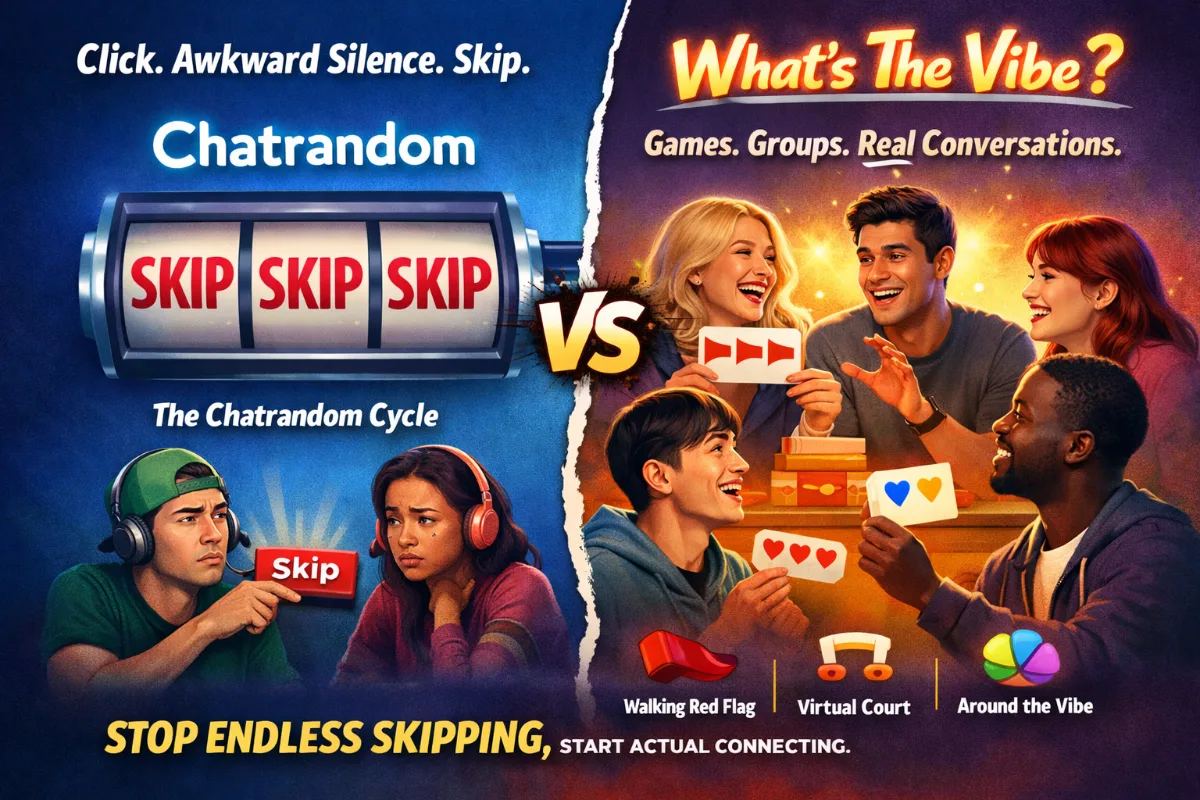
Chatrandom Alternative: Why the Skip Cycle Needs a Structural Fix
If you're searching for a Chatrandom alternative, you've probably lived this:
Click. "Hey." Three seconds of silence. Skip.
Click. Stranger stares at camera. You stare back. Skip.
Click. Actually seems interesting. Your brain goes blank. They skip you.
After 20 rounds of this, you're not questioning Chatrandom — you're questioning whether there's a better alternative to random video chat that doesn't feel like a slot machine where the jackpot is a decent conversation.
There is. But it requires fixing the structure, not just the filters.
Why Chatrandom Creates the Problems It Does
Before looking at alternatives, it's worth understanding why the skip cycle exists in the first place — because most platforms claiming to be alternatives make the exact same structural mistake.
Chatrandom does one thing well: instant connections. Large global user base, simple interface, no friction. If speed of matching is your only metric, it delivers.
The problem is what happens after the match.
When two strangers meet with zero shared context, three things happen simultaneously:
Performance pressure — Both people feel immediately obligated to be interesting. Someone has to open. Someone has to carry the moment. If neither person does, the silence becomes the verdict.
Evaluation mode — Without a shared activity or purpose, the interaction defaults to mutual assessment. You're sizing each other up for conversational compatibility before either of you has said anything worth assessing.
Frictionless exit — The skip button is always one click away, with zero social consequence. When the cost of leaving is nothing, the brain calculates the risk-reward of staying and usually lands on: try the next one.
Psychologists call this approach-avoidance conflict — you want connection, but manufacturing it from scratch with a stranger who can disappear instantly is genuinely stressful. Your brain's solution is to skip and try again. The next person faces the same situation. The cycle repeats.
This is why adding filters to Chatrandom doesn't fix the problem. Filters narrow who you're matched with. They don't give you anything to do together once you are.
What Most Alternatives Get Wrong
Most platforms that come up when you search for Chatrandom alternatives make the same mistake: they copy the 1-on-1 random format and add different filters or a cleaner interface.
OmeTV — Same instant-match, instant-skip loop. Better moderation, identical architecture.
Chatspin — Random matching with gender and location filters. Solves the "who" problem, not the "what now" problem.
CamSurf — Random matching with moderation focus. Cleaner, same dynamic.
Tinychat — Group chat rooms but no built-in structure. Better than 1-on-1 randomness but still leaves conversations to chance.
The pattern is consistent: filters, moderation improvements, cleaner UI. None of it touches the core issue — two strangers with nothing to do except hope chemistry appears.
As we break down in why most Omegle alternatives aren't actually alternatives, most platforms changed the branding without changing the architecture.
What Actually Fixes the Skip Cycle
The social psychology research here is clear. Shared activities dramatically accelerate bonding between strangers — far more reliably than shared interests or demographic matching. When two people have something to do together, the conversation stops being about filling silence and starts being about the shared experience.
This is the insight that separates platforms that actually produce connection from platforms that just produce the feeling of activity.
What's The Vibe was built around this principle. Instead of dropping users into blank 1-on-1 calls and hoping for chemistry, the platform gives every interaction shared context before the call even starts.
How What's The Vibe Works Differently
Vibe-based matching instead of pure randomness
Before connecting, you choose a vibe — Comedy, Gaming, Music, Fitness, Creator, or Social. That shared intent means you're not appearing on a stranger's screen with no explanation for why you're both there. You're entering a context you both chose.
Group dynamics that reduce pressure
Many interactions happen in group settings rather than isolated 1-on-1 calls. When one person goes quiet, others keep energy alive. The performance pressure of carrying an entire conversation solo disappears.
Conversation games that unlock authenticity
This is the structural fix most platforms miss entirely. What's The Vibe builds optional conversation games directly into video chat — not icebreaker prompts you can ignore, but actual shared activities with clear roles and immediate momentum:
- Walking Red Flag — Players defend controversial takes while the group votes: dealbreaker, yellow flag, or totally relatable
- Virtual Court — Argue absurd cases with defined roles from the first second
- Who Dis? — Live impersonation and guessing that makes the opening 60 seconds electric
The games aren't mandatory. Most users don't play them every session. But they're there when conversations need a spark — and they change the internal experience of the interaction entirely.
What the Difference Actually Looks Like
Here's the same scenario on both platforms:
Chatrandom:
- "Hey"
- "Hey what's up"
- "Not much, you?"
- "Same"
- [silence]
- [skip]
What's The Vibe with Walking Red Flag:
Prompt: "They check your phone every night 'just to make sure' — defend this."
Person 1: "Okay if you have nothing to hide—" Person 2: "IMMEDIATE red flag" Person 3: "Wait, I dated someone like this..." Person 4: [drops 🚩🚩🚩]
Five minutes later they're sharing real relationship stories. One admits they've been the insecure partner. Another talks about trust issues from a past relationship.
The game gave permission to be honest. The group gave safety to be vulnerable. The conversation that followed was entirely their own.
That's the difference between a platform that connects strangers and one that gives strangers something to do together.
Head-to-Head Comparison
| Feature | Chatrandom | What's The Vibe |
|---|---|---|
| Matching | Random 1-on-1 | Vibe-based groups + 1-on-1 |
| Conversation structure | None | Optional games + prompts |
| Skip rate | Very high | Significantly lower |
| Shared context | None | Interest-based vibes |
| Moderation | Basic | Proactive AI real-time |
| Best for | Quick randomness | Actual conversations |
Who Should Use Which Platform
Chatrandom makes sense if:
- You want pure randomness with zero structure
- You don't mind high skip rates and short sessions
- You treat video chat as something to pass time rather than build connection
What's The Vibe makes sense if:
- You want conversations longer than 90 seconds
- You prefer group dynamics over isolated 1-on-1 pressure
- You're tired of performing for strangers who might skip you anyway
- You want shared context before the conversation even starts
The Bottom Line
Chatrandom isn't broken — it's just optimized for speed, not connection. If speed is what you want, it delivers.
But if you're searching for an alternative because the skip cycle is exhausting, because conversations die in silence, because 1-on-1 with a stranger with nothing to do feels like an audition you didn't prepare for — the fix isn't a different platform running the same model.
It's a platform built around a different question entirely.
Not "who should we match you with?"
But "what should two strangers do together to actually connect?"
Related Guides
- Is random video chat safe? An honest 2026 guide — the real risks, ranked, and how to avoid them
- Uhmegle alternative in 2026 — why faithful Omegle clones inherit Omegle's problems
- Chatroulette vs Omegle — the full story of both pioneers
Frequently asked questions
Is What's The Vibe free like Chatrandom?
Yes. Completely free to use.
Do I have to play games on What’s The Vibe?
No. Games are completely optional. Many users just talk naturally. Games are there as tools if the conversation slows down or feels awkward, a game can instantly break the ice. Think of them as conversation starters, not requirements.
What makes this better than other chat random alternatives?
Unlike alternatives that just copy Chatrandom's format, What's The Vibe fundamentally redesigns how strangers connect through shared vibes and optional structure instead of random chance.
What is the best Chatrandom alternative?
The best Chatrandom alternative depends on why you’re leaving. If you’re tired of endless skipping, awkward silences, and conversations dying instantly, What’s The Vibe is built specifically to solve those problems using vibe-based group matching and optional conversation games.
Is there a What’s The Vibe app?
Not yet no download required. What’s The Vibe runs directly in your browser and works on both desktop and mobile.
Try it yourself
Start a vibe-matched video chat on What's The Vibe — free, no sign-up.
Related reading
- Monkey App Alternative 2026: Safer Picks That Actually Work
- Emerald Chat Alternative 2026: Better Options (The Bar Is Low)
- Random Video Chat Alternatives & Games
- Why Video Chat Without Context Forces Performance
- Comedy Is the Fastest Way to Connect on Omegle Alternatives
- The Lie Omegle Alternative Tells You About Making Friends