Comedy Is the Fastest Way to Connect on Omegle Alternatives
Humor isn't shallow on random video chat it's the fastest path to real connection. But only if you understand the difference between comedy and clowning.
By Mark Gjura ·
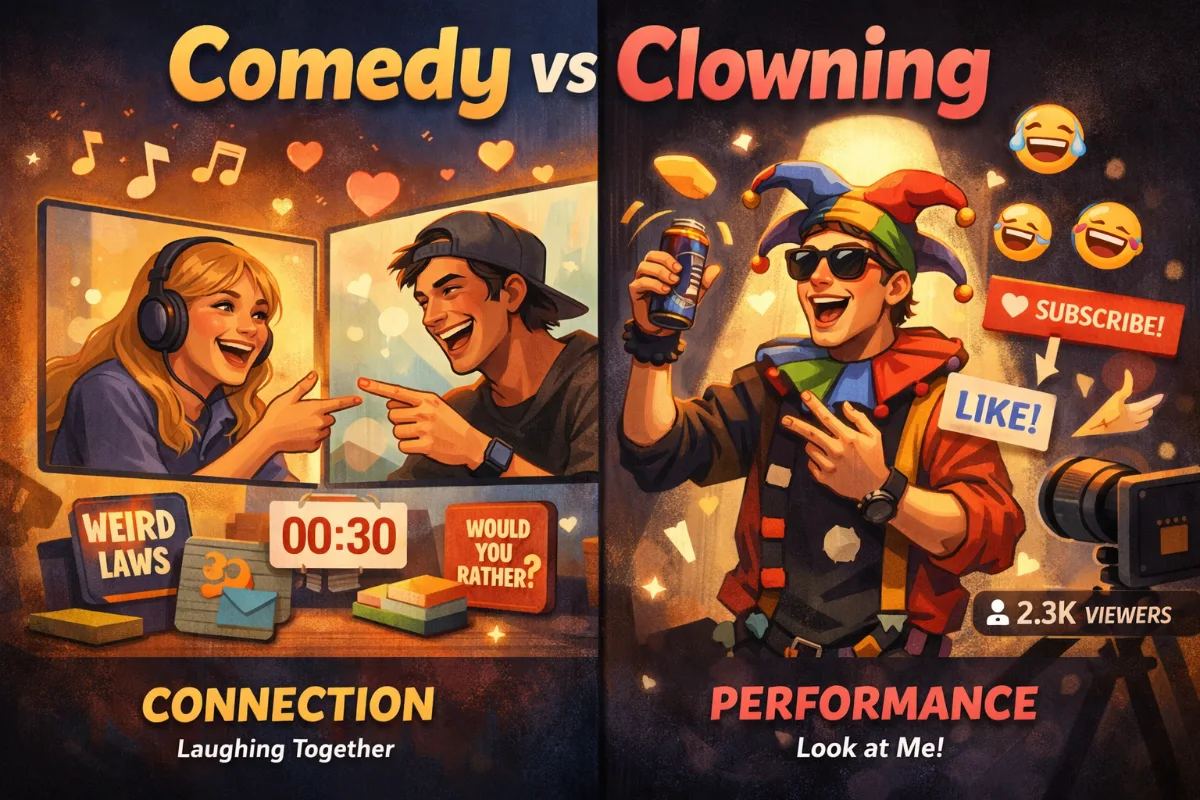
Why Comedy Is the Fastest Way Strangers Connect on Omegle Alternatives
Spend five minutes on any Omegle alternative or random video chat app and one thing becomes obvious:
People aren't trying to be deep. They're trying to feel comfortable.
And the fastest way humans do that, especially with strangers on video chat, is humor.
Not therapy talk. Not icebreaker interviews. Not forced vulnerability.
Comedy.
But here's where most random chat platforms (and critiques of them) get it wrong:
Comedy isn't the problem.
Clowning is.
Why Humor Dominates Random Video Chat (for Good Reason)
Random video chat is a uniquely awkward environment.
You're:
- dropped into conversations with zero context
- judged in seconds
- aware you can be skipped at any moment
In that setting, humor isn't shallow, it's adaptive.
Comedy:
- lowers social threat
- signals friendliness instantly
- shows personality without oversharing
- creates a shared moment right now
Laughter is proof of alignment.
It says:
"We're on the same wavelength."
That is connection, just compressed.
This is exactly why small talk actually creates real connection. It's not about the content of what you say, but the mutual experience you're building together.
The Mistake People Make: Confusing Comedy With Clowning
Here's the distinction that matters.
Comedy is shared. Clowning is performative.
Comedy happens with someone. Clowning happens at someone.
What This Looks Like in Practice
Clowning: "Watch me chug this energy drink on camera!" (waits for reaction, doesn't care about your response)
Comedy: "Wait, you still keep photos of your ex? Okay, you have 30 seconds to defend yourself." (builds on your answer, creates a game together)
Comedy:
- reacts
- listens
- builds on timing and energy
Clowning:
- chases attention
- ignores feedback
- exists to avoid rejection
Most people don't want to watch a stranger audition.
They want to play with them.
Comedy vs. Clowning: Key Differences
| Aspect | Comedy (Connection) | Clowning (Performance) |
|---|---|---|
| Direction | Bidirectional, mutual | One-directional |
| Focus | Shared experience | Individual attention |
| Response | Listens and builds | Ignores feedback |
| Timing | Collaborative | Solo performance |
| Goal | Create together | Get reaction |
| Result | Memorable connection | Forgettable moment |
| Sustainability | Builds momentum | Resets after each joke |
| Emotional Safety | High (playful) | Low (vulnerable to rejection) |
Why Clowning Feels Empty (Even When It Gets Laughs)
Clowning can work, temporarily.
It gets:
- quick laughs
- reactions
- viral clips
But it rarely creates connection because:
- there's no mutuality
- nothing is being built together
- the interaction resets after the joke lands
Once the laugh fades, there's nowhere to go.
That's why so many conversations on Monkey app alternatives and other random chat apps feel fun but forgettable.
Not because they were shallow but because they were one-directional.
This is part of the lie Omegle alternatives tell you about making friends. They promise connection but only deliver performance.
Shared Humor Is Real Connection (Even If It's Light)
There's a weird belief online that connection has to look serious to be real.
That if you're not discussing trauma, values, or life goals, nothing meaningful is happening.
That's just not true, especially in short-form, high-turnover environments like random video chat.
Shared humor:
- synchronizes attention
- builds trust without pressure
- creates inside jokes in seconds
- makes people feel seen without being exposed
Light-hearted doesn't mean empty.
It means safe.
And safety is the foundation of every real conversation, whether you're talking to strangers online or making friends in person.
Why "Trying to Be Deep" Often Backfires on Video Chat Apps
Depth has a cost.
On random chat platforms, forcing it:
- raises emotional stakes too early
- creates performance anxiety
- feels intrusive
- leads to faster skips
Most people aren't avoiding depth forever.
They're avoiding pressure.
Comedy lowers the barrier so connection can happen naturally, or not at all, without consequence.
That freedom matters.
It's why the best online chat experiences don't feel like interviews. They feel like play.
Comedy Works Best When It Has Direction
Here's the quiet truth most video chat platforms miss:
Humor thrives when there's something to react to.
The best moments on random video chat aren't stand-up routines. They're:
- playful arguments
- absurd prompts
- shared scenarios
- spontaneous roles
That's why conversation games, prompts, and formats work so well.
They don't replace humor. They give it momentum.
Why Structure Amplifies Comedy (Instead of Killing It)
Think about improv comedy.
The funniest moments don't come from "say whatever you want."
They come from:
- Yes, and...
- Scene prompts
- Character constraints
- Shared objectives
Random video chat works the same way.
When people are given:
- a structure
- a role
- a playful objective
Comedy stops being performative and starts being collaborative.
That's the difference between clowning and connection.
This is exactly why video chat needs a new genre. One that understands comedy isn't the enemy of connection. It's the engine.
Where What's The Vibe Fits Into This
What's The Vibe isn't about making conversations serious.
It's about making shared humor repeatable.
The goal isn't:
"Be funny."
It's:
"Have something fun to respond to together."
Instead of dropping you into blank conversations where clowning becomes the default, we give you:
Virtual Court: Defend absurd accusations together ("Your honor, they claim I'm the Walking Red Flag for putting ketchup on steak")
Walking Red Flag: Playfully debate whose random trait is worse
The structure doesn't kill spontaneity, it creates the conditions for it.
Because when there's something to react to, comedy becomes mutual.
And mutual comedy is just another word for connection.
Why This Matters for Anyone Looking for Better Online Chat
If you're tired of:
- watching strangers perform
- conversations that go nowhere
- skip cycles based purely on appearance
- Monkey app alternatives that feel exactly the same
The answer isn't to make video chat more serious.
It's to make humor collaborative instead of competitive.
That's how strangers become people you actually remember.
The Real Takeaway
Comedy isn't a distraction from connection on Omegle alternatives.
It's the gateway.
But connection only sticks when humor is:
- mutual
- responsive
- grounded in shared experience
Laughter isn't shallow.
Laughter is alignment.
And when strangers align, even briefly, something real already happened.
The platforms that understand this won't just get more laughs.
They'll get more real conversations.
That's the vibe.
Frequently asked questions
Why is humor important on random video chat platforms?
Humor is the fastest way strangers build comfort on video chat apps. In high-pressure environments like Omegle alternatives where you can be skipped instantly, comedy lowers social threat, signals friendliness, and creates immediate alignment between strangers.
What's the difference between comedy and clowning on random chat?
Comedy is shared and collaborative it happens with someone through reactions, listening, and building on each other's energy. Clowning is performative and one-directional it happens at someone to chase attention without creating mutual engagement. Comedy creates connection; clowning creates entertainment that fades the moment it ends.
Why doesn't "trying to be deep" work on random chat platforms?
Forcing depth on random video chat raises emotional stakes too early, creates performance anxiety, and feels intrusive to strangers who haven't built trust yet. Most people aren't avoiding depth—they're avoiding pressure. Comedy provides the safety and comfort needed for authentic connection to develop naturally.
Do conversation games kill spontaneity on video chat?
No structure actually amplifies spontaneity. Just like improv comedy works best with prompts and constraints, random video chat becomes more spontaneous when people have something to react to together. Games and prompts give humor momentum and direction, transforming performative comedy into collaborative play.
What makes What's The Vibe different from other Omegle alternatives?
What's The Vibe focuses on making shared humor repeatable through structured conversation games like Virtual Court and Walking Red Flag. Instead of dropping users into blank conversations where clowning becomes the default survival strategy, the platform provides playful prompts and roles that turn comedy from competitive performance into collaborative connection.
Try it yourself
Start a vibe-matched video chat on What's The Vibe — free, no sign-up.