Dead Internet Theory & the Rise of Live Video Chat
Bots account for roughly a third to over half of all internet traffic, depending on the measure. Here's what Dead Internet Theory actually gets right.
By Mark Gjura ·
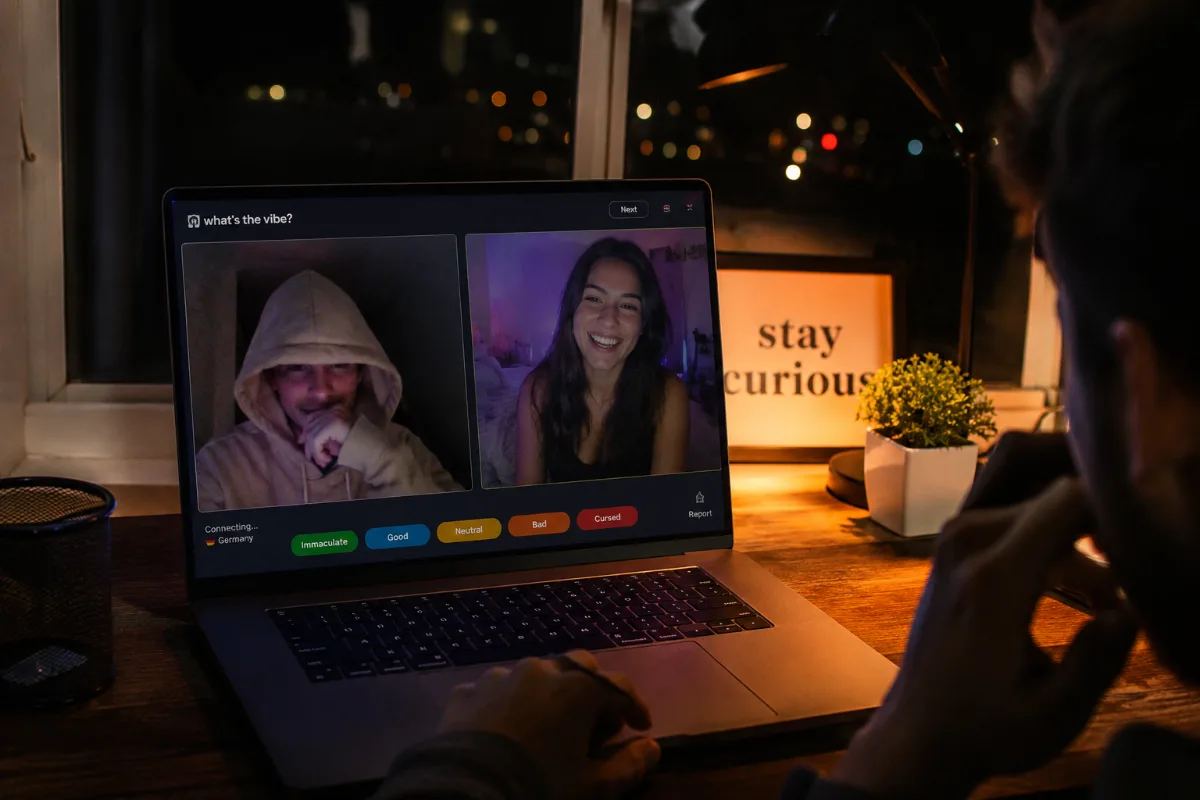
Dead Internet Theory: Why Live Video Chat Is One of the Internet's Strongest Human Signals
Something feels off online. You're not imagining it.
You scroll for twenty minutes and can't point to a single post that felt like it came from an actual person. The comments read like they were written by the same five accounts wearing different names. The "engagement" doesn't feel like people engaging with anything.
That feeling has a name: Dead Internet Theory. And for once, parts of the paranoid-sounding theory have uncomfortable data behind them.
What Dead Internet Theory Actually Says
The theory started on forums years ago as a fringe idea. The claim was blunt: most of the internet's traffic, content, and interaction isn't human anymore. It's bots posting to bots, algorithms grading algorithms, engagement manufactured for engagement's sake, with real people scattered around the edges of it.
It sounded paranoid when it started. It sounds like a fair description of the current internet now.
Precise numbers depend on who's measuring and what counts as "automated." Thales and Imperva's 2026 Bad Bot Report puts automated traffic at 53% of all web traffic in 2025, up from 51% the year before, with human traffic down to 47%. HUMAN Security's 2026 benchmark report puts bots at 51–52% of global traffic, having crossed 50% for the first time in 2024, with AI-driven traffic growing 187% year over year against 3.1% growth in human traffic. Cloudflare's own network data, a narrower and more conservative measure, put bot traffic at 35.2% as of June 2026 — still roughly one in three requests, and still climbing. The vendors disagree on the exact number because they're measuring different slices of the internet. They don't disagree on the trend: automated traffic is growing faster than human traffic, and has been for years.
You don't need a conspiracy to explain that. You just need to look at what's actually happening: AI-generated posts, AI-generated comments replying to them, AI accounts liking both, AI agents now browsing, clicking, and filling out forms autonomously in ways that look almost indistinguishable from a person doing the same thing. The internet didn't get taken over in some dramatic event. It got automated, layer by layer, until humans became optional in more places than anyone noticed.
Why the Numbers Finally Caught Up to the Feeling
For a while, Dead Internet Theory was easy to dismiss as internet folklore — the kind of thing people say when a platform feels stale, not something you could actually measure.
That's no longer true. What changed is that bots stopped being clumsy. A script from 2019 was easy to spot: it loaded pages instantly, never paused, never made a mistake. Generative AI broke that pattern. Today's automated traffic can browse naturally, interpret context, and adapt to a page it's never seen before — the same behaviors a real visitor has.
That's the part that should actually unsettle you. It's not that bots got more numerous. It's that they stopped being detectable by the old tells, right around the same time content itself got easy enough to fake that the difference stopped mattering to a lot of platforms anyway.
Text was the easiest target, and it went first. A sentence takes a fraction of a second to generate and no time at all to fake convincingly. A profile picture, a bio, a "just thinking out loud" post — all of it can now be produced at a volume no group of humans could ever match.
That's the uncomfortable part underneath all of it. It's not that the bots are impressive. It's that the format they're operating in — static content, one-directional posting, a feed built for scrolling instead of talking — was never designed to prove anyone was on the other end to begin with. A feed was never asking "is this real." It was only asking for your attention, and attention has never checked IDs. Once a format doesn't require proof of a person, it stops mattering whether one is there.
The Format AI Still Struggles to Fake Convincingly
Real-time video is different — not immune, just harder. Real-time deepfakes already exist; there are documented cases of scammers using them to impersonate people on live video calls. So this isn't a claim that live video is unfakeable. It's that sustaining a convincing, unscripted, two-way conversation with a stranger — one where you have to react naturally to something you didn't see coming, while the person across from you can immediately follow up if anything feels off — is still a much harder problem than generating a fake voice or a pre-planned deepfake clip.
Ask a stranger an unexpected question on a video call and watch what happens in the half-second before they answer. That half-second is the whole thing. It's involuntary, specific to them, and still one of the harder things to synthesize convincingly in real time — not the audio, not the video, the actual timing and texture of an unrehearsed person reacting live.
That's the real gap between "content" and "a person" right now. Text can be generated in advance and shipped at volume. A live, unscripted reaction only exists in the moment it happens, in front of someone who can push back on it.
Why This Makes Random Video Chat More Important, Not Less
Here's the part most people miss: as the rest of the internet gets harder to trust, the value of a genuinely live human conversation doesn't shrink. It goes up.
We've said it before — most random video chat is just two people guessing what the other person wants. That was true when the problem was awkwardness. It's still true now, but the stakes have changed underneath it. The problem isn't only "will this be a good conversation" anymore. It's "is there even someone there in the first place" — a question nobody had to ask about a stranger on a video call five years ago, and increasingly has to ask about almost everything else online today.
Structure doesn't just make a conversation better. It makes the humanness harder to fake. A vibe, a prompt, a game — anything that requires a specific, unscripted response — breaks the ice and makes scripted or AI-generated behavior much harder to sustain, because a genuine follow-up question is harder to hold up under than small talk.
That's the same thesis WTV was built on from day one, just pointed at a bigger problem than we started with. We didn't build conversation games because random chat was boring. We built them because two strangers sitting in silence, with nothing specific to react to, is where trust and connection have always broken down — and in 2026, "nothing to react to" happens to be exactly what a bot looks like too. The fix for boredom turned out to also be the fix for the trust problem nobody saw coming.
What Real Human Presence Actually Looks Like on a Call
It's worth being specific about the signals that someone's real on a video call, because "you can just tell" isn't a satisfying answer.
It's the pause before they laugh at something that wasn't obviously funny. It's them mishearing a question and asking you to repeat it. It's the mid-sentence "hold on" when a notification buzzes on their end, or their eyes flicking off-camera because something happened in the room they're actually sitting in. None of that is generated. It's just what a person looks like when they're not expecting to be tested.
A structured prompt is what creates the opening for that to happen. Small talk lets someone coast on generic responses. A specific, unexpected question doesn't.
Where WTV Fits
We're not going to tell you Dead Internet Theory means the sky is falling. A lot of the internet was already headed toward automation before AI made it obvious, and a lot of what bots do — crawling, indexing, monitoring — is genuinely useful and not the problem the theory is about.
But live video chat, done right, remains one of the formats where an unscripted human reaction is still hardest to fake in real time.
That's what What's The Vibe is built around — not just matching you with someone, but giving you a reason to talk that produces something genuinely unscripted.
Curious what a genuinely unscripted conversation still feels like? Pick a vibe and find out.
---
Keep Reading
If this resonated, these go deeper:
- Why strangers always disconnect first — the closed-gate problem behind most dead conversations
- Group video chat with strangers — why three or four people beats one-on-one
- Is random video chat safe? — an honest 2026 safety guide
- How to make friends online as an adult — rebuilding the conditions friendship needs
- Chatroulette vs Omegle — what both pioneers proved, and what killed them
Frequently asked questions
Is Dead Internet Theory actually true?
Parts of it are demonstrably true — automated traffic has been outpacing human traffic for years, and multiple 2026 industry reports put it at a third to over half of all web activity (see below). Whether all content and interaction is bots, as the most extreme version of the theory claims, is unproven and likely overstated. But the core trend is real and measurable.
What percentage of internet traffic is actually bots?
It depends on the source. The 2026 Thales Bad Bot Report puts it at 53%, HUMAN Security's benchmark puts it at 51–52%, and Cloudflare's narrower network-traffic measure puts it closer to 35%. The methodologies differ, but every major report shows bot traffic growing faster than human traffic for multiple consecutive years.
Can AI fake a live video call?
To some degree, yes — real-time deepfakes already exist and have been used in scam calls. What's still much harder is sustaining a convincing, spontaneous, unscripted conversation with a stranger who can push back with unexpected follow-up questions. That gap is narrowing over time, but it's still wide enough that a live, reactive video conversation remains one of the stronger signals of a real human on the other end.
Is random video chat safer from bots than social media?
Live, two-way video is a much harder environment for a bot to operate convincingly in than a feed built for one-way posting. That doesn't make any platform bot-proof, but the format itself raises the bar.
Try it yourself
Start a vibe-matched video chat on What's The Vibe — free, no sign-up.
Related reading
- Is Random Video Chat Safe? An Honest 2026 Guide
- Is the Monkey App Safe? An Honest 2026 Breakdown
- The Dead Internet Field Guide: Verify Real Humans Online
- Uhmegle Alternative in 2026: Honest Look at the Omegle Clone
- Chatroulette vs Omegle: What Happened to Both (2026)
- How to Make Friends Online as an Adult (2026 Guide)