Group Video Chat With Strangers: 3–4 Person Chats | WTV
Meet 3–4 strangers in a live group video chat without the dead air. Learn why random groups stall—and how shared vibes, turns, and games keep them moving.
By Mark Gjura ·
Group Video Chat With Strangers: How to Make 3–4 Person Chats Work
Search “group video chat” and most of the results are built for people who already know one another.
Work meetings. Family FaceTime calls. Study groups. Tools designed to help five coworkers see each other—not to help four complete strangers have a conversation worth staying for.
Random group video chat is a different product problem.
Putting four strangers on screen is easy. Giving all four of them a reason to participate is the difficult part.
Why Group Video Chat Fails Differently
One-on-one random video chat has a familiar failure mode:
Two people connect. Someone says hello. Neither person knows where to take the conversation. One of them presses Next.
Group chat usually fails in one of two different ways.
The Stall
Four people connect, everyone says some version of “what’s up,” and then the room goes quiet.
In a one-on-one call, silence belongs to both people. Each person feels some responsibility to fix it.
In a group, silence has an escape hatch. Everyone can wait for somebody else to speak first.
Because everyone is waiting, nobody does.
The Takeover
The opposite problem looks more successful at first.
One or two people begin talking rapidly while everyone else becomes an audience. The call technically has conversation, but it is not a group conversation. It is a two-person exchange being watched by two spectators.
Eventually, the spectators leave.
One version creates a silent room with four cameras. The other creates a private conversation with an unwanted live audience.
Neither gives all four people a meaningful reason to stay.
Four Strangers Need More Than an Icebreaker
The usual solution is to throw an icebreaker onto the screen:
> Where is everyone from?
That may produce four answers, but it does not necessarily produce a conversation.
The problem is not simply that strangers need a better opening question. A functioning group needs three things:
A Shared Frame
Everyone should understand what kind of interaction they have entered.
Are they debating something? Giving advice? Playing a guessing game? Defending an opinion? Reacting to a ridiculous scenario?
A shared frame removes the pressure to invent the entire conversation from nothing.
A Reason for Each Person to Participate
A good group format makes it clear whose turn it is, what they are responding to, and how the other people should participate.
Without that structure, the loudest person usually takes over while quieter people disappear into the background.
Something the Group Can React to Together
Real-life group conversations rarely happen in a vacuum.
Friends at a bar may be reacting to a game on television. People at a party may be playing cards. A group around a dinner table may be discussing something that just happened.
The shared activity gives the conversation somewhere to begin. The talking develops around it.
Four strangers with no shared history need that common point of attention even more.
What Keeps a Random Group Chat Moving
The most effective group formats use turns, reactions, votes, rankings, or verdicts.
Those mechanics solve several problems at once:
- Someone always knows when they are supposed to speak.
- Quieter people receive a natural opening.
- The loudest person cannot permanently control the room.
- Everyone has something specific to react to.
- The conversation can continue even when nobody has a new topic ready.
Structure does not make a conversation feel less natural. It creates the conditions in which natural reactions can happen.
The question, game, or prompt starts the interaction. The personalities of the people in the room determine where it goes next.
How Group Video Chat Works on What’s The Vibe
What’s The Vibe is designed around a simple idea:
> Do not place strangers in a blank room and expect chemistry to appear by itself.
Before matching, users choose a vibe that represents the kind of interaction they want. That creates a shared expectation before anyone appears on screen.
Once the group connects, the format provides something everyone can respond to together.
Instead of:
> “Here are three strangers. Say something.”
The experience becomes:
> “Here is the topic. Here is who goes first. Here is what everyone else is deciding.”
That small difference changes the energy of the room.
People are no longer trying to manufacture a conversation while three strangers watch them think. They are responding to something already happening.
Around the Vibe: Built for Four-Person Conversations
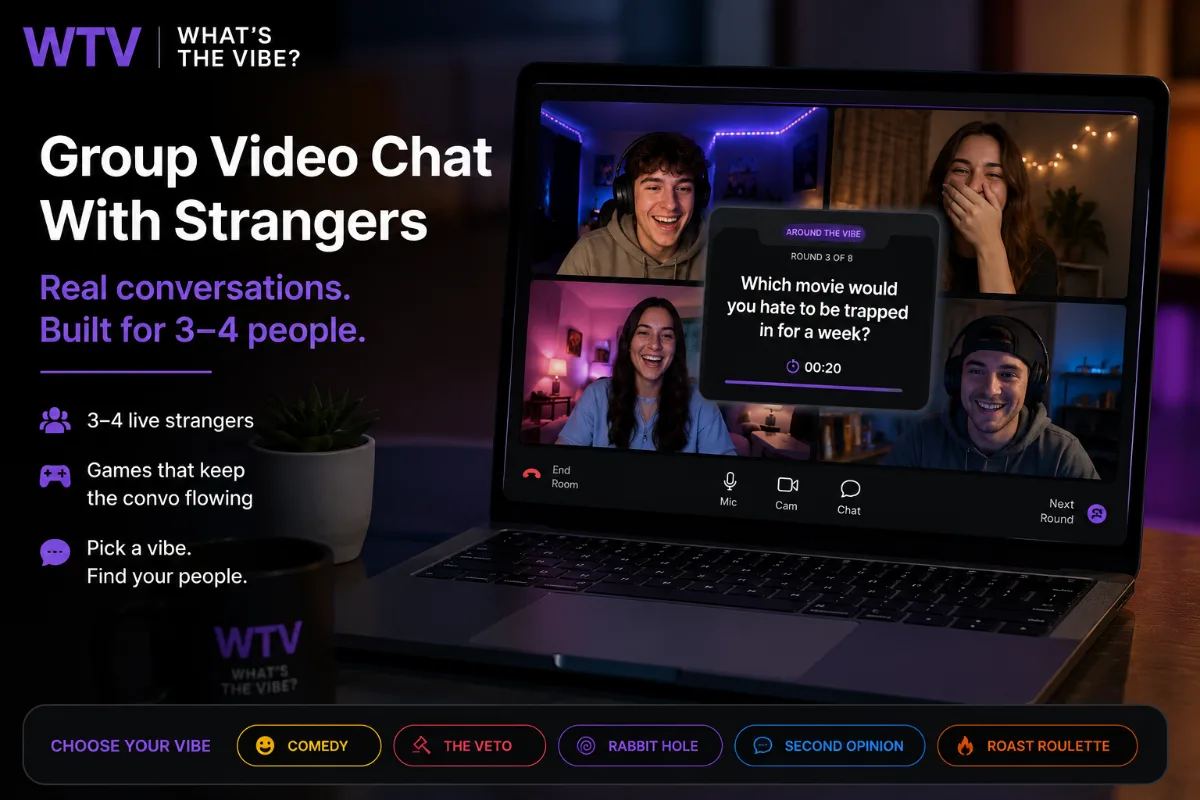
Around the Vibe is WTV’s group-native format.
The game rotates the spotlight from person to person across a series of topics. Each player gets a clear turn, while the rest of the group reacts and scores the response.
Topics can cover:
- Sports
- Music
- Movies and television
- Pop culture
- Dating
- Society
- Completely random questions
The rotation matters.
It prevents one person from dominating every topic, and it gives quieter participants a protected moment to speak. Nobody has to interrupt their way into the conversation because the format brings the attention back to them automatically.
The topic creates the opening. The disagreements, jokes, side comments, and unexpected opinions create the actual conversation.
That is the difference between a game being placed beside a video call and a game being designed to improve the video call itself.
What to Look for in a Group Video Chat Platform
Not every platform that supports multiple cameras creates a good stranger-group experience.
A useful random group video chat platform should offer more than the ability to place several people in one room.
Shared-Interest or Intent-Based Matching
The group should have at least one reason for being together beyond pure randomness.
Built-In Turn-Taking
The platform should help distribute attention instead of relying on everyone to interrupt politely.
Activities Designed for Conversation
Board games can be entertaining, but they do not necessarily help people learn anything about one another. The strongest formats create opinions, stories, arguments, jokes, and reactions.
Clear Moderation and Exit Controls
Every participant should be able to report a problem, leave quickly, or move to another group without confusion.
A Format That Includes Everyone
A four-person room should not become a two-person conversation with two silent viewers.
Is Group Chat Better Than One-on-One?
Not automatically. It creates a different kind of experience.
One-on-one calls are better for deeper, more focused conversations. There is less competition for attention, and both people can respond directly to each other.
Group calls are better for:
- Faster energy
- Multiple perspectives
- Debates and voting
- Guessing games
- Group reactions
- People who feel less pressure when attention is shared
The best choice depends on what kind of interaction someone wants at that moment.
That is why WTV separates the vibe from the format. The user is not merely choosing how many faces appear on screen. They are choosing the kind of experience they want those people to create together.
The Difference Is What Happens After the Match
Most video-chat platforms focus on getting people into a room.
That matters, but it is only the first step.
The quality of a group experience depends on what happens during the first thirty seconds after everyone connects:
- Does someone know how to begin?
- Does every participant have a role?
- Is there something specific to react to?
- Does the format pull quieter people into the conversation?
- Is there a reason to remain after saying hello?
A blank group call leaves those questions to chance.
A structured group call answers them before the silence has time to begin.
Pick a vibe and start a group video chat with strangers
---
Keep Reading
If this resonated, these go deeper:
- Why strangers always disconnect first — the closed-gate problem behind most dead conversations
- Group video chat with strangers — why three or four people beats one-on-one
- Is random video chat safe? — an honest 2026 safety guide
- How to make friends online as an adult — rebuilding the conditions friendship needs
- Chatroulette vs Omegle — what both pioneers proved, and what killed them
Frequently asked questions
Can I video chat with a group of strangers online?
Yes. Some platforms support random group video chat, although many video-call services are designed primarily for friends, families, or coworkers who already know one another. WTV is designed specifically around live interactions between strangers.
What WTV game is designed for group video chat?
Around the Vibe is designed around a four-person rotating format. Each participant receives time to respond while the rest of the group reacts and scores the answer.
What Should I Look for in a Random Group Video Chat Platform?
Look for clear moderation tools, easy exit and reporting controls, shared-interest or intent-based matching, structured participation, and activities that involve everyone instead of letting two people control the entire call.
Try it yourself
Start a vibe-matched video chat on What's The Vibe — free, no sign-up.
Related reading
- Is Random Video Chat Safe? An Honest 2026 Guide
- Is the Monkey App Safe? An Honest 2026 Breakdown
- The Dead Internet Field Guide: Verify Real Humans Online
- Uhmegle Alternative in 2026: Honest Look at the Omegle Clone
- Chatroulette vs Omegle: What Happened to Both (2026)
- How to Make Friends Online as an Adult (2026 Guide)