Social Anxiety? Video Chat Exposure Therapy Explained
Learn how video chat works as exposure therapy for social anxiety. CBT-backed techniques, fear hierarchies, and Omegle alternatives explained.
By Mark Gjura ·
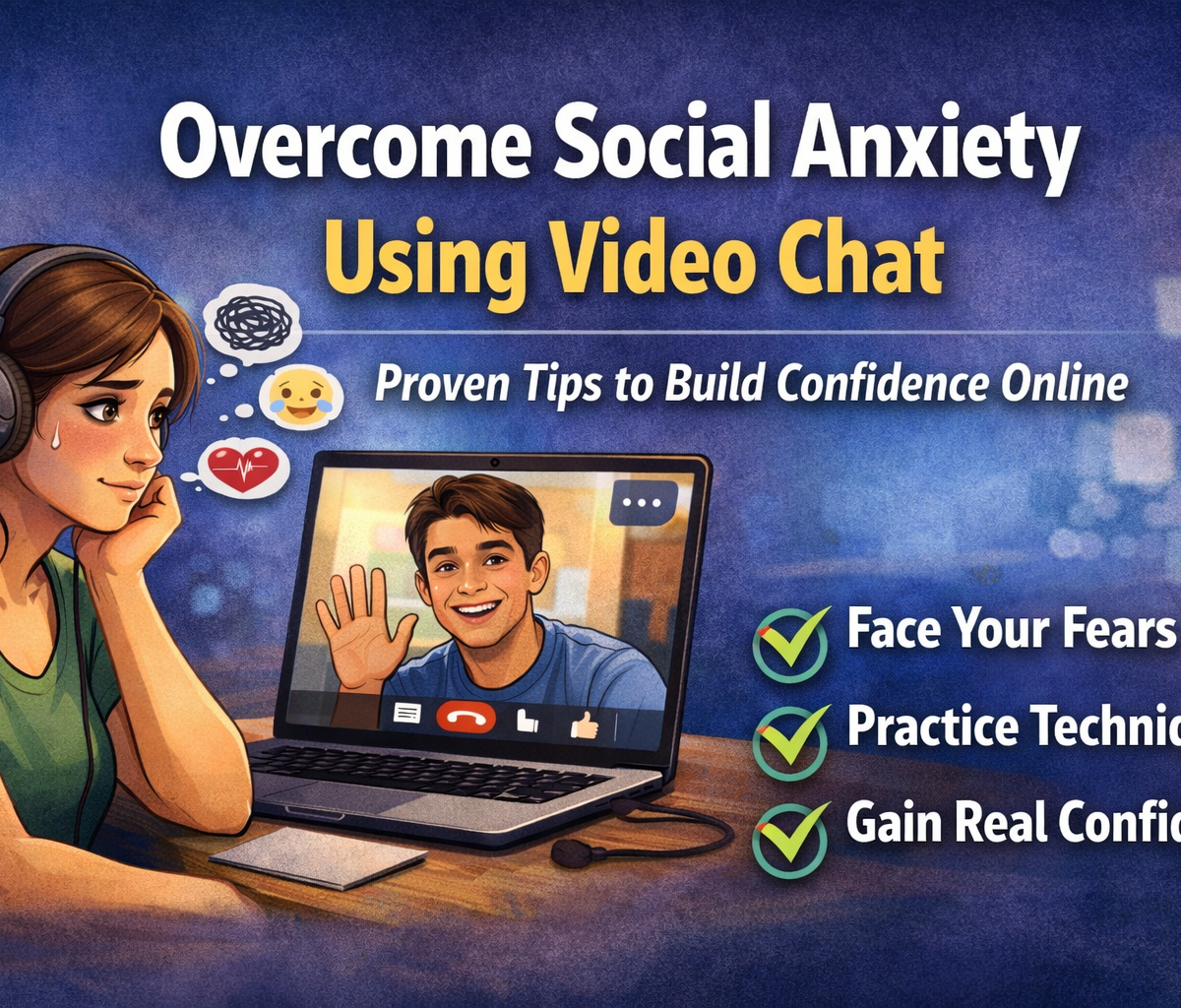
How to Overcome Social Anxiety Using Random Video Chat (Exposure Therapy–Backed Tips)
Your heart races. Your mind goes blank. The camera turns on and suddenly you're hyper-aware of every word, every pause, every awkward silence. If video chatting with strangers feels like your worst nightmare, you're not alone. Over 12% of Americans meet criteria for Social Anxiety Disorder—and that number spikes when cameras are involved (NIMH stats).
Here's the paradox every socially anxious person knows:
- Before: "Will I even survive this?"
- During: "This isn't so bad… but what do I say next?"
- After: "Why was I so anxious? That was easy. I could definitely do it again."
And yet, next time the cycle repeats.
The frustrating part? Your rational brain knows talking to strangers isn't dangerous. But anxiety doesn't care about logic. It floods your system with the same fight-or-flight response whether you're facing a bear or a webcam.
Sometimes conversations genuinely do suck—awkward energy, mismatched vibes, someone who clearly doesn't want to be there. But most of the time, the biggest obstacle isn't the other person. It's the voice in your head screaming that you're about to embarrass yourself.
So how do you break the cycle?
The answer might surprise you: more video chat, not less.
Random video chat platforms—the same ones that feel terrifying—might be your best tool for rewiring anxious patterns. Not through magic, but through science.
In this guide, you'll learn proven techniques used by therapists, backed by behavioral psychology, and tested in real-world exposure settings. Let's turn your worst nightmare into your training ground.
Why Random Video Chat Platforms Help Reduce Social Anxiety (Systematic Desensitization Explained)
If you struggle with social anxiety, platforms like Ome.tv, Monkey App, and ChatRandom might seem like your worst nightmare. But behavioral psychologists have long used a counterintuitive method for anxiety: exposure.
Systematic Desensitization in Action
Psychiatrist Joseph Wolpe developed systematic desensitization in 1958 as a treatment approach built around gradual exposure paired with relaxation (Wolpe, 1958; overview). The principle is simple: repeated exposure to feared situations—when done progressively—reduces fear responses over time.
Random video chat platforms are an unusually good environment for that because:
- Low stakes — you'll likely never see these people again
- Controlled exposure — you decide when to start and stop
- Anonymity — reduces fear of judgment
- Repeatability — you can practice daily without leaving home
The Science: Reciprocal Inhibition
Wolpe also argued that two opposing emotional states can't fully coexist—if you learn to reliably activate relaxation while facing the feared scenario, anxiety decreases (Wolpe, 1964 — referenced in clinical overview).
Whether you're using Ome.tv, Monkey App, or any other platform, the mechanism is the same: repeated, controlled exposure leads to habituation—your nervous system eventually "gets used to" what once terrified you.
That said, not all platforms give you the same exposure conditions. Pure random matching throws you into the deep end with zero context—which works for some, but can backfire for others. That's why structured platforms matter, and why we'll come back to them throughout this guide.
Comparison Table: Best Video Chat Platforms for Social Anxiety Practice (Random vs Structured)
| Platform | Random Matching | Interest / Topic Filters | Conversation Prompts / Games | Safety & Moderation Feel | Best For |
|---|---|---|---|---|---|
| Ome.tv | ✅ | ❌ | ❌ | Medium | Pure exposure reps |
| ChatRandom | ✅ | ❌ | ❌ | Medium | High-volume repetition |
| Monkey App | ✅ | ❌ | ❌ | Medium | Casual exposure practice |
| Chitchat.gg | ❌ | ✅ | ❌ | Higher | Context-based anxiety reduction |
| Emerald Chat | ❌ | ✅ | ❌ | Higher | Lower cognitive load (topic anchors) |
| What's The Vibe | ❌ | ✅ | ✅ | Higher | Structured exposure (prompts + games) |
The right platform depends on where you are in the process. Pure random chat is great for high-volume reps—but if the "blank slate" panic is what's stopping you from clicking Start, you may need structure first. More on that in Technique 7.
- The Psychology Behind Meaningful Video Chat
- Why Omegle Failed at Safety (What Video Chats in 2026 Must Do)
Technique 1: Create Your Personal Fear Hierarchy (SUDs Exposure Plan)
Before jumping on an Omegle alternative or random video chat, you need a roadmap. Therapists use a fear hierarchy—a ranked list of anxiety-provoking situations from least to most frightening.
What is a Fear Hierarchy?
A fear hierarchy often uses Subjective Units of Distress (SUDs), ranking situations from 0–100 based on how much anxiety they cause (PositivePsychology overview). Systematic desensitization research suggests this graduated approach is more effective than throwing yourself into your worst fear immediately (Lang & Lazovik, 1963 — reference summary).
How to Build Your Video Chat Fear Hierarchy
Level 1–2 (Minimal Anxiety):
- Open Ome.tv or ChatRandom, turn on camera for 5 seconds, immediately exit
- Watch other people's video chat streams without participating
Level 3–4 (Mild Anxiety):
- Say "Hi" and immediately skip to next person
- Stay connected for 30 seconds, even if silent
Level 5–6 (Moderate Anxiety):
- Have a 1–2 minute conversation on Ome.tv
- Ask one follow-up question before skipping
Level 7–8 (High Anxiety):
- Stay for a full 5-minute conversation (example: Monkey App)
- Make eye contact with camera for the majority of the call
Level 9–10 (Maximum Anxiety):
- Have a 10+ minute conversation without skipping
- Video chat from a public place (coffee shop, library)
The rule: start where anxiety is manageable (around 3–4 out of 10), not overwhelming. Going too fast can reinforce avoidance rather than reduce it (Lang & Lazovik, 1963 — reference summary).
Action Step: Write out your personal hierarchy before your next session. Know exactly which level you're tackling today.
Technique 2: Master Progressive Muscle Relaxation Before Sessions (PMR)
Here's the problem: if you're already tense when you click "Start," your anxiety will spike immediately. You need a way to enter the exposure calm, not wired.
Progressive Muscle Relaxation (PMR), developed by Edmund Jacobson in the 1920s and later incorporated into Wolpe's desensitization framework, gives you exactly that—a reliable method for activating your body's relaxation response before exposure (clinical overview reference). The principle is straightforward: systematically tensing and releasing muscle groups teaches your nervous system to distinguish tension from relaxation, making the latter something you can access on demand.
Why PMR Works for Video Chat Anxiety
PMR has been studied as a relaxation approach for anxiety reduction, especially when paired with exposure methods (Sajadi et al., 2017 — PMC). Pairing relaxation with exposure can reduce anxiety more than exposure alone—meaning you get more out of each practice session.
How to Practice PMR Before Video Chat (5-Minute Routine)
- Face (10 seconds): Scrunch facial muscles tight, release
- Neck/Shoulders (10 seconds): Raise shoulders to ears, drop and release
- Arms (10 seconds each): Make fists, tense biceps, release
- Chest (10 seconds): Deep breath in, hold, exhale slowly
- Legs (10 seconds each): Point toes, tense thighs, release
Action Step: Practice PMR daily for one week without video chat first. Once you can reliably relax on command, use it as your pre-session ritual. Think of it as warming up before the exposure reps.
Technique 3: Challenge Catastrophic Thoughts with Cognitive Restructuring (CBT)
PMR handles the physical side of anxiety. This technique handles the mental. If you've tried Ome.tv or Monkey App and felt paralyzed by thoughts like "They'll think I'm weird" or "This will be humiliating," you're experiencing cognitive distortions—negative thought patterns that fuel social anxiety regardless of what's actually happening on screen.
What is Cognitive Restructuring?
Cognitive restructuring is a core Cognitive Behavioral Therapy (CBT) technique used to identify and challenge maladaptive thoughts (Hofmann & Otto reference via PMC). Meta-analytic work has also supported CBT as an evidence-based approach for anxiety disorders (Ponniah & Hollon, 2008 — PMC).
Common Distortions on Random Video Chat
Mind Reading: "They think I'm boring."
- Reality check: You can't know what they're thinking
- Balanced thought: "Most people are focused on themselves, not judging me."
Catastrophizing: "If I stumble, it'll be a disaster."
- Reality check: Worst case—they skip you
- Balanced thought: "Small mistakes are normal. Most people won't notice."
Fortune Telling: "This will definitely be awkward."
- Reality check: You can't predict the future
- Balanced thought: "Some conversations flow, some don't. I can handle either."
How to Practice (Behavioral Experiment)
Before: Write your anxious prediction — "They'll skip me immediately because I'm awkward."
During: Observe what actually happens. Collect evidence.
After: Compare prediction to reality — "Actually, 3 out of 5 people stayed."
Behavioral experiments are a common CBT method for testing predictions against real-world outcomes (National Social Anxiety Center strategies).
Action Step: Before your next session, write down one specific anxious thought. After 5 chats, check how often it was actually true. Most people are surprised.
Technique 4: Set Micro-Goals to Build Self-Efficacy (Mastery Experiences)
Once you've started managing your thoughts, you need a system for turning small wins into compounding confidence. Albert Bandura's self-efficacy theory suggests that believing you can succeed is a strong predictor of performance—and that belief is built most reliably through "mastery experiences": completing progressively harder tasks and seeing yourself succeed (Bandura, 1977).
Micro-Goals for Video Chat Anxiety
Week 1 (Ome.tv / Monkey App):
- Day 1: Camera on, say "Hi," exit (success = did it)
- Day 2: Repeat 3 times
- Day 3: Say "Hi, how are you?" then exit
Week 2:
- Day 1: Stay 1 minute minimum (even silent)
- Day 2: Ask one question ("Where are you from?")
- Day 3: Ask one follow-up question
Week 3:
- Day 1: Stay 3 minutes
- Day 2: Share one small detail about yourself
- Day 3: Complete 5 conversations in one session
Tracking small wins is also a common CBT-adjacent strategy for reinforcing progress (National Social Anxiety Center strategies).
Action Step: Choose ONE micro-goal today. Success = completing the action, not "feeling calm." The feeling follows the doing.
Technique 5: Practice Mindfulness to Stop Rumination
As your micro-goals build confidence, you'll notice something: the anxiety cycle doesn't just happen during video chat—it starts before and continues after.
- Before: "What if I freeze?"
- During: "They're judging my background."
- After: "Why did I say that?"
This is rumination—and it maintains anxiety even when the actual exposure goes fine. Mindfulness-based approaches have been studied as helpful tools for reducing rumination and anxiety symptoms when combined with CBT strategies (Hofmann et al. reference via PMC).
The goal isn't to clear your mind. It's to notice when anxious thoughts arise and redirect attention back to the actual conversation in front of you—which, most of the time, is going better than the voice in your head claims.
Action Step: During your next 3 sessions, notice when your mind wanders into anxious thoughts. Label it ("there's the worry again"), then return attention to the conversation. No self-criticism required.
Technique 6: Embrace Awkward Silences (Exposure + Response Prevention)
One of the biggest mistakes anxious people make is treating silence as failure—and then scrambling to fill it, which usually makes things worse.
Tolerating discomfort rather than avoiding it is central to exposure principles (Wolpe, 1958). This extends to the micro-discomforts within a conversation, not just the act of showing up at all.
The Experiment
Next time a pause happens:
- Don't blurt the first thing that comes to mind
- Sit with the discomfort for 5–10 seconds
- Observe what actually happens
- Notice that anxiety often drops after 10–15 seconds (habituation in real time)
This aligns with exposure-and-response-prevention principles used in anxiety treatment models (ERP overview reference).
Action Step: In your next 5 conversations, allow at least ONE silence to exist for 10+ seconds. Track how often people actually skip because of it. You'll find the silence is far less catastrophic than anticipated.
Technique 7: Filter by Shared Interests to Reduce Cognitive Load
By now you've built some exposure reps, learned to challenge catastrophic thoughts, and practiced sitting with discomfort. But there's one more factor that determines how hard each conversation feels: context.
Pure randomness amplifies anxiety because you have zero shared ground—so your brain panics: "What do I say?" Having shared context reduces that "blank slate" pressure and makes conversation easier to initiate from the first second (National Social Anxiety Center strategies).
Interest filters help because:
- They provide built-in conversation starters (lower cognitive load)
- They give the interaction immediate structure ("We're both here because of gaming")
- They reduce pressure to be universally interesting
Even better: conversation games reduce improvisational demand entirely. Platforms like What's The Vibe use structured games alongside vibe-based matching to give both people something to do together—which research on structured conversation suggests is significantly less threatening to anxious individuals than unguided small talk (similar to structured practice approaches in CBT models) (Hofmann & Otto reference via PMC).
Platforms that offer this:
- Emerald Chat: interest matching
- Chitchat.gg: topic-based rooms
- What's The Vibe: vibe matching + conversation games designed to eliminate the "what do I say?" moment
Action Step: Instead of pure random matching, try an interest-filtered option next session and compare your initial anxiety spike. If What's The Vibe's structured games reduce your cognitive load enough to stay longer, that's more exposure—which is the point.
Technique 8: Drop Safety Behaviors Gradually
Safety behaviors make you feel safer short-term, but they prevent you from learning that the situation is manageable without them—which means anxiety stays high long-term.
Common safety behaviors in video chat:
- Turning the camera away slightly
- Over-rehearsing before clicking "Start"
- Keeping sessions ultra-short
- Avoiding eye contact
- Using a rigid conversation script
Safety behaviors can prevent you from learning the situation is safe without them (National Social Anxiety Center strategies). The goal isn't to white-knuckle through discomfort—it's to systematically test whether you actually need these crutches (spoiler: you usually don't).
How to Drop Them (Gradually)
Week 1 — Identify: list 3 safety behaviors you use. Week 2 — Reduce one: click "Start" with no prep. Week 3 — Reduce another: look at the camera 50% of the time. Week 4 — Full exposure: no script, no rehearsing, consistent eye contact.
Action Step: Choose ONE safety behavior to reduce (not eliminate) next session. Run the experiment: what actually happens when you don't rely on it?
Choosing the Right Platform for Anxiety Practice
The techniques you use matter more than the platform—but the platform shapes the exposure conditions. Here's how to match them:
For Pure Exposure (No Filters)
- Ome.tv — straightforward random matching
- ChatRandom — high variety, high repetition
For Interest-Based Matching
- Chitchat.gg — topic rooms
- Emerald Chat — interest filters, text + video
For Structured Conversations (Lowest "What Do I Say?" Pressure)
- What's The Vibe — vibe matching + conversation games that give both people immediate structure
If Ome.tv's pure randomness feels too overwhelming, start with structure and reduce cognitive load first—then graduate to more unpredictable platforms as your tolerance builds. That progression is the exposure plan.
Conclusion: Your Anxious Brain Is More Trainable Than You Think
Here's the honest truth: social anxiety isn't a character flaw. It's a learned pattern—which means it can be unlearned through exactly the kind of graduated, consistent practice this guide describes.
The eight techniques here aren't theoretical. Exposure works. Cognitive restructuring works. Building self-efficacy through small wins works. The research is decades deep and the mechanism is straightforward: your brain learns safety through experience, not through convincing yourself.
What makes video chat uniquely powerful as a training ground is the sheer volume of practice available. Unlike weekly therapy sessions or awkward real-world encounters, you can run exposure reps daily, on your schedule, at whatever intensity matches where you are today.
Start with structure if randomness feels too overwhelming—What's The Vibe's conversation games were specifically designed to eliminate the "blank slate" panic that makes the first ten seconds hardest. Graduate to pure random platforms as your tolerance grows.
Whether you choose Ome.tv, ChatRandom, Chitchat.gg, Monkey App, or What's The Vibe—the platform matters far less than your consistency. Start today. Start small. Trust the process.
Your anxious brain can be rewired, one conversation at a time.
Sources
- Wolpe (1958) — Psychotherapy by Reciprocal Inhibition (Springer chapter)
- Systematic desensitization clinical overview (PMC)
- Lang & Lazovik (1963) — desensitization reference summary
- PositivePsychology SD overview
- ScienceDirect Topics SD
- CBT / SAD techniques reference (PMC)
- Ponniah & Hollon (2008) meta-status (PMC)
- Sajadi et al. (2017) relaxation vs SD (PMC)
- National Social Anxiety Center strategies
- ERP principles reference
- NIMH social anxiety stats
- Bandura (1977) PsycNet record
Related Guides
- How to make friends online as an adult — why it gets harder after 25, and what actually works
- Group video chat with strangers — small rooms beat one-on-one
- Is random video chat safe? — an honest safety guide
Frequently asked questions
Is video chat good for social anxiety?
Yes when used intentionally, video chat can work like exposure therapy, meaning repeated, controlled practice helps your nervous system habituate and feel less threatened over time. Start with short sessions and gradually increase difficulty.
Can random video chat help overcome social anxiety?
It can. Random video chat is high-repetition and low-stakes (you can exit anytime), which makes it useful for exposure practice. The key is doing it in a structured way (fear hierarchy + micro-goals), not doom-scrolling conversations.
How do I stop freezing up on video calls?
Use a pre-session routine and a script-free micro-goal: 1. Do 2–5 minutes of relaxation (PMR or slow breathing) 2. Set one tiny goal (“Say hi and ask one question”) 3. Allow awkwardness to exist for 10 seconds without escaping Freezing decreases when your brain learns you can tolerate the discomfort.
How do I stop overthinking after video chat conversations?
That’s rumination. A practical fix is mindfulness: 1. Notice the replay (“I’m ruminating”) 2. Label it (“anxiety problem-solving”) 3. Return attention to the present (“What am I doing right now?”) This prevents your brain from turning every conversation into a post-game analysis.
What should I say on random video chat if I have social anxiety?
1. “Where are you from?” 2. “What are you up to today?” 3. “What’s something you’ve been into lately?” Then ask one follow up question. Your goal is reps, not performance.
How do I stop being awkward on video chat?
Counterintuitively: don’t try to eliminate awkwardness. Practice tolerating it. A powerful exposure drill is allowing one silence per conversation (10+ seconds) without filling it. Confidence grows when your brain learns awkward moments aren’t dangerous.
Is random video chat safe for people with social anxiety?
It depends on the platform’s moderation and your boundaries. Use safety basics: 1. Never share personal info 2. Skip fast when someone is hostile 3. Use interest-based or moderated platforms when starting If safety concerns are part of your anxiety, begin with more structured/moderated options.
Try it yourself
Start a vibe-matched video chat on What's The Vibe — free, no sign-up.