How to Start a Conversation on Video Chat (That Doesn't Die)
Learn how to start a video chat conversation that actually lasts. Psychology-backed openers, silence rules, and why "hey" kills connection.
By Mark Gjura ·
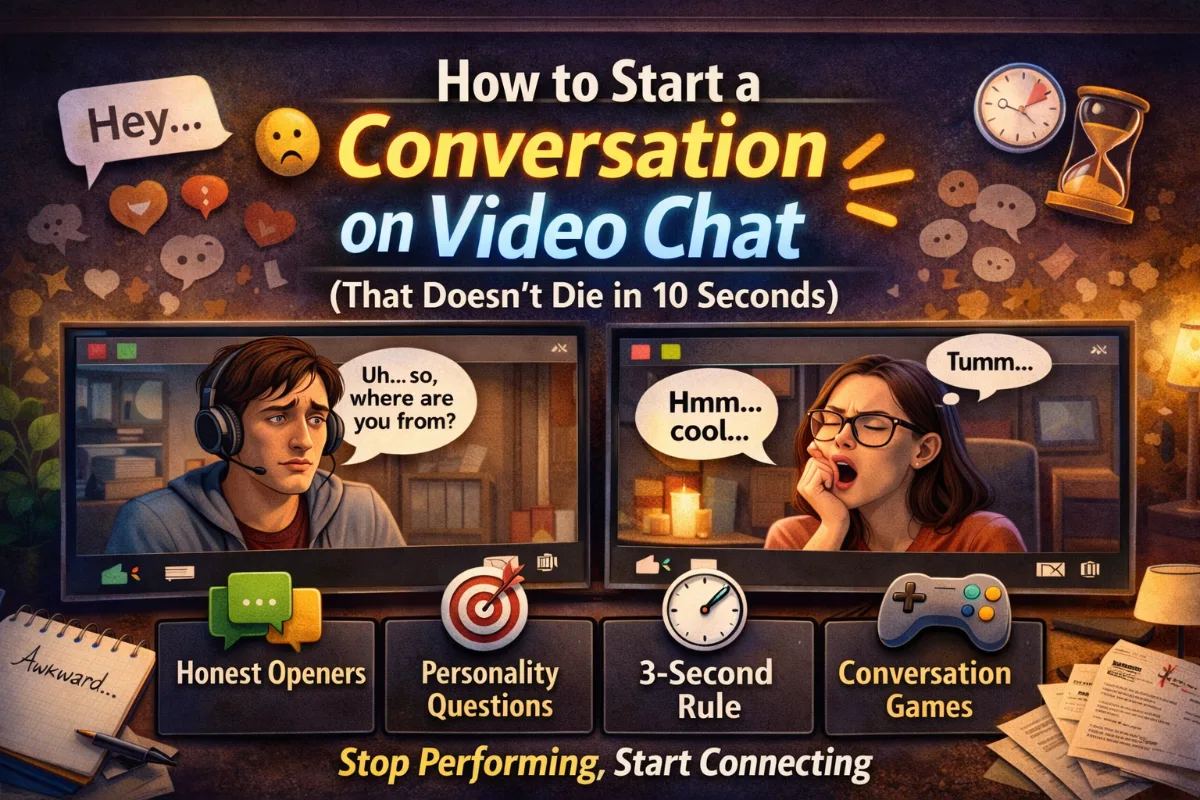
How to Start a Conversation on Video Chat (Without It Getting Weird)
95% of video chat conversations die within the first 10 seconds.
Not because people are boring. Not because they said the wrong thing. But because both people are performing instead of connecting — and the conversation collapses under the weight of trying to "do it right."
I'm writing this as the founder of What's The Vibe, a platform built specifically to solve this problem. But also as someone who has watched thousands of video chat conversations begin the same way: cautious, awkward, overthought. Two people trying so hard to be interesting that they forget to be present.
If you've ever searched for how to start a conversation on video chat without it immediately going silent, here's the truth most advice gets wrong:
Conversation doesn't fail because you lack tactics. It fails because you're thinking about the conversation instead of being in it.
This article won't give you scripts to memorize. It gives you frameworks — grounded in behavioral science — that work without asking you to become someone you're not. By the end, you'll understand not just what to say, but why certain approaches create connection where others kill it.
Why "Hey" Fails as a Video Chat Conversation Starter
You match. Camera turns on. You say "Hey." They say "Hi." Silence. Skip.
"Hey" isn't a conversation starter — it's a conversation placeholder. It signals that you showed up, but it doesn't give the other person anything to work with. You've essentially handed them a blank piece of paper and said "go." Most people won't, and can't.
The Psychology Behind Why "Hey" Dies
Research on self-disclosure shows that connection forms when one person gives the other something real to respond to (Jourard, 1971). A one-word greeting gives nothing — no energy, no direction, no invitation. So nothing follows.
This isn't about confidence or charisma. Even highly social people get stuck after "hey" because the word itself creates no conversational momentum. It's the verbal equivalent of showing up to a potluck empty-handed and expecting others to feed you.
What Actually Works: The Honest Ground Opener
Instead of pretending you're smooth, try grounding the moment in reality:
- "I never know how to start these, but hi."
- "Okay, I'm bad at openers — what's your go-to?"
- "I'm easing into the night. How's yours going?"
These work because they're honest, not clever. You're not hiding nervousness — you're naming it. And that instantly lowers the pressure for both people, because now neither of you has to pretend this isn't slightly awkward.
Why Honest Openers Outperform Scripts
When one person shows authenticity, the other subconsciously relaxes and mirrors it — a well-documented social dynamic rooted in authenticity research (Kernis & Goldman, 2006). The result is that conversations last longer, go deeper faster, and feel less like auditions. You're not being evaluated. You're just two people starting a conversation.
The irony is that admitting "I don't know how to start this" is one of the strongest openers you can use — because it's the one thing both people are secretly thinking.
Related: How Video Chat Works as Exposure Therapy for Social Anxiety
Why "Where Are You From?" Feels Like an Interview
The second most common video chat opener is: "Where are you from?"
It's not terrible — but it stalls more often than it connects. Here's why: geography is data, not identity. If the place isn't somewhere the other person has a strong feeling about, you get a one-word answer and land right back in silence. Worse, it frames the entire interaction as an information exchange rather than a human connection — and information exchanges are easy to exit.
Better Video Chat Openers: Ask for Personality, Not Data
Instead of demographics, ask for something that reveals who someone actually is:
- "What's something you're weirdly passionate about?"
- "What's your most controversial food opinion?"
- "If you had to rewatch one movie forever, what are you picking?"
These questions work because people genuinely enjoy talking about what they care about — and answering them requires the other person to reveal a piece of themselves, which naturally invites you to do the same.
The Science Behind Personality-Based Questions
Self-expansion theory shows that conversations introducing new perspectives feel more engaging and meaningful than information-gathering exchanges (Aron et al., 2000). When you ask someone about their weirdest passion instead of their zip code, you're not filling time — you're discovering someone. That's a fundamentally different interaction, and both people feel it.
The practical upside: personality-based questions also give you far more to work with. One good answer can fuel ten minutes of conversation. "Where are you from?" rarely gives you more than thirty seconds.
The 3-Second Rule for Awkward Silence in Video Chat
Here's where most people panic. The conversation pauses. Your brain screams say something. You rush to fill the space with whatever comes to mind — a filler question, a nervous laugh, an abrupt topic change.
That's the mistake.
Why Forcing Conversation Backfires
Silence isn't the problem. Your anxiety about silence is. When you rush to fill a pause, you derail whatever natural flow existed and signal discomfort — which the other person picks up on immediately. You've now communicated that you find this situation threatening, which makes them feel like they're doing something wrong. The anxiety compounds on both sides.
How to Actually Handle Awkward Pauses
The counterintuitive move: let the silence breathe.
- Let it sit for 3–5 seconds
- See if they respond — often they will, because they felt the same impulse to fill it
- If they don't, that's information: either the conversation has run its natural course, or one of you needs to pivot topics
What you'll find after doing this a few times is that silence is rarely as long as it feels. Anxiety warps time perception — a three-second pause feels like fifteen. And the moment you stop treating silence like an emergency, it loses its power over you.
The Psychology of Tolerating Discomfort
Exposure research shows that allowing discomfort to exist without escaping it reduces anxiety over time (Foa & Kozak, 1986). Each time you sit with a pause instead of fleeing it, you're training your nervous system to recognize that awkwardness isn't danger. It's just awkwardness — and it passes on its own, faster than you think.
This principle is foundational to using video chat as exposure therapy for social anxiety. The more reps you get sitting with minor discomfort, the easier every conversation becomes.
When Structure Saves You: Why Conversation Games Work
Some days, you don't want to improvise. You're tired, distracted, or just not feeling the creative pressure of inventing conversation from nothing. That's not a personal failing — it's human. And it's exactly why structured conversation formats exist.
When you give two people something to react to together rather than requiring them to generate content independently, the entire dynamic shifts. You're no longer performing. You're participating.
How What's The Vibe Solves the "What Do I Say?" Problem
What's The Vibe was built around this exact insight. Instead of dropping two strangers into a blank video call and hoping they figure it out, the platform uses conversation games and vibe-based matching to give both people immediate structure and shared context. A few examples:
Virtual Court — One person gets charged with an absurd crime and has to defend themselves. It's comedy without pressure, because the game itself carries the energy. Neither person has to "be funny" — the format does the work.
Walking Red Flag — Hot-take prompts that reveal values fast. You find out quickly whether you're talking to someone you actually want to keep talking to, without the usual small-talk runway.
Around The Vibe — Opinion questions that spark instant debate. Disagreement becomes interesting rather than uncomfortable because the game frames it as the point.
Why Structured Conversations Lower Anxiety
Structure lowers cognitive load — the mental effort required to create conversation in real time (Hofmann & DiBartolo, 2000). When you're not simultaneously trying to think of something interesting to say and manage your anxiety and read the other person's reactions, you have more bandwidth to actually be present.
This is the same principle behind using video chat platforms for social anxiety practice — reducing improvisational demand makes interaction feel safer, which means you stay in it longer, which means you get more practice, which means you get better. The structure isn't a crutch. It's a scaffold.
Related: The Psychology Behind Meaningful Video Chat Connections
The Real Secret: Authenticity Beats Tactics Every Time
Here's the irony that runs through all of this: the best video chat conversation starters aren't the clever ones. They're the ones that let you be yourself without the performance layer on top.
Most people approach video chat like a job interview — trying to say the right things, avoid the wrong ones, project confidence they don't feel. The result is a conversation that feels hollow to both parties, because both parties are talking to a version of the other person that isn't quite real.
Finding Your Natural Conversation Style
The fix isn't to replace one performance with another. It's to drop the performance entirely and let your actual personality lead:
- If you're playful by nature — joke. Start with something absurd and see who laughs.
- If you're genuinely curious — ask. Lead with a real question you actually want the answer to.
- If you're naturally quiet and need time to warm up — say so. "Hey, I'm a slow warmer, but I like real conversations" is one of the most effective openers that exists, because it sets accurate expectations and signals that you're worth waiting for.
Why Being Yourself Creates Better Connections
People trust self-congruent behavior — when what you say matches how you feel (Kernis & Goldman, 2006). When your words and your energy align, the other person relaxes because they sense they're talking to someone real. That ease is the foundation of every good conversation — not wit, not charm, not a perfectly timed opener.
Tactics can get a conversation started. Authenticity is what makes it worth having.
What to Do When the Conversation Still Dies
Sometimes you do everything right and it still doesn't click. You used a good opener, asked a personality question, sat with the silence — and the conversation still has no pulse.
That's not failure. That's incompatibility, and it happens.
Understanding When to Move On
Connection requires mutual responsiveness — both people engaging, reacting, contributing (Reis & Shaver, 1988). If one person isn't bringing anything to the table, no opener can fix that. Chemistry isn't manufactured through technique; it's recognized when it's there.
The most useful reframe: a dead conversation isn't evidence that you did something wrong. It's evidence that this particular pairing didn't have the right conditions for connection. That's useful information. Next.
Skip Without Guilt
The goal isn't to make every conversation work. The goal is to show up honestly — with a real opener, real curiosity, real presence — so that when the right conversation happens, you're ready for it. That's the whole game. Volume plus authenticity. The more conversations you have, the better you get at recognizing when one has potential and when to cut it loose.
The Framework That Actually Works
Everything above distills into a simple framework you can run before, during, and after every conversation:
Before you start: Remind yourself — "I don't need to impress. I just need to be present." That's the only mental reset that matters.
In the first 10 seconds: Use an honest opener or a personality hook. Not both — pick one and commit. The goal is to give the other person something real to respond to, not to deliver a performance.
During the conversation: Allow silence instead of fleeing it. Follow genuine curiosity rather than conversational obligation. Share something real when it feels natural — not forced, not strategic. The moment you catch yourself thinking "what should I say next?" instead of listening to what they just said, you've left the conversation. Come back.
If it's not working: Skip without guilt, without self-criticism, without a post-mortem. Some conversations don't click. Move on quickly enough that neither person has to sit in a dead interaction longer than necessary.
The underlying principle: Less performance, more presence. Every technique in this article is just a different path to the same destination — a conversation where both people feel like they can relax and be real.
Why This Matters Beyond Video Chat
The skills you build in video chat conversations — tolerating awkwardness, leading with honesty, reading when to push and when to let go — transfer directly to every social context in your life. Job interviews. First dates. New friendships. The specific platform doesn't matter. The capacity to be present with another person does.
Video chat, done intentionally, is one of the best low-stakes training grounds available for exactly that skill. You can have dozens of conversations in a single evening, experiment with different approaches, and build a kind of social fluency that used to require years of in-person experience.
That's not a small thing.
Ready to Try This for Real?
What's The Vibe removes the "what do I say?" panic with conversation games, vibe-based matching, and zero pressure to perform — just prompts that make connection easier from the first second.
Start your first conversation →
Sources
- Jourard, S. M. (1971). Self-disclosure: An experimental analysis of the transparent self. https://psycnet.apa.org/record/1972-03997-000
- Kernis, M. H., & Goldman, B. M. (2006). A multicomponent conceptualization of authenticity: Theory and research. Advances in Experimental Social Psychology, 38, 283–357. https://psycnet.apa.org/record/2006-07783-006
- Aron, A., et al. (2000). Couples' shared participation in novel and arousing activities and experienced relationship quality. Journal of Personality and Social Psychology, 78(2), 273–284. https://doi.org/10.1037/0022-3514.78.2.273
- Foa, E. B., & Kozak, M. J. (1986). Emotional processing of fear: Exposure to corrective information. Psychological Bulletin, 99(1), 20–35. https://psycnet.apa.org/doi/10.1037/0033-2909.99.1.20
- Hofmann, S. G., & DiBartolo, P. M. (2000). An instrument to assess self-statements during public speaking. Behavior Therapy, 31(3), 499–515. https://doi.org/10.1016/S0005-7894(00)80032-0
- Reis, H. T., & Shaver, P. (1988). Intimacy as an interpersonal process. In S. Duck (Ed.), Handbook of personal relationships. https://psycnet.apa.org/record/1989-14998-001
Frequently asked questions
What's the best way to start a video chat conversation?
Start with an honest opener that acknowledges the awkwardness rather than hiding it. Try "I never know how to start these, but hi" or ask a personality based question like "What's something you're weirdly passionate about?" These work because they give the other person something real to respond to, triggering reciprocal authenticity. Research on self-disclosure shows connection forms when you provide genuine context instead of generic greetings. Avoid "hey" or "where are you from" both put the creative burden entirely on the other person and typically lead to dead-end conversations within seconds.
Why do my video chat conversations always die quickly?
Video chat conversations die because both people are performing instead of connecting. When you focus intensely on saying the "right" thing or appearing interesting, you stop being present in the actual conversation. This creates a performative pressure that the other person unconsciously feels, making them equally self-conscious. The conversation collapses under mutual anxiety rather than flowing naturally. Research shows that self-congruent behavior—when your words match your genuine feelings creates trust and ease. Stop trying to impress and start trying to be present. Authentic conversations last 3x longer than scripted ones.
Should I use conversation starters on random video chat?
Yes, but focus on personality hooks rather than demographic questions. Ask "What's your most controversial food opinion?" instead of "Where are you from?" Personality-based questions invite interesting responses and reveal what makes someone unique, while geographic questions often lead to dead ends unless you happen to share that interest. Self-expansion theory demonstrates that conversations introducing new perspectives feel more engaging and meaningful. Conversation games like Virtual Court or Walking Red Flag work even better because they provide structure that reduces improvisational anxiety while still allowing authentic connection.
How do I handle awkward silences on video chat?
Wait 3-5 seconds before filling the pause. Silence isn't conversation failure it's a natural rhythm of dialogue. The real problem is your anxiety about silence, which causes you to blurt something forced or off-topic that derails the flow. Exposure research shows that tolerating discomfort without immediately escaping it actually reduces anxiety over time. When you sit with awkwardness for a few seconds, it often passes naturally and the conversation continues organically. If the other person doesn't respond after 5 seconds, that's useful information about compatibility not something you need to frantically fix.
Do conversation games really help with video chat anxiety?
Yes conversation games significantly reduce social anxiety by lowering improvisational demand. When you're responding to a prompt like "Defend yourself in Virtual Court" or debating a Walking Red Flag scenario, you're reacting to existing content rather than generating conversation from scratch. Research on cognitive load shows this reduces the mental effort required for real-time interaction, making participation feel easier than performance. Games also provide clear roles and structure, which removes the "what do I say next?" panic. Studies on social anxiety interventions demonstrate that structured frameworks help people engage more authentically by reducing self-focused attention.
Try it yourself
Start a vibe-matched video chat on What's The Vibe — free, no sign-up.
Related reading
- The Spotlight Effect in Random Video Chat
- Comedy Is the Fastest Way to Connect on Omegle Alternatives
- Why Random Video Chat Fails and How Conversation Games Fix It
- OmeTV Alternative: We Put OmeTV on Trial. It Lost. (2026)
- Is Random Video Chat Safe? An Honest 2026 Guide
- Uhmegle Alternative in 2026: Honest Look at the Omegle Clone