The Internet Has a Lurking Problem
Social media has never been more crowded, yet most of us barely talk to anyone. Here's how feeds turned social interaction into passive consumption.
By Mark Gjura ·
The Internet Has a Lurking Problem
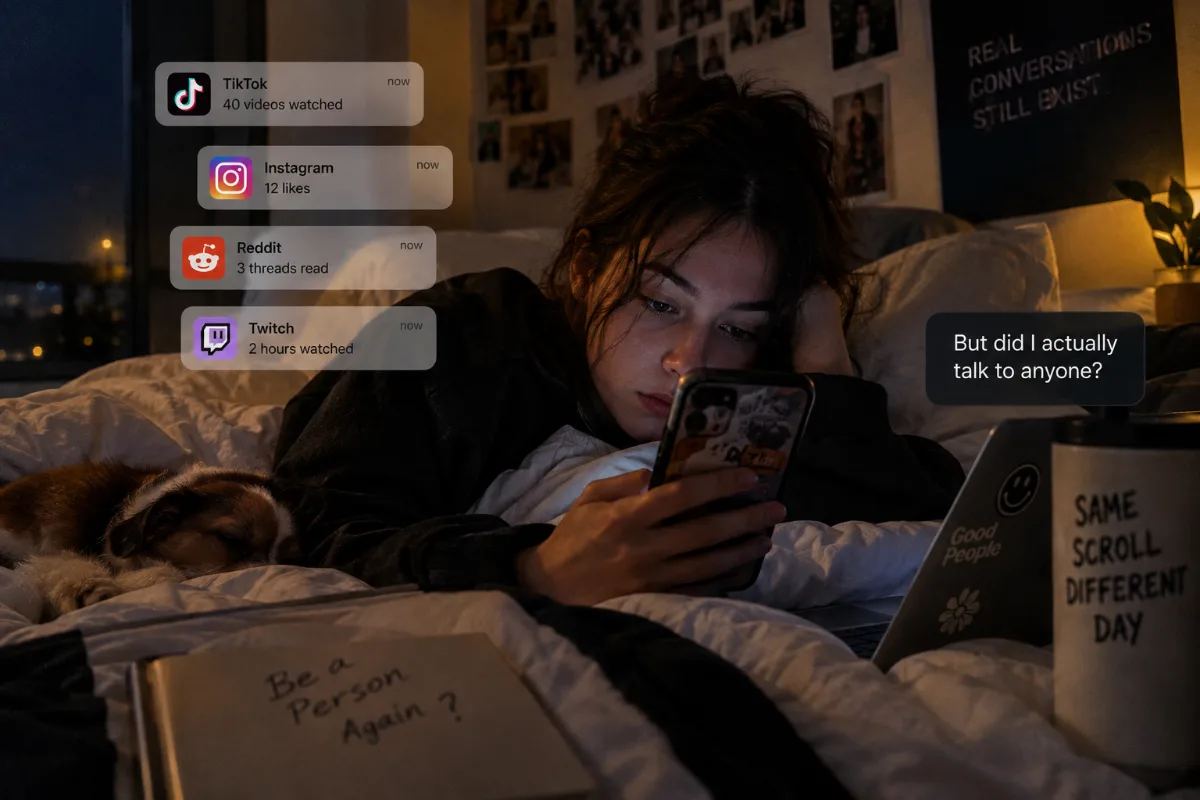
Open TikTok. Scroll for twenty minutes.
You watched forty people talk, laughed at twelve comments, maybe double-tapped a video.
You didn't say a word to anyone.
Open Reddit. Read three threads deep into an argument between strangers. You have opinions on all of it. You typed none of them.
Open Twitch. Watch a streamer for two hours. Thousands of people are flying through the chat faster than anyone could possibly read it.
You were there.
But did you actually talk to anyone?
That's the weird contradiction at the center of modern social media: we spend more time around people online while spending a surprising amount of that time not interacting with them at all.
We call it social media.
A lot of the time, we're really just watching.
Lurking isn't the problem. It's the product working.
There's nothing inherently wrong with lurking.
Sometimes you don't want to post. Sometimes you don't have anything to say. Sometimes watching something funny for twenty minutes is exactly what you came online to do.
The interesting question isn't why people lurk.
It's why lurking became the default mode of the social internet.
Modern platforms are extraordinarily good at removing the need to participate.
Infinite scroll doesn't ask you to contribute anything. The next video is already waiting.
Recommendation algorithms don't need you to start a conversation. They need enough signals to figure out what will keep you watching.
Even when you're surrounded by comments, creators and communities, you can experience the entire thing without another person ever knowing you were there.
That's an incredible product achievement.
It's also a strange outcome for something we still call social media.
The distinction is simple:
Interacting with content isn't necessarily the same thing as interacting with a person.
A like is interaction with a platform.
A view is interaction with content.
A conversation requires somebody to answer back.
Those experiences aren't interchangeable.
We've written before about why everything online can start to feel fake. But there's another part of the problem that has less to do with authenticity and more to do with participation.
You can spend hours online surrounded by human beings and leave without having a single reciprocal interaction.
That's lurking.
And the modern internet is unbelievably good at it.
Livestreaming found the loophole
Livestreaming is where this gets interesting.
Because livestreaming brought something back that feeds had slowly removed:
presence.
Something is happening right now.
Someone is actually on the other side of the screen.
They could say something unexpected. Something could go wrong. A person in chat could change where the conversation goes.
That unpredictability matters.
Watch a Twitch stream and thousands of people may be watching the same person simultaneously. Most will never speak to the streamer.
But occasionally the streamer reads someone's message.
For a few seconds, the wall disappears.
The person who was watching becomes part of what everyone else is watching.
Shopping livestreams use a similar dynamic. Someone holds up a product and talks directly into a camera while hundreds or thousands of people watch. The format feels more personal than a normal advertisement because it is happening now.
Livestreaming found an extremely effective middle ground:
the feeling of being somewhere live without requiring you to participate.
And people clearly like that.
You get spontaneity.
You get another human being.
You get the possibility that something unexpected happens.
But you can still sit there completely silent.
That's not a criticism of livestreaming. It's one of the reasons the format works so well.
But it exposes something important about how people behave online.
We haven't lost our appetite for live human presence.
We've lowered the amount of effort we're willing to spend getting it.
Watching someone isn't the same as talking to them
There's a point where the illusion breaks.
You can watch somebody for three hours and feel like you know them.
They still don't know you exist.
That's the fundamental limitation of parasocial interaction. The experience can be entertaining, comforting and even meaningful, but the relationship isn't reciprocal.
Conversation is.
When you talk to another person, you can change what happens next.
They react to you.
You react to them.
A joke bombs.
A question goes somewhere neither person expected.
Someone says something ridiculous.
Someone changes your mind.
The experience exists because both people are participating in it.
That's much harder to manufacture than a feed.
It's also harder to scale.
The internet optimized away friction
Most technology companies spend enormous amounts of time removing friction.
Usually that's good.
One-click checkout is better than entering your information twelve times.
Instant search is better than digging through directories.
A feed that immediately understands what you're interested in is easier than hunting for something entertaining.
But social interaction is unusual because some of the friction is the product.
Conversation requires another person.
You have to take turns.
You have to risk saying something stupid.
You occasionally have to survive five awkward seconds.
You don't know exactly what's going to happen.
That's inefficient compared with scrolling.
It's also why conversations can be memorable.
Think about how much content you've consumed this week.
Now try to remember ten individual TikToks.
Harder than it should be.
But you probably remember an unexpectedly funny conversation you had months ago.
The internet became incredibly good at giving us things to consume.
It became less interested in giving us reasons to interact with each other.
Random video chat proved people still want strangers
This is part of what made Omegle such a strange internet phenomenon.
The product was almost absurdly simple:
You. A stranger. Talk.
There wasn't much context.
There wasn't much structure.
Sometimes there wasn't much conversation.
And yet the basic behavior survived for years and continued across Omegle alternatives and random video chat platforms long after the rest of social media became dramatically more sophisticated.
That tells us something.
The interesting part of random video chat was never the randomness itself.
It was the possibility.
There was an actual person on the other side.
You didn't know what they were going to say.
They didn't know what you were going to say.
For once, an algorithm wasn't choosing the next piece of content.
Another human being was.
The problem was that traditional random video chat removed too much friction.
Two people would connect and immediately face the same question:
Now what?
We've explored why strangers disconnect so quickly in random video chat. When neither person knows why the other person is there, every interaction starts from zero.
That's a lot to ask from two strangers.
Maybe strangers don't need less friction. They need better friction.
This is the distinction that matters.
The solution probably isn't making human interaction completely effortless.
Then it stops being human interaction.
The better question is:
Can you remove the awkward friction while keeping the human part?
You shouldn't need to spend thirty minutes building a profile.
You shouldn't need followers.
You shouldn't need to join a Discord server and learn its culture.
You shouldn't need to become a creator.
And you shouldn't need to stare at another stranger wondering who is supposed to speak first.
Give two people a reason to interact before they meet.
That's a different problem.
And it's the idea behind what we're building at What's The Vibe.
Instead of matching two strangers and hoping something happens, you choose what kind of interaction you actually want first.
Maybe you want a ridiculous argument.
Maybe you want someone else's opinion.
Maybe you want to get roasted.
Maybe you want to disappear down a rabbit hole at 1 a.m.
Maybe you just want to talk.
Games like Virtual Court and Walking Red Flag give the interaction somewhere to start.
The room does some of the awkward work for you.
The person does the rest.
From audience member to participant
That's the larger idea.
For most of the modern internet, you're the audience.
Someone posts.
You watch.
Someone streams.
You watch.
Someone argues.
You read.
Someone makes something funny.
You like it.
There's nothing inherently wrong with any of that.
But there should probably be another button on the internet:
Participate.
Not post.
Not build an audience.
Not create content.
Just participate in something happening between actual people.
That's the gap we're interested in.
The livestream instinct is already there:
I want something live.
Random video chat adds another:
I want another person.
Structured social experiences add the missing piece:
Give us something to do.
Put those together and social media starts looking a little more social again.
The internet doesn't need more people watching people
There is already more content than anyone could consume in a lifetime.
And we're about to get considerably more of it.
The interesting scarcity isn't content anymore.
It might be participation.
Lurking isn't laziness. It's what happens when incredibly sophisticated products make watching easier than talking.
Livestreaming showed that people still want presence.
Random video chat showed that people still want strangers.
Communities showed that people still want belonging.
The next interesting question is what happens when you combine those instincts without asking somebody to turn themselves into a creator first.
Maybe the future of social media isn't another feed that's slightly better at predicting what you'll watch.
Maybe it's giving you a reason to stop watching for a minute.
And actually say something.
Try it yourself
Start a vibe-matched video chat on What's The Vibe — free, no sign-up.
Related reading
- OmeTV Alternative: We Put OmeTV on Trial. It Lost. (2026)
- Anonymous Video Chat: Who Dis? Meet Strangers
- Why a Playful Roast Can Break the Ice Better Than ‘Hey’
- Which WTV Vibe Are You? Take the Quiz
- We Took Our Vibe to OmeTV and Monkey App. Here's What Happened
- The Weak Ties Theory: Why Strangers Make You Happier