Why a Playful Roast Can Break the Ice Better Than ‘Hey’
Two strangers. One awkward “hey.” Instant skip. Could a playful roast change everything? Explore why shared games can turn dead chats into real connections.
By Mark Gjura ·
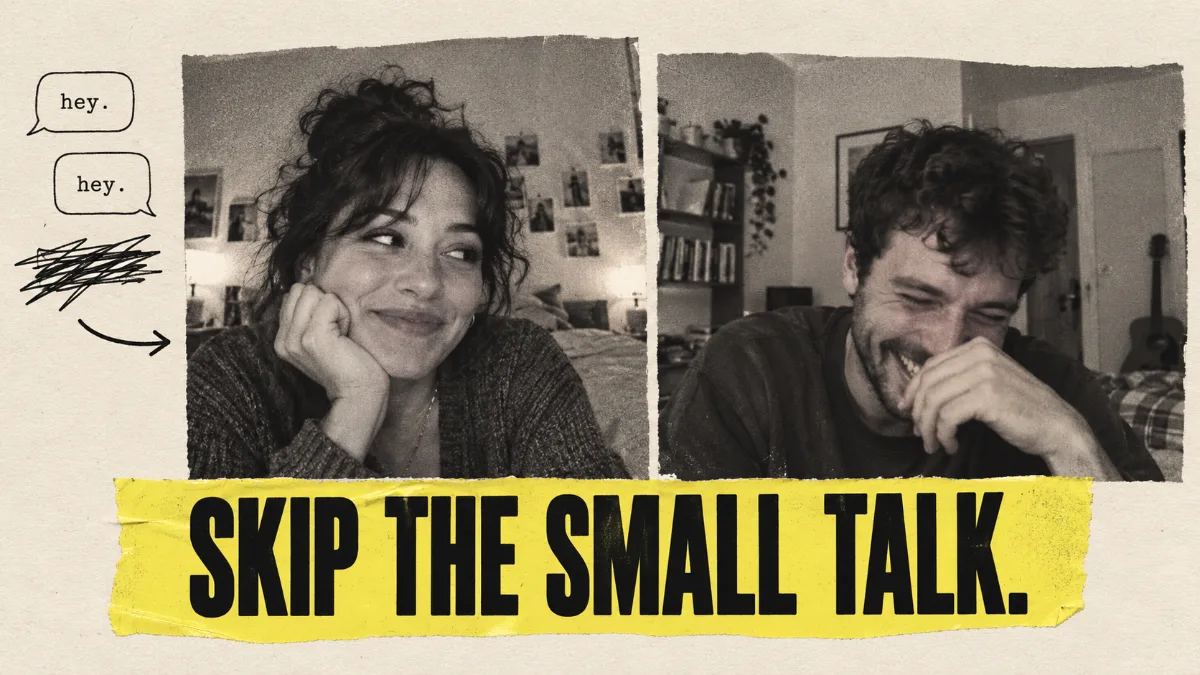
Two strangers match on a random video chat.
"Hey."
"Hey."
"…So where are you from?"
You already know how this ends. Somebody's thumb drifts toward the skip button, and by second twelve, they're gone.
Now run it back. Same two strangers. Except this time the screen says Roast Roulette, and the first thing out of her mouth is:
"You look like you'd return a rotisserie chicken because it was 'too warm.'"
He laughs. Fires back something about her lighting setup. Four minutes later they're still on — and they're not talking about lighting anymore. They're talking about why he actually did return a rotisserie chicken once, and what that says about his dad.
Same people. Same camera. Same internet.
Different frame.
This post is about why that works — and it's not luck, and it's not that funny people are better at connecting. It's decades-old social psychology that most video chat platforms have completely ignored.
The Short Version
"Hey" isn't a neutral opener. It's a blank frame — and blank frames force strangers to perform.
A roast, a game, or a mild disagreement gives both people a shared script, a clear role, and permission to fail. That removes the performance anxiety that kills most stranger conversations, and it moves people past the surface layer faster than polite small talk can.
Here's the psychology behind each piece.
"Hey" Is a Blank Frame. That's the Problem.
In 1974, sociologist Erving Goffman published Frame Analysis, and the core idea is simple: every interaction runs on an unspoken answer to the question "What is going on here?"
A job interview has a frame. So does a first date, a funeral, a pickup basketball game. The frame tells you what counts as a normal move, what counts as weird, and what a mistake looks like. You don't think about frames — until you're in a situation that doesn't have one.
Random video chat is that situation.
When two strangers match with nothing but "hey," neither person knows the frame. Is this flirting? Networking? Entertainment? A vibe check? Am I supposed to be funny? Interesting? Chill? Both people are silently running the same calculation — and the safest move in an undefined frame is to reveal as little as possible.
That's why "hey" produces "hey." It's not boring people. It's two people refusing to commit to a frame the other might reject.
Before Goffman, anthropologist Gregory Bateson made a related point in his work on play: animals and humans signal "this is play" before a play-fight, so that a nip gets read as a game instead of an attack. That signal — the play frame — is what makes it safe to do things that would otherwise feel risky.
A roast only works inside that frame. Out of context, "you look like you return rotisserie chickens" is an insult. Inside Roast Roulette, where both people clicked in knowing exactly what they signed up for, it's an invitation.
The vibe is the frame. That's the entire design thesis behind What's The Vibe: fix the "what is going on here?" problem before the call starts, so nobody has to solve it live, on camera, in front of a stranger. (We went deeper on this in Why Video Chat Without Context Forces Performance.)
The Permission to Fail
Here's the thing nobody says out loud about random video chat: most people who skip aren't bored. They're exposed.
In a classic 2000 study, psychologists Thomas Gilovich, Victoria Medvec, and Kenneth Savitsky had college students walk into a room of peers wearing an embarrassing T-shirt. The wearers were asked to guess how many people noticed. Their guess was roughly half. The real number was closer to a quarter.
Chart 1 — The Spotlight Effect: How Noticed We Think We Are vs. How Noticed We Are
| Share of observers | ||
|---|---|---|
| What the wearer predicted | ██████████████████████████ | ~50% |
| What actually happened | ████████████ | ~23% |
Source: Gilovich, Medvec & Savitsky (2000), Journal of Personality and Social Psychology.
That gap is the spotlight effect — we massively overestimate how much other people are watching and judging us. Now put that bias on a front-facing camera, one foot from a stranger's face, with nothing to do but be interesting. Every pause feels like it's being graded. (Full breakdown: The Spotlight Effect in Random Video Chat.)
Structured games attack this in three specific ways:
1. They give you a role instead of a personality test. In Who Dis?, one person is the Actor and one is the Guesser. The Actor isn't being judged as themselves — they're doing a terrible Walter White impression because the game told them to. If it flops, the character flopped. Not you.
2. They move the spotlight off your face and onto a shared object. When both people are staring at the same 60-second timer, neither one is staring at the other. Attention points at the task. The spotlight effect needs an audience — games turn the audience into a teammate.
3. They make failure part of the fun. A bad impression in Who Dis? is funnier than a good one. A roast that doesn't land becomes material for the comeback. When failing is a normal, expected, even entertaining outcome, the stakes of trying drop to almost nothing.
That's the permission to fail. Small talk doesn't offer it — a flat "so what do you do?" has no upside if it lands and a very visible downside if it dies.
Low-Stakes Friction: Why a Little Conflict Beats Polite Small Talk
This is the counterintuitive part, and it's where most "how to start a conversation" advice gets it wrong.
The standard advice is: be warm, be agreeable, find common ground. That's not wrong. We've written before about why small talk still matters — it builds baseline safety.
But polite agreement between two strangers has a ceiling. Agreement gives the other person nothing to push against. "Oh nice, I like pizza too" is a dead end with a smiley face on it.
Mild, playful friction does three things agreement can't:
- It creates a back-and-forth by default. A roast demands a comeback. A hot take on The Veto demands a response. The conversation has momentum built in — nobody has to invent the next move.
- It forces people to reveal what they actually think. You can't defend a position without showing your reasoning. And reasoning is where personality lives.
- It creates a shared experience, not just an exchange. Surviving a roast together — laughing at yourself, landing one back — is a small, real event two people went through.
That last point has research behind it. In a 2004 study, Barbara Fraley and Arthur Aron paired strangers and had some of them go through a genuinely funny shared experience together. Those pairs reported feeling closer afterward than pairs who did a comparable task without the humor. Laughing together built closeness — not just being around funny content.
Psychologist Dacher Keltner and colleagues, reviewing the research on teasing, found the same double edge you'd expect: teasing can bond people or wound them, and the difference is whether it's clearly marked as play — tone, exaggeration, a smile, and shared understanding that nobody means it literally. That's the Bateson play frame again. A roast between two people who both opted into Roast Roulette is marked as play before anyone opens their mouth.
Chart 2 — "Hey" vs. a Framed Opener, Side by Side
| What the opener gives you | "Hey" / "Where are you from?" | Roast / Game / Hot Take |
|---|---|---|
| Is the frame clear? | ▮▯▯▯▯ Unknown — both people guessing | ▮▮▮▮▮ Set before the call starts |
| Does each person have a role? | ▮▯▯▯▯ No — both "being themselves" | ▮▮▮▮▮ Yes — roaster, actor, guesser, challenger |
| Is there a built-in next move? | ▮▮▯▯▯ Maybe — someone has to invent it | ▮▮▮▮▮ Yes — comeback, guess, rebuttal |
| What does failing cost? | ▮▮▮▮▮ Feels personal | ▮▯▯▯▯ It's part of the game |
| Does it reveal real personality? | ▮▯▯▯▯ Rarely — scripted answers | ▮▮▮▮▯ Often — how people play is who they are |
Design comparison, not measured data. Five blocks = strongest.
The goal isn't conflict. It's friction low enough to be safe and high enough to create motion. Think sparring, not fighting.
Social Penetration Theory: Games Are an Elevator, Not a Shortcut
In 1973, Irwin Altman and Dalmas Taylor described relationships with a now-famous metaphor: people are like onions. Closeness develops as two people move from the outer layers (name, job, weather) toward the inner ones (values, fears, the stuff you don't tell coworkers). This is Social Penetration Theory, and one of its core points is that disclosure is usually reciprocal — you go one layer deeper, I match you, we both move in.
The problem with small talk on random video chat isn't that the outer layers are bad. It's that strangers get stuck there. Nobody wants to be the first person to go deeper, because going deeper alone is exposure. So both people circle the outer ring until someone skips.
Structured formats solve this in a sneaky way: they let you go deeper while pretending you're still just playing.
Chart 3 — The Onion: How Formats Move You Through the Layers
| Layer | What gets shared | Where you usually get stuck | What moves you inward on WTV |
|---|---|---|---|
| 1. Surface | Name, location, "what do you do" | "Hey." "Hey." Skip. | The vibe itself — you already know why you're both here |
| 2. Tastes & reactions | Humor, preferences, what makes you laugh | Polite agreement dead-ends | Comedy, Who Dis? — you see someone commit to a bit |
| 3. Opinions | What you actually think about things | Fear of disagreeing with a stranger | The Veto, Virtual Court — disagreeing is the format |
| 4. Self-perception | How you see yourself, your flaws | Nobody volunteers their flaws | Roast Roulette, Walking Red Flag — flaws become content |
| 5. Real stuff | Values, fears, the rotisserie-chicken-and-your-dad story | Takes trust most chats never build | Happens on its own once 2–4 went well |
Notice what's happening. A roast is technically a Layer 4 move — it's about how someone comes across, their quirks, their flaws. But the play frame makes it feel like Layer 1. You get the intimacy of "someone looked at me and saw something specific" without the risk of "I just confessed something to a stranger."
That's the elevator. You're not skipping steps — you're riding past the floors where most conversations stall.
This is the same principle behind Arthur Aron's famous "fast friends" procedure from 1997 — the one that went viral years later as "the 36 questions." Strangers who took turns answering questions that escalated in depth felt significantly closer after about 45 minutes than pairs who stuck to small-talk questions. The secret wasn't the specific questions. It was structured, turn-based, escalating disclosure. A game does the same thing, just with more laughing.
Why It Works Better With Strangers Than Friends
It's tempting to read all of this as "games are fun, so people stay." That's true, but it undersells what's actually going on. Strangers are uniquely set up for this — and uniquely bad at predicting it.
A few findings worth knowing:
- We underestimate how much strangers like us. Research on the "liking gap" (Boothby, Cooney, Sandstrom & Clark, 2018) found that after a conversation with someone new, people consistently believed their partner liked them less than the partner actually did. We walk away from good chats thinking they went badly.
- We underestimate how good talking to strangers will feel. Nicholas Epley and Juliana Schroeder (2014) had commuters either talk to a stranger or keep to themselves. People predicted the solitude would be nicer. The ones who talked had the more pleasant ride.
- We underestimate how much people want to go deeper. Kardas, Kumar & Epley (2022) found people expect deep conversations with strangers to be more awkward and less enjoyable than they actually turn out to be — and that the other person is more interested in going deep than we assume.
- Weak ties genuinely matter. Gillian Sandstrom and Elizabeth Dunn's work on weak ties (2014) found that on days people interacted with more casual acquaintances, they reported greater happiness and sense of belonging. Not best friends. Casual, brief, real contact. Chart 4 — The Stranger Prediction Gap
| What we predict about talking to a stranger | What research actually finds |
|---|---|
| "They're judging me constantly." | They're paying far less attention than you think (spotlight effect) |
| "They probably didn't like me." | They liked you more than you think (liking gap) |
| "It'll be awkward if we go deep." | It's less awkward and more enjoyable than expected (Kardas et al.) |
| "I'd rather keep to myself." | Talking usually feels better (Epley & Schroeder) |
| "A random chat doesn't matter." | Casual contact measurably lifts mood and belonging (Sandstrom & Dunn) |
Put that together and the picture is clear: the obstacle to stranger connection is almost entirely in our predictions, not in the actual interaction. People skip because they expect it to go badly, and the expectation gets locked in during the first ten seconds.
A game or a roast doesn't make strangers nicer. It gets both people past those first ten seconds — long enough for reality to overwrite the prediction.
(If the "strangers get the real you" part interests you, read Why You're More Honest With Strangers Than People You Know.)
When a Roast Goes Wrong
A roast is a tool, not a personality. And like any tool, it cuts both ways. Keltner's research on teasing is clear that the same words can bond or wound depending on context — and "context" includes whether the other person actually signed up for it.
The rules that separate a good roast from just being a jerk:
- Only roast people who opted in. That's why Roast Roulette is its own vibe. Opening with a roast on someone who clicked Second Opinion to ask about their breakup isn't bold — it's a frame violation.
- Roast choices, not bodies. Their lighting, their room, their obvious energy-drink collection — fair game. Things they can't change aren't.
- Exaggerate. Always. Exaggeration is the play signal. "You look like you've alphabetized your spice rack twice" is a roast. "You look boring" is just an insult.
- Take one as well as you give one. Reciprocity is the whole mechanism. If you can dish it but fold on the comeback, there's no exchange — just a bit.
- Know when to drop the bit. The best roast conversations end as real conversations. When the other person opens a real door, walk through it. Don't roast it.
The goal of friction is to get you to something real, not to replace it.
If You Have Social Anxiety, Read This Part
Everything above has a specific meaning if talking to strangers genuinely makes your chest tight.
Social anxiety runs largely on anticipated judgment — the exact spotlight-effect prediction from Chart 1, turned all the way up. Unstructured video chat is close to a worst-case setup: maximum visibility, zero script, total ambiguity about what "doing well" looks like.
Structured formats flip that:
- You know your job. Guess the character. Defend your case. Land one comeback. A defined task is much easier to start than "be interesting."
- Your attention has somewhere to go. Focusing on the game instead of on how you're coming across is a lot like the attention-shifting techniques used in CBT.
- Failure is small and normal. Every flopped impression is a tiny piece of evidence that screwing up in front of a stranger isn't catastrophic.
That's not therapy, and it's not a replacement for it. But it's a much gentler on-ramp than "hey" into the void. If you want the full breakdown of how video chat can work as gradual exposure, read Social Anxiety? Video Chat Exposure Therapy Explained.
A practical order if you're easing in:
- Comedy — lowest stakes. You're just there to laugh.
- Who Dis? — you get a role and a timer. The character takes the pressure.
- The Veto — you share an actual opinion, but on a topic, not about yourself.
- Roast Roulette — the deep end. Come here once you've seen that being on camera isn't the verdict you thought it was.
What This Means for Skip Culture
Skip culture usually gets blamed on short attention spans. We think that's lazy.
People don't skip because they're incapable of sitting through a conversation. They skip because the first ten seconds of an unframed chat are genuinely uncomfortable, and skipping is the fastest way to make the discomfort stop. It's not a character flaw. It's a completely rational response to a badly designed situation.
Fix the frame, and you fix the ten seconds. Fix the ten seconds, and the skip button stops being the most attractive thing on screen.
That's what every vibe and every game on What's The Vibe is actually for. Not gimmicks. Not "fun features." Frames.
Final Thought
"Hey" asks a stranger to invent a whole conversation from nothing — on camera, in real time, while being watched.
A roast hands them a script, a role, and a reason to laugh.
Goffman would call it a frame. Bateson would call it play. Altman and Taylor would call it a faster way through the onion.
We just call it the vibe.
Stop introducing yourself. Start playing.
Pick a vibe on What's The Vibe →
Frequently asked questions
Why do strangers connect faster over a game than small talk?
Games give both people a clear frame, a defined role, and a shared task. That removes the uncertainty about "what is this conversation supposed to be," which is what makes early small talk with strangers feel awkward. With a game, attention shifts from judging each other to playing together, and the conversation has a built-in next move.
What is Goffman's framing theory in simple terms?
Erving Goffman's framing theory says every interaction runs on a shared, usually unspoken answer to "what is going on here?" The frame tells people what's normal, what's weird, and what counts as a mistake. When there's no frame — like a blank random video chat — people get cautious and reveal very little.
What is social penetration theory?
Social penetration theory, from Irwin Altman and Dalmas Taylor (1973), describes closeness as moving through layers, like an onion — from surface facts toward values and personal experiences. Disclosure tends to be reciprocal: one person goes a layer deeper and the other matches. Structured games and roasts help strangers move past the surface layers faster by making deeper disclosure feel like play.
Isn't opening with a roast just rude?
Only outside a play frame. Research on teasing shows it can bond or hurt depending on whether it's clearly marked as play and whether both people are in on it. That's why Roast Roulette is an opt-in vibe on What's The Vibe: both people chose it, so the roast reads as an invitation, not an attack. Roast choices, not bodies, and always exaggerate.
Can conversation games help with social anxiety?
They can make talking to strangers less intimidating, because a defined task and a shared focus reduce the feeling of being constantly judged. They aren't a replacement for professional support, but they're a gentler way to practice than unstructured video chat. Starting with low-stakes vibes like Comedy or Who Dis? and working up is a good approach.
What is the spotlight effect?
The spotlight effect is the tendency to overestimate how much other people notice and judge us. In a well-known 2000 study, people wearing an embarrassing T-shirt guessed about half the room noticed; the real figure was closer to a quarter. On camera, this bias gets stronger, which is a big reason random video chats feel awkward.
Research referenced
- Altman, I., & Taylor, D. A. (1973). Social Penetration: The Development of Interpersonal Relationships.
- Aron, A., Melinat, E., Aron, E. N., Vallone, R. D., & Bator, R. J. (1997). The experimental generation of interpersonal closeness. Personality and Social Psychology Bulletin.
- Bateson, G. (1972). A theory of play and fantasy. In Steps to an Ecology of Mind.
- Boothby, E. J., Cooney, G., Sandstrom, G. M., & Clark, M. S. (2018). The liking gap in conversations. Psychological Science.
- Epley, N., & Schroeder, J. (2014). Mistakenly seeking solitude. Journal of Experimental Psychology: General.
- Fraley, B., & Aron, A. (2004). The effect of a shared humorous experience on closeness in initial encounters. Personal Relationships.
- Gilovich, T., Medvec, V. H., & Savitsky, K. (2000). The spotlight effect in social judgment. Journal of Personality and Social Psychology.
- Goffman, E. (1974). Frame Analysis: An Essay on the Organization of Experience.
- Kardas, M., Kumar, A., & Epley, N. (2022). Overly shallow? Miscalibrated expectations create a barrier to deeper conversation. Journal of Personality and Social Psychology.
- Keltner, D., Capps, L., Kring, A. M., Young, R. C., & Heerey, E. A. (2001). Just teasing: A conceptual analysis and empirical review. Psychological Bulletin.
- Sandstrom, G. M., & Dunn, E. W. (2014). Social interactions and well-being: The surprising power of weak ties. Personality and Social Psychology Bulletin.
Try it yourself
Start a vibe-matched video chat on What's The Vibe — free, no sign-up.