Why Strangers Always Disconnect First
Conversations don't fail because people are boring. They fail because they start wrong. Here's why.
By Mark Gjura ·
Why Random Video Chat Fails (And Why We Built What's The Vibe)
The closed gate problem isn't theoretical. You see it everywhere.
Walk into an elevator. Everyone stares at the floor.
Sit next to a stranger on a plane. You both pretend the other doesn't exist.
Join a random video chat. "Hey." "Where are you from?" Skip. Skip. Skip.
The pattern is identical because the psychology is identical.
The Real Reason Omegle Fails
Skip culture isn't actually about the person on the other end of the camera.
It's about the defensiveness that happens before anyone even speaks.
When you don't know why someone is there, your brain immediately asks:
- Can I trust this?
- Are they judging me?
- What do they actually want?
- Should I leave?
The ego takes over. Walls go up. You're already halfway out the door before the conversation starts.
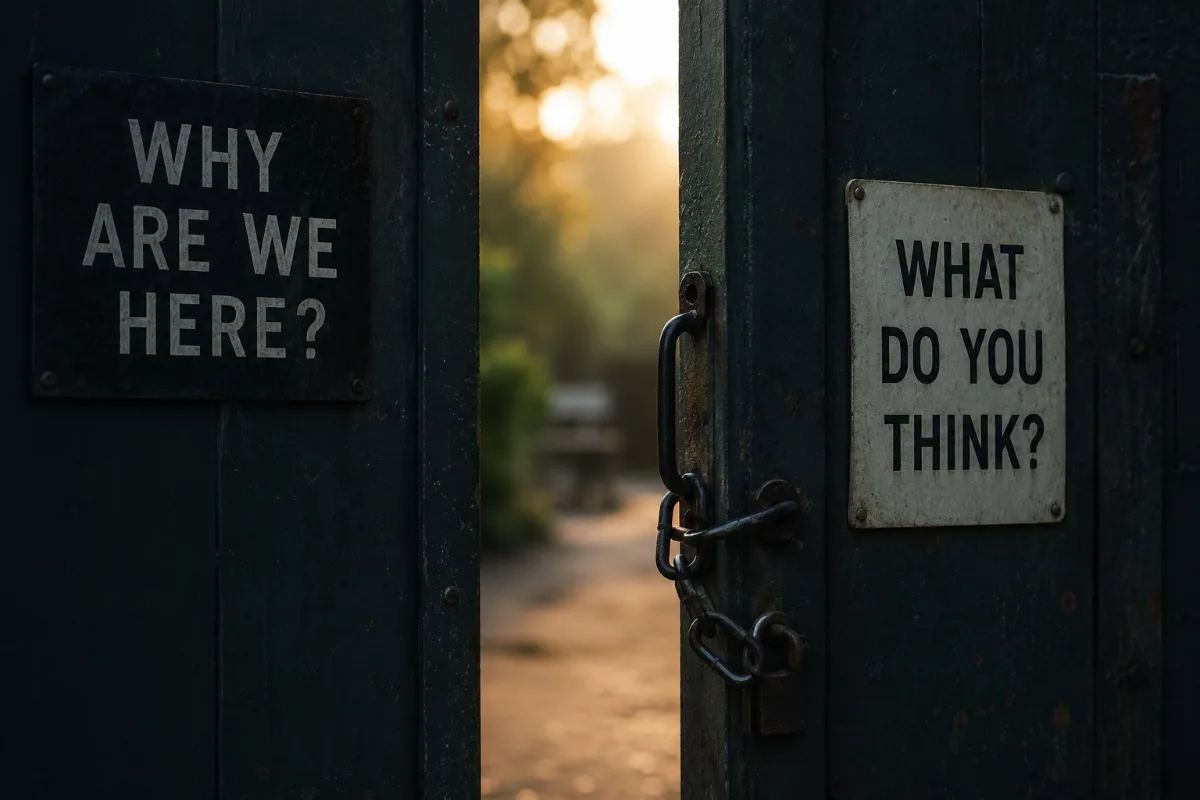
The Closed Gate
I call this the Closed Gate.
It's the psychological state that exists whenever two strangers meet without a shared reason for meeting.
The first conversation isn't about curiosity.
It's about uncertainty.
Until that uncertainty disappears, people naturally evaluate before they engage.
The gate stays closed.
Randomness without context often creates defensiveness. When people don't understand why someone else is there, many instinctively become more guarded.
Why Shared Purpose Changes Everything
Now consider a different scenario.
You walk into a room knowing exactly why you're there. Everyone else knows too.
Maybe you're all there to debate something you care about.
Maybe you all showed up because you like conspiracy discussions.
Maybe you just want to laugh.
The first real question isn't "Who are you?"—it's "What do you think?"
That changes the entire interaction.
You're no longer standing in front of a closed gate with a stranger. You're both already walking toward the same conversation. The gate is open before anyone speaks.
This is why it works in real life:
- People at a concert have already declared something about themselves
- People in a live chat about music taste aren't strangers—they're peers with aligned interests
- People in a debate understand they're there to think, not to judge Purpose precedes connection.
What Random Video Chat Platforms Get Wrong
Every major random video chat platform optimizes for one thing: randomness.
They focus on the matching algorithm. The speed of connection. How quickly you can find someone new.
They completely miss the point.
Randomness is half the equation. Without purpose, it's just... random.
Random video chat works fine if you're trying to find someone to have a specific conversation with. But most people aren't doing that. They're opening the app hoping something interesting will happen.
And when nothing interesting happens because there's no framework for it—they skip.
What We Built Instead
What's The Vibe solves this a completely different way.
We didn't optimize randomness. We optimized purpose.
That's why we built conversation games and vibes:
Comedy. You know why people are there.
Music. You know what to talk about.
Rabbit Hole. You know the energy you're walking into.
Second Opinion. You know someone wants your thoughts on something real.
The Veto. You know this is about finding the weirdest idea together.
Walking Red Flag. You know both people are here to be unapologetically themselves.
Virtual Court. You know the frame is debate, not judgment.
These aren't games bolted onto a random video chat app.
They're conversation catalysts. They answer the silent question every stranger asks before they even click connect:
Why are we here?
Once that question is answered, the gate opens.
The Difference
With most random video chat, you're hoping randomness leads to connection.
With purpose-first design, randomness becomes discovery.
The person you match with isn't a random roll of the dice. They're someone who showed up for the same reason you did.
That's a fundamentally different psychological experience.
Traditional Random Chat vs. Purpose-First Design
| Aspect | Traditional Random Chat | Purpose-First Design |
|---|---|---|
| Initial Frame | Two strangers meeting with no context | Two people arriving for the same reason |
| First Question | "Who are you?" | "What do you think?" |
| Default Mindset | Defensive and evaluative | Curious and engaged |
| Psychological Safety | Low (closed gate) | High (gate already open) |
| Skip Culture | High (easy exit) | Low (momentum built in) |
| Conversation Quality | Surface-level, transactional | Genuine, exploratory |
| User Retention | Dependent on luck | Built into the design |
| Why People Stay | They found someone interesting | They're already invested in the vibe |
Why This Matters
Skip culture isn't a user problem. It's a design problem.
If your platform creates defensiveness before conversation starts, people will skip. Not because there's anything wrong with the people on the other end. But because there's nothing compelling them to stay.
Purpose flips this.
When someone knows why they're there, they're not evaluating whether to engage. They're already engaged. They're just waiting to see what happens.
The closed gate only stays closed if no one told you why the room exists.
Once you know, you walk in a completely different person.
We Didn't Build Another Random Chat App
Technology has spent years making it easier to meet strangers.
We think the harder problem is giving strangers a reason to meet.
People don't open up because they were randomly matched.
They open up because they discover they're already walking toward the same conversation.
Randomness creates discovery.
Purpose creates connection.
That's the philosophy behind What's The Vibe.
Not because conversation needs more algorithms.
Because it needs fewer closed gates.
Keep Reading
If this resonated, these go deeper:
- Why strangers always disconnect first — the closed-gate problem behind most dead conversations
- Group video chat with strangers — why three or four people beats one-on-one
- Is random video chat safe? — an honest 2026 safety guide
- How to make friends online as an adult — rebuilding the conditions friendship needs
- Chatroulette vs Omegle — what both pioneers proved, and what killed them
Frequently asked questions
Why do people skip on random video chat platforms?
People skip because they're uncertain about why the other person is there. Without a shared purpose, both people become defensive. The ego prioritizes self-protection over connection, which creates an awkward dynamic that leads to skipping before real conversation begins.
What makes conversation games better than random matching?
Conversation games establish a frame before matching happens. Instead of two strangers guessing why they're together, both people arrived knowing the purpose. This removes the psychological barrier that causes skip culture and creates genuine curiosity instead of defensiveness.
How does the closed gate concept apply to video chat?
The closed gate is when two strangers meet without context. Neither knows why the other is there, so both become guarded. In random video chat, this manifests as awkward introductions and quick skips. Purpose-driven conversation breaks this pattern by opening the gate before people connect.
Why is purpose more important than the algorithm in random chat?
The algorithm only matters if people want to have the conversation in the first place. Purpose-first design ensures people want to be there before they're matched. This creates retention and engagement that no matching algorithm can achieve, because the fundamental psychological need is met before interaction starts.
What's the difference between random video chat that works and random video chat that fails?
Random video chat that works has a clear frame or purpose. Random video chat that fails leaves people guessing. Without shared purpose, randomness creates awkwardness. With shared purpose, randomness creates discovery.
Try it yourself
Start a vibe-matched video chat on What's The Vibe — free, no sign-up.