Second Opinion: Ask a Stranger. Get the Truth.
Got a question? Ask a stranger. Second Opinion on What's The Vibe is real-time advice from real people who don't know you and have no reason to lie to you.
By Mark Gjura ·
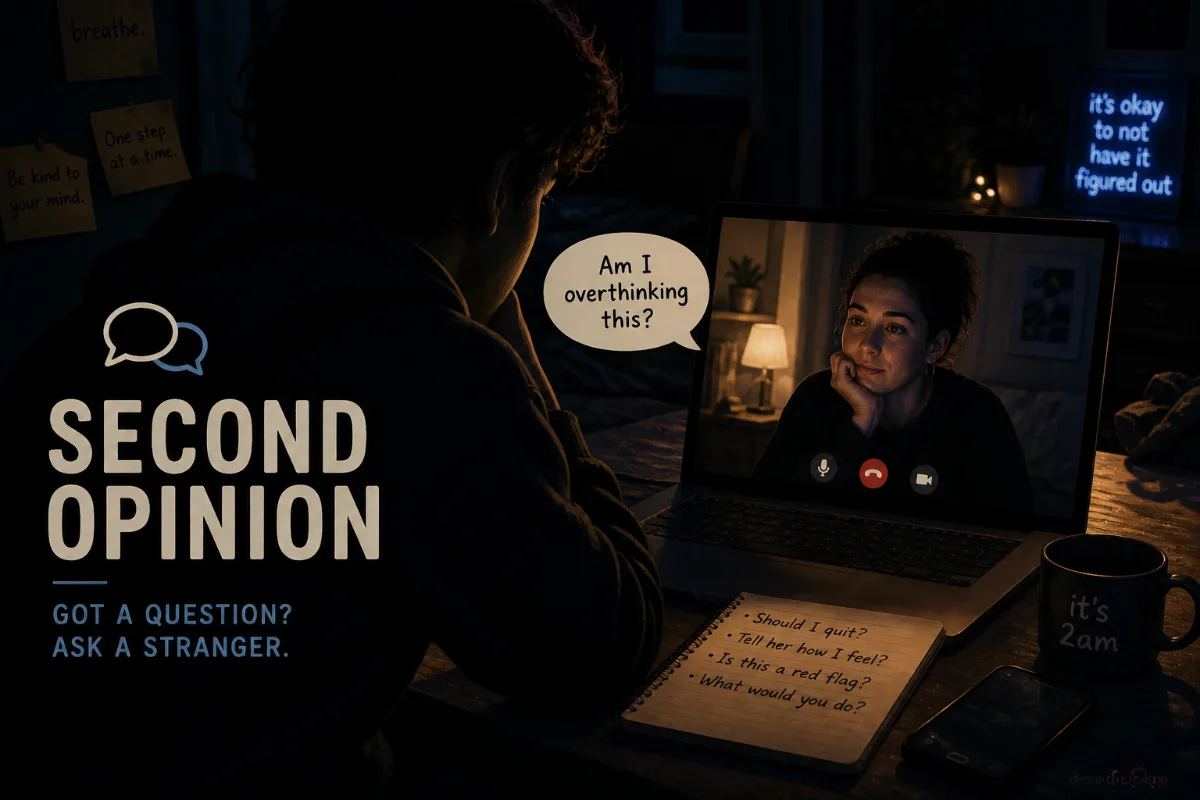
Second Opinion: The Internet Has Always Been About Asking Strangers. We Just Made It Face to Face.
Got a question? Ask a stranger.
Think about that for a second.
The entire internet — Reddit threads, anonymous forums, advice columns, comment sections, Quora, Yahoo Answers, Discord servers at odd hours — is fundamentally one thing: people asking strangers what to do. What's the problem with my relationship. Whether to quit the job. If the thing they're thinking is crazy or if everyone else is. Whether to send the text.
It's the oldest impulse on the internet and nobody has ever solved it right. Because every single platform that tries gives you the same thing: text. Delayed. From someone whose face you'll never see. Who has no stakes in your situation. Who might be a teenager, might be a troll, might be giving you genuinely bad advice with total confidence.
Second Opinion gives you something none of them can: a real person. Live. Face to face. Reading the situation the same way they'd read it in real life. You can see when something lands. You can ask a follow-up. You can watch their expression when you say the part you've been afraid to say out loud.
That's the twist. That's what's never existed before.
Open What's The Vibe, click Second Opinion, and bring the thing you've been sitting on.
What Is Second Opinion?
Second Opinion is a matching vibe on What's The Vibe. When you click it, you're matched 1-on-1 or in a group of up to four strangers who all showed up for the same thing — to ask, to answer, or both.
The name is deliberate. A second opinion implies you've already asked. You've already talked to your friends, your family, the group chat. You've gotten the polite version, the supportive version, the version calibrated to protect your feelings and maintain the relationship. And something in you knows that's not the whole truth.
A stranger has none of those incentives. They don't know you. They don't need anything from you. They're not going to see you at Thanksgiving. They're going to tell you what they actually think — which is the one thing everyone around you is slightly too invested to do.
The tagline — Got a question? Ask a stranger. — sounds simple. It is. But the simplicity hides something important: this is the first time that question has ever been answered live, to your face, in real time.
The Entire Internet Is This — Just Worse
Let's be honest about what we all actually use the internet for.
Someone posts on Reddit: my boyfriend did this thing, am I overreacting? Six hundred people respond. Three say yes, you're overreacting. Four hundred say leave him immediately. The rest argue with each other. The person reads all of it, feels more confused than when they started, and still doesn't know what to do — because none of those six hundred people saw their face when they described it. None of them could ask a follow-up question. None of them had to sit with the answer.
Someone posts on an anonymous forum: should I quit my job? Forty responses. All confident. All contradictory. All from people who know exactly three sentences of context and are advising with the certainty of someone who's been watching this situation for years.
That's not a second opinion. That's noise with upvotes.
The internet is great at giving you volume. It is terrible at giving you the thing you actually need when you have a real question: a real person reading you in real time, who has to actually engage with what you said, and whose face tells you whether they believe what they're telling you.
Second Opinion on What's The Vibe is the first version of this that works the way human advice is supposed to work. Not asynchronous. Not anonymous text from someone with nothing at stake. A live conversation with a real person who has exactly one thing to offer: an honest reaction from someone who doesn't know you.
Why Strangers Specifically
Your friends love you. That's the problem.
When you ask someone who loves you for advice, you're not getting their honest read of the situation. You're getting a version of it that's been filtered through everything they know about you, everything they want for you, and everything they need to preserve between you. They're going to be a little softer than the truth. A little more generous with your role in it. A little more invested in making you feel okay than in telling you what's actually happening.
That's not a criticism — it's just what it means to care about someone. You calibrate your honesty to the relationship.
A stranger calibrates to nothing. They read the situation cold. They don't know which parts you want them to validate, so they react to all of it equally. They don't have a history with you that makes certain observations off-limits. They just see what's in front of them and tell you what they think.
This is why people have always taken their realest questions to the internet — to strangers, not to the people in their life. The anonymity removes the social cost of the honest answer. Second Opinion keeps that honesty but removes the anonymity — because it turns out the face makes it better, not worse. You can tell when someone is being real with you. You can see it.
What People Actually Bring to Second Opinion
There's no required topic. But the questions that show up here tend to belong to a recognizable category: the ones that are too real to ask anyone you know.
The Relationship Question
Is this a red flag or am I overthinking it? Should I send the text? Is what they did actually bad or have I been alone too long? Did I mess this up or did they?
These are the questions that swamp Reddit every day. The difference in Second Opinion is that you can describe the situation and watch someone's face when you do. You can see the moment they think oh, yeah, that's a problem. You don't have to wait three days for a thread to fill up and then sort by top.
The Decision You've Been Stalling On
Quit the job or stay. Move or don't. Say the thing or let it go. Go back to school. End the friendship. Make the call.
You already know what you're leaning toward. What you need is someone to say it back to you — or to tell you why you're wrong — who has no stake in the outcome. Your friends have opinions about your life. A stranger just has the situation you described.
The Thing You Can't Say to Anyone You Know
Some situations are too complicated to explain to people who know the full history. Too embarrassing to bring to the group chat. Too messy for anyone who'll have to look at you afterward.
A stranger gets the version you actually tell, not the version that's been softened by ten years of context. That clean slate is the whole point.
The Sanity Check
Am I crazy or is this actually wrong? Does this seem normal? Is this just me?
Sometimes you don't need advice. You need confirmation that your read on something is accurate. A stranger with no skin in the game, who reacts to what you described without any reason to make you feel better, is the most reliable sanity check available.
1-on-1 vs. Group of 4
Same platform. Different uses.
1-on-1
One person. One situation. One real conversation.
This is the format for the question that actually matters to you. When it's just you and one stranger, the whole conversation focuses on what you brought. You get a genuine back-and-forth — they ask follow-ups, you fill in the gaps, they give you a read that's based on more than just the opening sentence.
The best 1-on-1 Second Opinion sessions feel like the conversation you wish you could have with someone in your life who knew less about you and owed you nothing.
Group of 4
Four strangers. Four completely different reads on the same situation.
Group Second Opinion has a different value — you get the range. Someone who immediately sides with you. Someone who immediately doesn't. Someone with an angle you hadn't considered. Someone who asks the question nobody else thought to ask. That collision of perspectives on one situation is something you genuinely cannot replicate anywhere else.
The group vibe format on What's The Vibe was built for exactly this kind of multi-angle energy. Second Opinion might be the vibe where it's most useful — because four independent reactions to the same situation is closer to what the truth actually looks like.
How This Is Different From Reddit, Quora, and Every Advice Forum
| Reddit / Quora | Second Opinion | |
|---|---|---|
| Response time | Hours to days | Real time |
| Format | Text | Face to face video |
| Follow-up questions | Thread dependent | Immediate |
| Reading your energy | Impossible | Happens naturally |
| Anonymous | Yes | Real person, live |
| Incentive to be honest | None / clout-chasing | No stakes, no reason to perform |
| Volume of responses | Hundreds | 1 or 4, actually engaged |
The table makes it obvious. Every advantage Reddit has is a scale advantage — lots of responses, lots of perspectives. Every advantage Second Opinion has is a quality advantage — one real person, actually engaged, reading the situation the way a human being reads a situation.
Both have their place. But when the question actually matters, the quality version wins.
If you've looked at Omegle alternatives trying to find somewhere that feels like a real conversation, Second Opinion is the most direct answer to that search. You're not looking for someone to chat randomly with. You have something specific. This is where it goes.
The Ethos Behind It
There's a reason people have always taken their real questions to strangers.
It's not because strangers are smarter. It's not because they have better information. It's because they have nothing to protect. No relationship to manage. No version of you they're invested in. No reason to soften the truth.
The internet figured this out in its first decade and built an entire culture around it — anonymous forums, advice threads, confessional subreddits. All of it is just people trying to get the honest reaction they can't get from the people around them.
Second Opinion is that impulse, finally done right. Not text from an anonymous username. Not advice from someone performing for upvotes. A real person, face to face, with the question you actually need answered — reacting to it the way a human being reacts when they hear something real.
The platform is What's The Vibe. The vibe system exists because conversation needs context to work. You show up to Second Opinion with a question. The person on the other side shows up to give you a real answer. That shared context — that's the entire foundation.
It's the one thing that's been missing from every version of this that's existed before.
The Type of Person Who Clicks Second Opinion
- You have a situation you've been turning over and you need an outside read — not validation, an actual read
- You've already asked the people in your life and gotten the polite version
- You know that the honest answer might not be what you want to hear, and you want it anyway
- You've posted on Reddit before and found the advice either too broad or too confident from people with too little context
- You want to see someone's face when they react to what you're about to say There are more of these people than you'd think. They're everywhere on the internet already — Reddit, forums, anonymous advice threads. Second Opinion just gives them somewhere better to go.
Got a question?
Ask a stranger.
Keep Reading
If this resonated, these go deeper:
- Why strangers always disconnect first — the closed-gate problem behind most dead conversations
- Group video chat with strangers — why three or four people beats one-on-one
- Is random video chat safe? — an honest 2026 safety guide
- How to make friends online as an adult — rebuilding the conditions friendship needs
- Chatroulette vs Omegle — what both pioneers proved, and what killed them
Frequently asked questions
What kind of questions work best?
Real ones. The situation you've been sitting on. The decision you've been stalling on. The thing you can't quite say to anyone you know. The more specific, the better — vague situations produce vague advice. Give the real version.
Do I have to share something? Can I just give advice?
Yes. Some people show up to Second Opinion specifically to be the stranger on the other side. You can come to give, not just to get. Both roles are the vibe.
Is it anonymous?
You're on video — so not anonymous the way a Reddit username is. But the stranger you're talking to has no connection to your life, no shared contacts, no reason to bring it anywhere. The social cost is effectively zero.
What if the advice is bad?
It's a second opinion, not a verdict. Take what's useful, leave what isn't. The value is in hearing an unfiltered reaction from someone with no stake in the answer — not in outsourcing your decisions to a stranger.
Can I use this in a group?
Yes — up to four strangers. Group Second Opinion gives you multiple independent reads on the same situation at once, which is closer to the full picture than any single perspective.
Try it yourself
Start a vibe-matched video chat on What's The Vibe — free, no sign-up.