The Veto: Video Chat for People With Opinions
No small talk. Come opinionated. The Veto is a video chat vibe for real debates — politics, hot takes, ideas worth arguing about. Face to face with strangers.
By Mark Gjura ·
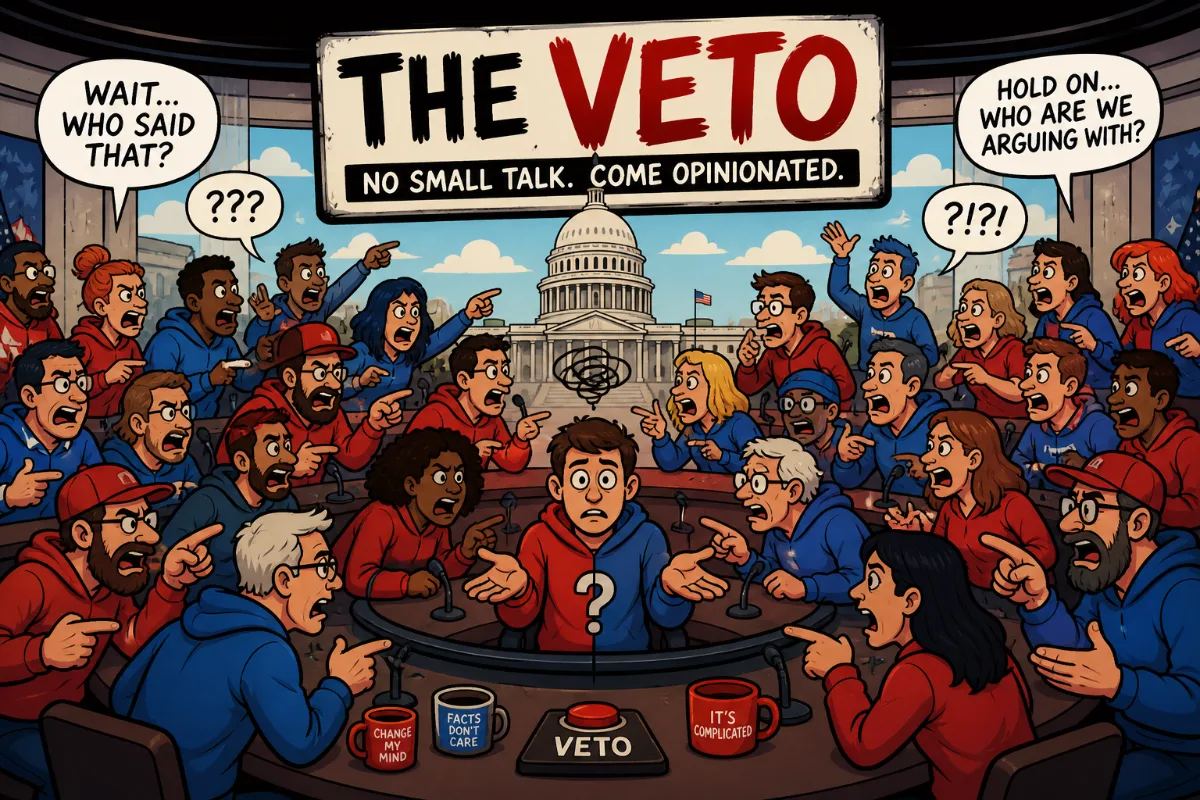
The Veto: Video Chat for People Tired of Arguing Into the Void
No small talk. Come opinionated.
That's the whole brief.
It's 2026. Everyone is arguing about politics online. Everyone has a take, a ratio, a screenshot, a thread. And somehow, despite all of it, nobody actually changes their mind. Nobody actually listens. The algorithm rewards the loudest version of a position, not the most honest one. You're not having a conversation — you're performing one for an audience that already agreed with you before you started.
The Veto is what political debate on the internet was supposed to be. One real person. Face to face. No audience to play to. No ratio. No reply guys. No "I can't believe you think that" from someone who stopped reading at the third word. Just a stranger who showed up for the same reason you did: to actually talk about it.
It's not a debate club. It's not a fight. It's a room where you show up with a point of view and find out what it's actually worth when someone who doesn't owe you agreement pushes back on it.
Think of it less like a chat and more like walking into a room where everyone already has something to say — and they're looking at you like, well?
That's The Veto. Open What's The Vibe, click it, and bring something worth saying.
What Is The Veto?
The Veto is a matching vibe on What's The Vibe. When you select it, you're matched 1-on-1 or in a group of up to four strangers who clicked the same thing. Same mechanics as every other vibe — except what you're opting into is completely different.
The name comes from a simple idea: some conversations deserve to be vetoed before they start. The weather. How busy work has been. The vague shape of someone's weekend. The Veto is where that stuff doesn't make it through the door.
What does: takes. Positions. Opinions you've been sitting on. Political views you can't fully say at work without it becoming A Thing. Disagreements you have with the conventional wisdom. Half-formed arguments you want to stress test on someone who has zero reason to agree with you.
The tagline — No small talk. Come opinionated. — is a filter, not just a descriptor. It's telling you exactly who belongs here and who doesn't. If you find small talk exhausting not because you're antisocial but because you know what a conversation can actually be, you belong here.
Why Online Political Debate Is Broken — And What The Veto Fixes
Let's be honest about how political argument works online in 2026.
You post a take. Your followers agree. Someone from the other side quote-tweets it with a dismissive one-liner. You clap back. They clap back. Fourteen people pile on from each direction. Nobody is reading what the other person actually wrote — they're reading for ammunition. The whole exchange generates heat and zero light, and both sides walk away more convinced than ever that the other side is irredeemably stupid.
This isn't an accident. It's how the platforms are designed. Outrage gets engagement. Engagement gets reach. The algorithm doesn't care whether anyone changed their mind — it cares whether anyone kept scrolling.
The Veto is the opposite environment. There's no audience. No performance incentive. No one keeping score of who dunked harder. Just you and one other person — or three — who came here specifically to have a real conversation about something that matters. You have to actually engage with what the other person said because there's literally nothing else happening.
That changes everything about how the conversation goes.
The Problem With Every Other Video Chat
Most random video chat has the same problem. Two people appear on screen. Someone says hi. The other person says hi. Someone asks where you're from. The other person answers and asks the same back. And then — nothing. The conversation has nowhere to go and everyone knows it.
The skip cycle kicks in. Back to the lobby. Repeat.
The issue isn't the people. It's the absence of any starting point. Two strangers with no shared context produce exactly the kind of conversation you'd expect: polite, brief, forgettable.
The Veto solves this before the call starts. Not with a game or a prompt — just with a vibe that filters for the right person. When you both clicked The Veto, you already know one thing about each other: you both have something to say and you're not interested in wasting the next ten minutes getting there slowly.
That shared expectation replaces "sooo where are you from" with an unspoken agreement: let's actually talk.
If you've scrolled through Omegle alternatives looking for somewhere that feels like a real conversation, this is the answer. Not because the technology is different. Because the people who click The Veto are different.
What The Veto Is Not
Worth being clear on this.
It's not a debate platform. No opening statements. No rebuttals. No judges. You don't need to be right. You don't even need to fully believe what you're saying — testing a half-formed position out loud is one of the most useful things you can do with it.
It's not a fight. People who show up to The Veto wanting to win aren't going to have a good time, because the best conversations here aren't won. They go somewhere. That's different.
It's not political only. Politics is the obvious home for it — because politics is where everyone has opinions they can't say freely — but The Veto is for any take that deserves more than a nod. Culture. Society. Ideas. The conventional wisdom on whatever you've been quietly disagreeing with for years.
The common thread is that you showed up with something. An angle. A thing you actually think. The Veto is where that gets to exist out loud.
What People Actually Talk About
There's no required topic. But The Veto conversations tend to orbit a recognizable set:
Politics — But Actually
Not the Twitter version of politics. The real version — where you have to finish your sentence, where the other person has to respond to what you actually said, where you can ask a follow-up question and get an answer instead of a meme.
Left vs. right. Local vs. federal. Policy vs. values. The stuff everyone has a position on and almost nobody gets to genuinely argue about with someone who disagrees. The Veto is that conversation, with none of the performance and all of the actual thinking.
The Political Opinion You Can't Say at Work
There's a version of your views that lives entirely in your head because saying it at the office would make things weird for months. A stranger on The Veto has no workplace, no HR department, no shared social graph with you. Zero cost to just say it.
This is one of the most common Veto use cases — not because people want to be incendiary, but because the social cost of honesty with people you know is genuinely high right now. A stranger with no skin in your life removes that cost entirely.
The Cultural Stuff Everyone Pretends to Agree On
Movies everyone calls masterpieces that don't hold up. Institutions everyone defends reflexively that nobody has actually examined. Trends everyone is performing enthusiasm for. The conventional wisdom on pretty much anything.
Social pressure produces a lot of false consensus. Everyone nods in the room and then says what they actually think in private. The Veto is the rare space where the private take becomes the public one.
Ideas You Want to Stress Test
There's a specific value to putting your argument in front of someone who has no investment in agreeing with you. Not a friend who'll be supportive. Not a critic who already decided you're wrong. Just a stranger who's going to respond to what you actually said.
1-on-1 Veto does this best. You hear what your argument sounds like when someone who's never heard it before pushes back on the parts that don't hold. That feedback is worth more than ten conversations where everyone agreed.
The Question Everyone Is Avoiding
Every era has questions that are technically allowed but socially discouraged — not because they're dangerous, just because they're uncomfortable. The Veto is for exactly those. The ones where the honest answer is more interesting than the safe one.
1-on-1 vs. Group of 4
Same platform. Very different experience.
1-on-1
This is the format if you want to actually get somewhere. One person. One conversation. The kind of back-and-forth where you can track a position evolving in real time. It's slower, more accountable — when there's nowhere else to look, both people have to actually engage with what the other person said.
The best 1-on-1 Veto conversations feel like the kind you have with someone you just met at a wedding — no shared baggage, suddenly talking about something real, mildly surprised that a stranger can challenge your thinking that effectively.
Group of 4
Noisier. Faster. More positions colliding at once. Someone stakes out a political take, someone else immediately disagrees, a third person has an angle neither of you considered, and the fourth is the one quietly keeping score. Group Veto is closer to a roundtable than a debate — better for broad questions where multiple perspectives actually change the shape of the answer.
The group vibe format on What's The Vibe was built for exactly this kind of collision. Rabbit Hole might be the deeper vibe — but group Veto is the louder one.
Why Strangers Are Actually Better for This Than Anyone You Know
Your friends mostly agree with you. Not because they're sycophants — because people tend to cluster around others who share their general worldview. Your social circle is a narrow slice of possible perspectives, and everyone in it has reasons to be careful about how honest they are with you.
A stranger from a different city, different background, different set of experiences, with no relationship to protect and no reason to soften their response — that person is going to tell you what they actually think. Not a calibrated version of it. Not the one that keeps things comfortable. The real one.
That's rare. Most people's political views never get challenged by anyone who takes them seriously enough to actually argue back.
The Veto on What's The Vibe makes it available to anyone willing to show up with something worth saying. Compare that to Twitter, where your take gets smashed against thousands of people and what comes back is noise, or Reddit, where you post today and get a response in three days when the moment is long gone. The Veto gives you one real person, in real time, who has to actually engage with what you said.
If you want to see how that fits in the broader landscape, the comparison of WTV against Omegle, OmeTV, and Monkey makes the vibe system's role clear. It's not just a filter — it's a contract between two people about the kind of conversation they're both showing up for.
How to Get the Most Out of The Veto
Come in with something specific. Not "I want to talk about politics" — that's too wide to go anywhere. Something like: I think [specific policy/position/institution] is actually wrong, and here's why. Or: I've changed my mind on [specific thing] and I'm not sure I'm right. Or: here's the take I can't say at work.
The more specific, the better. Broad positions produce the same surface-level exchange everyone has already heard. Specific takes produce actual conversations — the kind where someone says something that makes you pause.
Don't come to win. Come to find out if your position holds up when someone who has no reason to coddle you argues with it. You might leave with the same view, better argued. You might leave with something that shifted. Either outcome is more useful than a conversation where everyone nodded.
And if the match isn't clicking — skip. Unlike the platform's conversation games like Virtual Court and Who Dis?, which have enough structure to carry an awkward match, The Veto needs both people to actually show up with something. When one person didn't, there's nothing to argue about. That's not a failure — it's just a mismatch. Next match.
The Type of Person Who Clicks The Veto
Not everyone. That's the point.
- You have political opinions you can't fully say out loud without it costing you something at work or at home
- You find it genuinely interesting when someone disagrees with you well — not annoying, actually interesting
- You've changed your mind on something significant and you remember the specific conversation that did it
- You think most online political debate is either too polite to be honest or too loud to be useful
- You want someone to push back — not someone who'll agree to keep things comfortable
- You've typed a take, looked at it, and deleted it because the room wasn't ready for it If that's you, The Veto was built for you. And the person on the other side clicked it for the same reasons.
No small talk.
Come opinionated.
Frequently asked questions
Is this just for political debates?
Politics is the obvious use case because that's where everyone has the most pent-up opinions they can't say freely. But The Veto is for any topic with real disagreement — culture, society, ideas, hot takes of any kind.
Is this going to turn into an argument?
It might. That's not automatically bad. A real disagreement where both people are genuinely engaging is one of the more useful conversations you can have. What The Veto filters out is the fake argument — where both sides are performing for an audience instead of actually thinking.
Can I use The Veto in a group?
Yes — up to four strangers, same vibe. Group is noisier and faster, better for broad questions with multiple angles. 1-on-1 is better if you want to actually trace a specific position somewhere.
What if I don't have a topic ready?
Show up and say that. "I don't have a take but I'm ready to argue with yours" is a completely valid Veto opener. Someone in the room will have something.
How is this different from political subreddits or Twitter?
Real-time. Face to face. No audience. No algorithm rewarding the loudest take. No one performing for engagement. Just you and one person who has no reason to be polite about whether your argument actually holds up.
Try it yourself
Start a vibe-matched video chat on What's The Vibe — free, no sign-up.