Why You're More Honest With Strangers Than People You Know
Science says you open up more with strangers than friends. Here's why — and why a game like Walking Red Flag gets to the truth faster than therapy.
By Mark Gjura ·
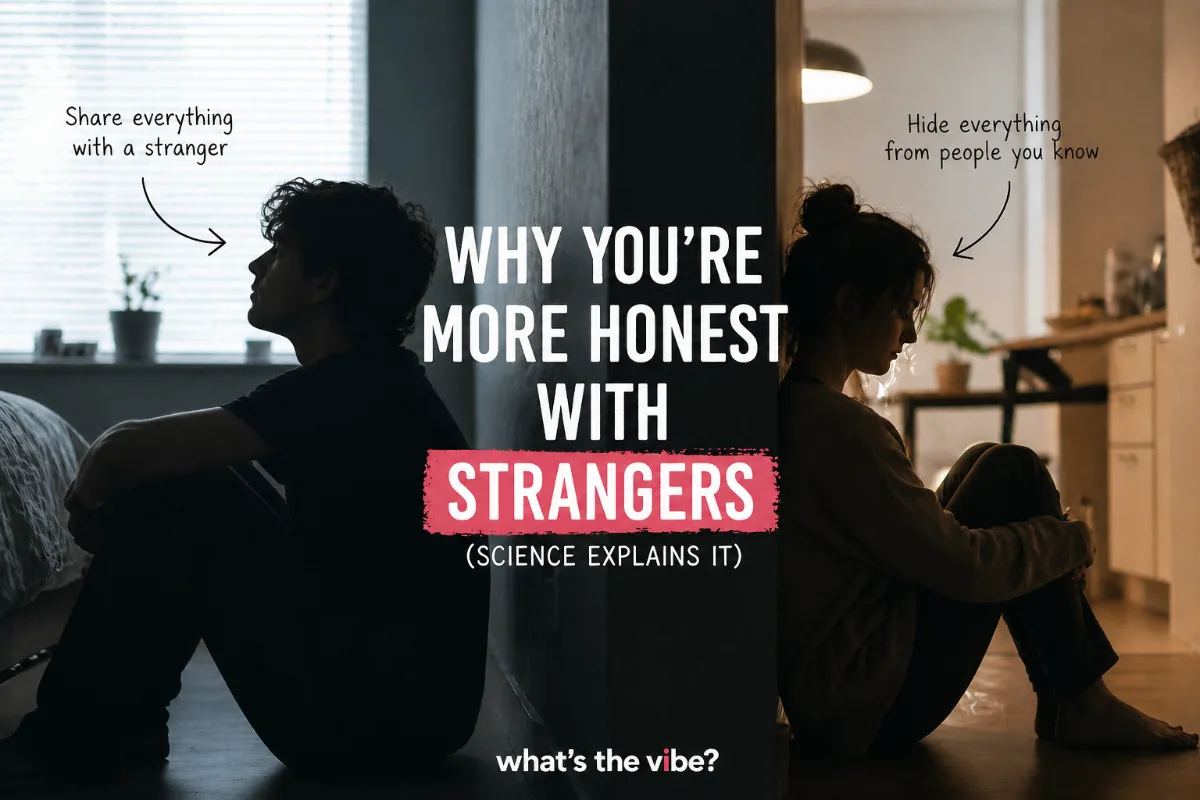
You Tell Strangers the Truth. Science Knows Why.
Most people are more honest with someone they just met than with people they've known for years.
That's not a personality flaw. It's well-documented psychology — and it's the reason a five-minute conversation with the right stranger can hit different than a year of small talk with people you see every day.
---
What the Research Actually Says
In 2018, researchers from Cornell, Harvard, and Yale published a study in Psychological Science on what they called the "liking gap." After conversations between strangers, people consistently underestimated how much the other person liked them and enjoyed talking to them. Every time. Whether the conversation was two minutes or forty-five.
You think it was awkward. They thought you were interesting.
There's also a documented phenomenon called the online disinhibition effect — the consistent finding that people self-disclose more openly in low-stakes, low-consequence contexts. A meta-analysis across fourteen studies confirmed that anonymity has a statistically significant positive correlation with how honestly people talk. Less social consequence means more real conversation.
Psychologist Noam Shpancer noted in Psychology Today that encounters with strangers tend to be low-conflict by nature, which pulls out more genuine behavior from both sides. Your friends carry your history. A stranger doesn't. And that changes what you're willing to say.
---
Why That Matters for Random Video Chat
The format of most random video chat is two people, a camera, and nothing to do. No shared context. No reason to stay. The skip button is right there and using it costs nothing.
But the research says people actually enjoy talking to strangers more than they expect to. The problem isn't the stranger. It's the empty space between them.
Give people something to react to and the conversation starts itself. The honesty comes out faster. The liking gap closes before either person decides it isn't worth it.
That's the idea behind Walking Red Flag on What's The Vibe.
---
What Walking Red Flag Actually Does
It's not an icebreaker. It's a prompt game built to skip the part where you're both performing and get straight to something real.
Questions like:
Every single ex of theirs was "the crazy one." Do you believe it?
Have you ever lied about your body count? The number versus the real one.
They want to know your location 24/7 "for safety" — protective or possessive?
What's your most toxic trait in a relationship?
They Venmo request $4.99 after sending you a nude — entrepreneurial or unacceptable?
Nobody answers those on autopilot. Nobody hides. You get a real take from a real person in the first thirty seconds — and more often than not, you learn something about yourself in the process of answering.
That's the part that doesn't get said enough. A good prompt doesn't just reveal who the other person is. It makes you think about where you actually stand on something you've never had to say out loud before.
---
Two Strangers, No History, No Filter
Your friends already know your answers. Or they think they do. Which means you perform for them in ways you don't even notice.
A stranger has no expectations. No shared history. Nothing to cross-reference your answer against. That's what makes the conversation honest — and sometimes more revealing than you expected.
The research backs it. The prompts accelerate it. What's The Vibe is built around it.
Pick a vibe. Play the game. See what comes out when there's nothing to protect.
---
Related: Why most Omegle alternatives feel exactly the same
---
Keep Reading
If this resonated, these go deeper:
- Why strangers always disconnect first — the closed-gate problem behind most dead conversations
- Group video chat with strangers — why three or four people beats one-on-one
- Is random video chat safe? — an honest 2026 safety guide
- How to make friends online as an adult — rebuilding the conditions friendship needs
- Chatroulette vs Omegle — what both pioneers proved, and what killed them
Try it yourself
Start a vibe-matched video chat on What's The Vibe — free, no sign-up.
Related reading
- Is Random Video Chat Safe? An Honest 2026 Guide
- Is the Monkey App Safe? An Honest 2026 Breakdown
- The Dead Internet Field Guide: Verify Real Humans Online
- Uhmegle Alternative in 2026: Honest Look at the Omegle Clone
- Chatroulette vs Omegle: What Happened to Both (2026)
- How to Make Friends Online as an Adult (2026 Guide)