Random Chat Rebuilt for Mobile | What's The Vibe
Most Omegle alternatives suck on mobile. We rebuilt the whole thing from scratch. Better layout, faster matching, actually works on phones. See what changed.
By Mark Gjura ·
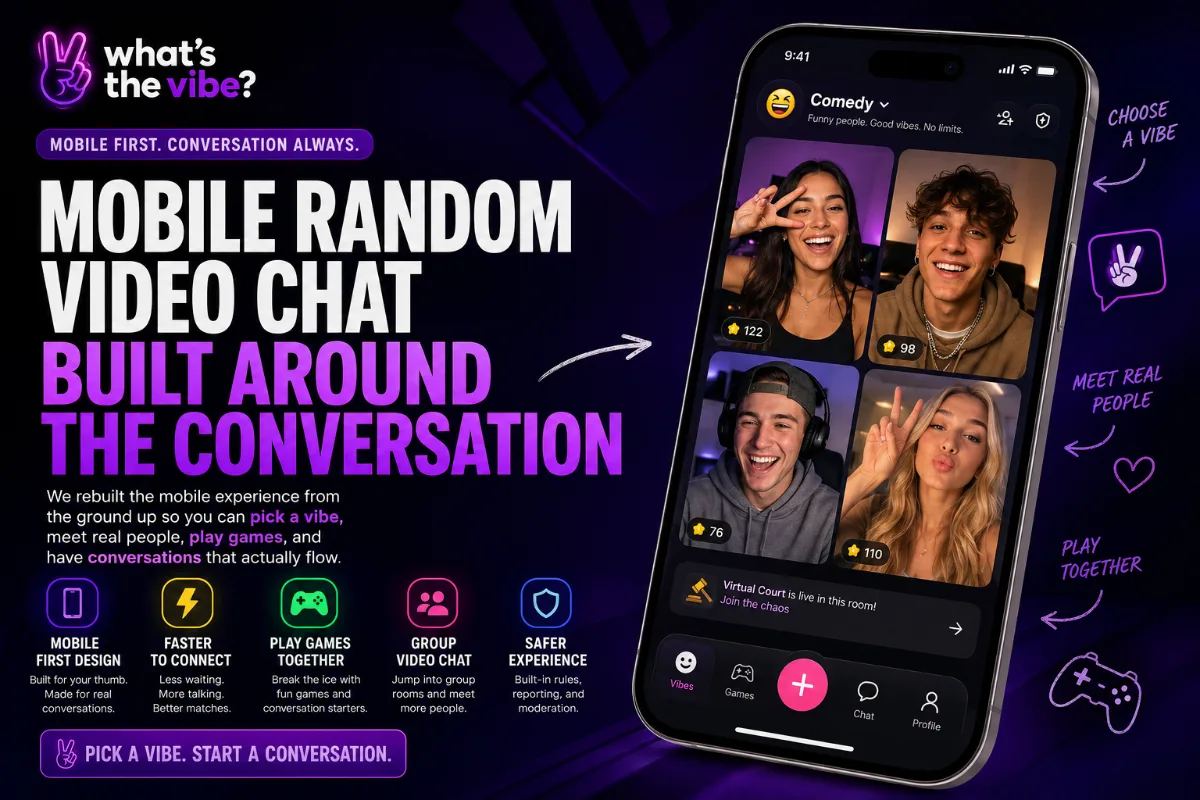
We Rebuilt Random Video Chat for Mobile. This Is What Changed (and Why It Matters)
Most random video chat sites were built for a different internet.
Omegle, Chatroulette, and the first wave of webcam platforms were desktop experiences. You sat at a computer, clicked a button, and waited to see who appeared. It was simple, chaotic, and built for a screen with space.
Then the internet moved to phones.
The problem is that most random video chat platforms did not actually rebuild for mobile. They just squeezed the desktop experience into a smaller screen and called it responsive.
That is why random video chat on mobile often feels broken.
Not because the camera does not work. Not because the call cannot connect. It feels broken because the experience was not designed for how people actually hold, tap, watch, react, and talk on a phone.
What's The Vibe rebuilt its mobile layout around one simple idea: the video is the conversation. Everything else should serve it.
This update was not about making buttons look nicer. It was about making mobile random video chat feel natural again.
- A better phone layout.
- Clearer video space.
- Faster vibe selection.
- Easier one-on-one calls.
- Cleaner group video chat.
- Better prompts for games and conversations.
- Less friction between wanting to talk and actually talking.
Because on mobile, every extra tap matters.
Why Random Video Chat Completely Failed on Mobile
Random video chat started as a desktop idea.
That worked when people were sitting at laptops with webcams, keyboards, and big screens. The interface could be rough because there was enough room to hide the roughness.
Mobile changed the rules.
On a phone, there is no extra space. The screen is the experience. If the navigation blocks the video, the conversation feels worse. If the buttons are hard to reach, the call feels awkward. If the prompts are too small, the game dies. If the layout makes it hard to see the other person, the human part disappears.
That is the real issue with a lot of Omegle alternatives on mobile.
They technically work, but they do not feel built for the device people are actually using.
A mobile random video chat app needs to answer different questions:
- Can I start talking fast?
- Can I see the other person clearly?
- Can I use the controls with one hand?
- Can I understand the vibe before I match?
- Can I play a game without the screen feeling crowded?
- Can I move to the next conversation without getting lost?
That is what What's The Vibe focused on.
Mobile Is Not a Smaller Desktop (And That's the Whole Problem)
A phone is not just a tiny laptop.
People use phones differently. They hold them with one hand. They tap with their thumb. They open apps while sitting on the couch, waiting in a car, walking around, lying in bed, or killing time late at night.
That matters for video chat.
Desktop video chat can afford clutter. Mobile video chat cannot.
On mobile, bad layout becomes emotional friction. The user is not thinking, "This interface has poor hierarchy." They are thinking, "This feels annoying," and then they leave.
So the redesign focused on the parts that actually matter in a live conversation:
- the face,
- the controls,
- the selected vibe,
- the prompt,
- the next action.
Everything else had to get out of the way.
What Actually Changed: The Mobile Layout Rebuild
The new mobile layout was built around live conversation, not around old website rules.
1. The Video Comes First (Everything Else Serves It)
In random video chat, the video is not a feature. It is the whole point.
If the person's face is hidden, squeezed, covered, or surrounded by clutter, the conversation loses energy before it even starts.
The updated mobile layout gives the video more breathing room so the person on the other side feels present. That matters more than people realize. Random video chat works when the interaction feels immediate and human.
You should not feel like you are fighting the page to talk to someone.
You should feel like the app disappears once the conversation starts.
2. Bottom Navigation Makes Sense on a Phone (Top Nav Doesn't)
Old desktop-style layouts put important navigation at the top.
That makes sense with a mouse. It does not make sense with a thumb.
On mobile, your thumb naturally lives near the bottom of the screen. That is where the main actions should be. Moving key controls into a more thumb-friendly flow makes the app feel faster because the user does not have to stretch, reach, or think.
This is one of those details that sounds small until you use it.
In live video chat, tiny interruptions matter. If muting, leaving, switching, or moving forward feels awkward, it breaks the rhythm of the conversation.
The new layout keeps the experience closer to how people actually use phones.
3. Vibe Selection Happens Before the Match (No More Awkward Silences)
Pure random chat has always had the same problem: nobody knows why the other person is there.
One person wants to joke.
One person wants to flirt.
One person wants to debate.
One person wants music.
One person wants weird theories.
One person is just bored.
That mismatch is why a lot of random video chat turns awkward fast.
What's The Vibe fixes that by making users choose the energy first.
Before jumping into a conversation, users can pick a vibe like:
Comedy — jokes, funny people, and chaotic conversations.
Roast Roulette — people who can take a joke and fire back.
Rabbit Hole — conspiracies, weird theories, and late-night "hear me out" conversations.
Second Opinion — honest feedback from strangers.
Music — songs, artists, taste, and hot takes.
The Veto — debates, opinions, and arguments that actually have a topic.
This makes mobile random video chat feel less aimless.
You are still meeting strangers, but now there is context.
That is the difference between random and pointless.
4. One-on-One Video Chat Feels Cleaner
One-on-one random video chat has to be simple.
There are only two people. The layout should not make that complicated.
The mobile update improves the way the user and participant views are arranged so the conversation feels more natural. The other person should be the focus. Your own view should be available without taking over the screen.
That sounds obvious, but a lot of mobile video chat layouts get this wrong.
The goal is not to create a busy dashboard. The goal is to make two strangers feel like they are actually talking.
5. Group Video Chat Gets a 2×2 Grid (Spatial Awareness Matters)
Group video chat is different from one-on-one.
In a group, reactions matter. Who laughed matters. Who is waiting to talk matters. Who looks confused matters. The social energy is part of the experience.
That is why the mobile group layout matters so much.
A clean grid makes it easier to understand the room at a glance. Instead of feeling like a stack of random video boxes, the group starts to feel like a shared space.
For What's The Vibe, this is especially important because group conversations are not just open rooms. They can become debates, games, hot takes, or live reactions.
If users cannot see the room, they cannot feel the room.
Optional Games Make Random Video Chat Less Awkward
Random video chat is exciting because anything can happen.
But that is also the problem.
Sometimes two people match and there is no spark. Nobody knows what to say. The conversation starts with "what's up," dies in ten seconds, and both people skip.
What's The Vibe adds optional games and formats so users have something to do together.
The games are not the whole point of the app. The conversation is the point.
The games are there when the conversation needs a reason to keep going.
Who Dis? — gives users a fast guessing game built for live reactions.
Virtual Court — turns ridiculous accusations into funny arguments.
Walking Red Flag — turns dating opinions and social behavior into a judgment game.
Around the Vibe — brings group debate energy into video chat.
This is what makes What's The Vibe different from a normal Omegle alternative.
It is still random video chat, but it gives the randomness structure.
That structure matters even more on mobile, where users decide quickly whether something is worth staying for.
Why Prompts Had to Be Completely Redesigned for Mobile
Conversation prompts sound simple until you try to show them during a live video call on a phone.
The screen is already doing a lot.
It has to show the person.
It has to show your own camera.
It has to show controls.
It has to show the current vibe or game.
It has to show what the user is supposed to do next.
If the prompt is too large, it blocks the conversation.
If it is too small, nobody reads it.
If it is in the wrong place, the user misses it.
If the rules are too long, the game loses momentum.
The mobile update made prompts easier to scan while keeping the video experience clear.
That is the balance.
Structure should help the conversation, not crowd it.
Built for Mobile Browser, Not Just an App Store Download
A lot of people searching for random video chat do not want to download something right away.
They want to open the site, see what it is, and start.
That is why mobile browser matters.
What's The Vibe is built as a mobile-friendly web experience so users can visit from their phone browser and understand the app quickly. That is important for people searching terms like:
- mobile random video chat
- random video chat app
- Omegle alternative mobile
- talk to strangers on mobile
- video chat with strangers
- Monkey app alternative
- OmeTV alternative
- random video chat games
- group video chat with strangers The goal is simple: make the first mobile visit feel like the product was actually built for the phone in your hand.
Not like a desktop website pretending to be mobile.
See how WTV stacks up against other Omegle alternatives →
Why This Matters for the Future of Random Video Chat
The old version of random video chat was built around novelty.
Click. Match. Skip. Repeat.
That was enough when the internet was younger and seeing a stranger on webcam felt new by itself.
But novelty wears off.
The future of random video chat needs more than a camera and a skip button. It needs:
- Better reasons for people to stay
- Better ways to match energy
- Better structure when the conversation gets quiet
- Better mobile design because that is where people actually are What's The Vibe is built around that shift.
It is not trying to remove the chaos that made random video chat fun. It is trying to give that chaos a direction.
Pick a vibe.
Meet someone live.
Talk, debate, laugh, play, or skip.
But at least know what kind of energy you are walking into.
That is what random video chat should feel like on mobile.
A Better Omegle Alternative for Mobile
Omegle proved that strangers on the internet could create unforgettable moments.
But the internet changed.
People now expect:
- Cleaner design
- Faster flows
- Safer experiences
- Better mobile layouts
- More control over the type of interaction they are entering What's The Vibe takes the best part of random video chat — the unpredictable human moment — and rebuilds the experience around mobile users.
It is for people who want something more alive than scrolling.
For people who want to talk to strangers without the conversation being completely pointless.
For people who want comedy, debates, music, weird theories, second opinions, group energy, and games that actually give the chat a reason to exist.
Random video chat did not die when Omegle shut down.
It just needed to evolve.
What's The Vibe is building that next version for mobile.
Ready to Try It?
Pick a Vibe. Start Talking. See Where It Goes →
Keep Reading
If this resonated, these go deeper:
- Why strangers always disconnect first — the closed-gate problem behind most dead conversations
- Group video chat with strangers — why three or four people beats one-on-one
- Is random video chat safe? — an honest 2026 safety guide
- How to make friends online as an adult — rebuilding the conditions friendship needs
- Chatroulette vs Omegle — what both pioneers proved, and what killed them
Frequently asked questions
Is What's The Vibe mobile-friendly?
Yes. What's The Vibe is designed for mobile random video chat, with a phone-friendly layout, vibe selection, one-on-one video chat, group video rooms, optional games, and a faster flow from matching to conversation.
How is What's The Vibe different from Omegle?
Omegle was mostly random. What's The Vibe lets users choose the type of conversation they want before matching. Users can pick vibes like Comedy, Roast Roulette, Rabbit Hole, Second Opinion, Music, or The Veto.
Can I use What's The Vibe on my phone?
Yes. What's The Vibe works as a mobile-friendly web app, so users can open it from a phone browser and start exploring live video conversations.
Is What's The Vibe just a random video chat app?
What's The Vibe is random video chat with more structure. Users can talk freely, join group conversations, or use optional games and prompts to make conversations less awkward and more entertaining.
What kind of conversations can I have on What's The Vibe?
Users can have funny conversations, debates, music discussions, second opinions, weird late-night theories, roast battles, group chats, and game-based conversations with strangers.
Is What's The Vibe an Omegle alternative?
Yes. What's The Vibe can be used as an Omegle alternative for people who want mobile random video chat with more direction, better conversation structure, and vibe-based matching.
Try it yourself
Start a vibe-matched video chat on What's The Vibe — free, no sign-up.