Music Video Chat | Play Live for Strangers Online
The Music vibe on What's The Vibe is where you get matched with a stranger and someone starts playing. One-on-one or group. No stage. No audition. Just the moment.
By Mark Gjura ·
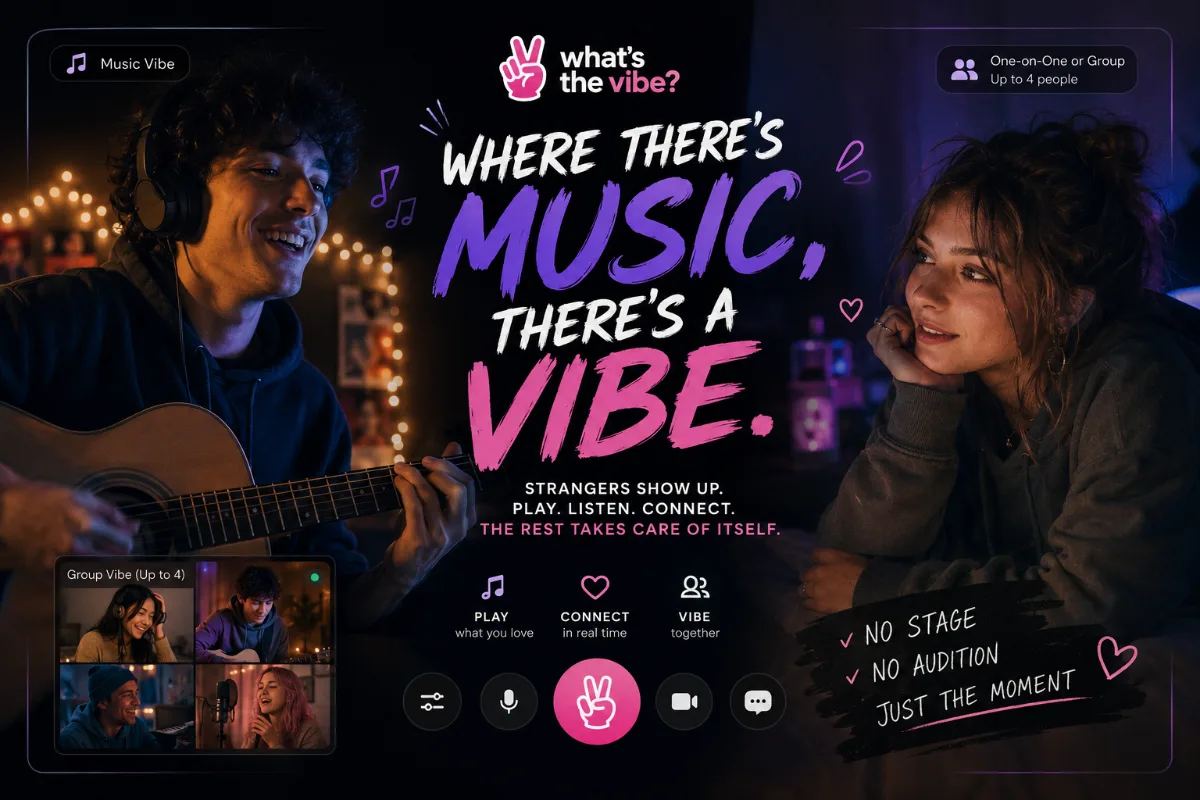
Where There's Music, There's a Vibe. The Rest Takes Care of Itself.
You don't need a stage. You don't need an audience. You just need to start playing.
There's a moment everyone who grew up on random video chat remembers.
Not the weird ones. Not the blank stares and instant skips.
The moment someone on the other side just — started playing.
No warning. No "hey I play guitar." No context. They just picked up an instrument, or leaned into a mic, or started beatboxing, or sang something completely unironically at a stranger through a laptop camera — and suddenly the whole experience changed.
The skip button disappeared from your mind. You forgot you were talking to someone you'd never met. For a few minutes, there was just the music, and two people in completely different places sharing the same room.
That's the oldest magic in random video chat. And it's the one nobody built an actual home for.
Until the Music vibe.
Why Music Does Something No Other Vibe Can
Music doesn't need an introduction. It doesn't need a conversation starter. It doesn't need anyone to break the ice.
It is the ice breaking.
Research from the University of Oslo's RITMO Centre — one of the world's leading music science research centers — found that live music compelled audience members to synchronize their breathing and movement, creating a collective stillness that reflected a profound shared emotional experience. The lead researcher described concerts as creating bonds among strangers, noting: "As social creatures, this likely explains why concerts are so popular."
That finding was from an orchestra study. But the same principle holds in a video chat window at midnight with someone you've never met and will probably never see again.
According to research from Frontiers in Psychology, as adults move synchronously to the beat of music, they remember more about each other and have greater levels of trust, cooperation, and fondness than after moving asynchronously.
Think about what that means for a random video chat. Two strangers. One starts playing. The other starts nodding, or tapping, or just listening with the kind of attention they don't give to much else. Something biological kicks in. Trust forms faster than it has any right to between people who don't know each other's names.
That's not platform design. That's music doing what music has always done.
When individuals who've never met discover their voices or instruments complement each other, audiences witness something authentically spontaneous — genuine realness that creates emotional reactions because viewers recognize they're observing a singular occasion that cannot be precisely recreated.
The Music vibe is built to create the conditions for exactly that.
The Nostalgia Is Real
Ask anyone who spent time on Chatroulette or Omegle in their peak years what they actually remember.
Not the weirdness. Not the skips. Not the blank faces.
They remember the musicians.
The person who was clearly mid-session, headphones half on, who looked up at the camera like they'd been caught and then just kept playing anyway. The bedroom producer walking someone through a beat they'd been working on for three days. The kid who could play anything by ear and kept asking chat after chat to name a song. The person who sang something they'd written and looked genuinely terrified the entire time.
Those moments stuck. Because they were real in a way nothing else on those platforms was.
When unfamiliar people connect through music, audiences experience vicarious relief from online disconnection — a powerful reminder that real interpersonal engagement is still achievable.
The Music vibe on What's The Vibe is built for the people who were always on the other side of those moments — the ones who kept clicking "next" hoping for something worth staying for.
And the ones who were playing.
One-on-One vs. Group: Two Completely Different Rooms
The Music vibe runs in two modes. They're not the same experience. Both are worth understanding.
One-on-One
This is the most intimate version of the vibe.
One person. One stranger. Someone starts playing.
There's nowhere to hide and nothing to hide behind. If you're playing, the other person sees everything — the way you look when you're lost in it, the moment you decide to take the song somewhere unexpected, the instinct to make eye contact through a camera with someone you've never met.
And if you're watching, there's nowhere to look away. It's just you and whoever decided to show up and play. No crowd. No comments section. No algorithm deciding whether to amplify it.
Just the oldest version of a performance there is — one person playing for one other person who's actually paying attention.
When artists mess up, laugh, or stretch a moment just a little longer, it reminds you they're right there with you, in this moment, too. That back-and-forth creates a feedback loop, turning a performance into an experience.
That feedback loop exists in the Music vibe one-on-one in a way it can't on a stage or in a comment section. The person watching is right there. You can see them react in real time. That changes how you play.
Group Vibe — Up to 4 People
This one is different energy entirely.
When there's music and four strangers in the same room, something shifts. Suddenly there's an audience with opinions. Someone might join in. Someone might try to one-up. Someone might just vibe so hard the whole room feels it.
The energy of a crowd can be contagious, amplifying emotions and reactions. When everyone around you is moving or engaged, it's hard not to get caught up in the moment — and it can actually influence perception of the music itself, making it sound better or more enjoyable.
In a group Music vibe that's four people, that contagion happens fast. Someone starts playing. Two people start nodding. One person pulls out their own instrument. Nobody planned any of it.
That's the group vibe. It's not a concert and it's not a jam session. It's something between the two that only exists because four strangers decided to end up in the same room.
The Full Spectrum: Who Actually Shows Up
The Music vibe isn't a talent show. That's the first thing to understand.
There's no audition. There's no score. Nobody's watching with a paddle.
What shows up in the Music vibe is a full spectrum of human relationship with music — and all of it is valid, and almost all of it is interesting.
The ones who genuinely rip. They picked up the instrument years ago and never stopped. They're not performing. They're just playing. Those sessions hit different because there's nothing performative about them — the skill is just there, effortlessly.
The ones who think they rip. This is arguably the better entertainment. The gap between self-perception and reality in a live video chat is a beautiful and humbling thing. No shame in it — the confidence alone is worth watching.
The ones who are mid-process. Learning something. Working through a section that isn't coming together yet. Sharing the messy middle of getting good at something. Those sessions are often the most human.
The ones who haven't played in years. They see the Music vibe and something pulls them. They find the guitar under the bed. They're rusty. They go anyway.
The ones who show up just to listen. Also a valid entry. The Music vibe needs an audience as much as it needs players. If you're the person who sits across from someone playing and actually listens — not skipping, not half-present, actually there — you're doing something rarer than most people realize.
All of it is the vibe. That's the whole point.
Why "Wherever There's Music, There's a Vibe" Is Actually True
Shared experiences are one of the strongest ways to build relationships, and few experiences are as communal as listening to or making music together. Even strangers at a concert can find a sense of unity as they sing, dance, and revel in the soundscape together.
This is why the Music vibe doesn't need rules or prompts or conversation starters.
The music is the conversation starter. The music is the structure. The music is the reason to stay past the first ten seconds.
Heineken's research found that while 77% of music fans have connected with someone at a live event, those interactions rarely last beyond the moment. The Music vibe on What's The Vibe is trying to solve for exactly that — the fleeting musical connection that actually goes somewhere because the platform gives it a place to land.
Every platform in this space is built around the same interaction loop: you appear, you say something, you decide whether to skip. That loop has been failing people since Omegle invented it. The Music vibe breaks it at the foundation. You don't need to say anything. The music does the talking. And suddenly the skip button is the last thing on anyone's mind.
What the Music Vibe Is Not
It's not a performance platform. If you want to stream to an audience, there are tools for that — Twitch, YouTube Live, TikTok. Those are broadcast platforms. The Music vibe is not.
It's not a talent competition. Nobody rates you. Nobody puts a number on it. The only metric is whether both people in the room feel something. That's unquantifiable and that's the point.
It's not background noise. If you're going to pick the Music vibe and then half-engage, you're in the wrong room. The one-on-one format in particular doesn't work if one person isn't present. The person playing knows. It changes the whole thing.
It's not what other random video chat platforms do when they slap a music category on a filter dropdown and call it a feature. The Music vibe is a frame. A shared intent. Two or four people who showed up for the same thing, even if they'll never agree on what that thing is.
The Moments That Only Happen Here
Some things can only happen in the Music vibe. They can't be manufactured. They can't be scheduled. They can only happen when a stranger and a screen and an instrument are in the same place at the same time.
The session that starts as background noise and turns into the best forty minutes of someone's week. The person who asks "can you play something sad?" and means it. The stranger who sings harmony to something you're playing without saying a word beforehand. The moment both people realize they know the same obscure song and neither of them can explain how. The player who's clearly nervous and keeps going anyway and gets better in real time because someone is watching.
None of those moments happen on platforms where the interaction is built around skipping. They happen when there's a reason to stay. Music is that reason.
Who the Music Vibe Is For
Anyone who has ever:
- Played an instrument alone and wondered what it would feel like if someone was actually listening
- Been on the other side of one of those old Chatroulette music moments and felt it
- Wanted to share something they're working on without the weight of a real audience
- Needed music to be the first word instead of a conversation they have to warm up to
- Wanted to find out what four strangers in a group room do when someone starts playing That's a wide net. Intentionally.
The Music vibe doesn't require a skill level or a genre or a specific instrument. It requires showing up. The rest happens or it doesn't — and either way, something real passed between two people who didn't know each other five minutes ago.
That's the vibe.
Pick it up. Someone's already waiting.
*The Music vibe is live on What's The Vibe — one-on-one and group. *
Sources:
- Live Music Connects People Emotionally and Physically — Earth.com / RITMO Centre, University of Oslo
- The Concert Experience: How We Form Connections Through Live Music — The Maneater / Frontiers in Psychology
- The Psychology of Shared Songs: Turning Strangers Into Tribes — Inverse
- Duet Performance Goes Viral: When Strangers Created Magic Together — Skillup to Scaleup
- Why Live Music Feels So Powerful — Concerts and Tickets
- Concert Psychology: The Science Behind Live Music Experiences — Neurolaunch
- Heineken Helps Strangers Connect Through Music — LBB Online
- How Music Builds Connections and Unites Us — MDLBEAST
Frequently asked questions
What is the Music vibe on What's The Vibe?
The Music vibe is a random video chat mode where you get matched with a stranger in a shared musical context — either one-on-one or in a group of up to four people. Someone starts playing or performing, and the vibe takes it from there.
Do I have to be a good musician to use the Music vibe?
No. The Music vibe has no skill requirement. What it requires is showing up — whether that means playing, singing, listening, or just being present when someone else does.
What's the difference between one-on-one and group in the Music vibe?
One-on-one is intimate — one player, one listener, full presence from both sides. Group is up to four people, which changes the energy completely. More voices, more reactions, more chance for something spontaneous to happen between multiple strangers.
What instruments or formats work on the Music vibe?
Anything that comes through a microphone. Guitar, piano, voice, beatboxing, production, humming something you wrote at 2am. The format doesn't matter. The presence does.
Is this like other random video chat platforms with music filters?
No. Most platforms add music as a tag or filter — it means nothing about what the interaction will actually be. The Music vibe is a frame that both people opted into, which means both people showed up for the same reason.
Is What's The Vibe like Omegle?
What's The Vibe is random video chat built differently. Vibes like Music give the interaction a shared purpose before it starts, so something actually happens instead of two people deciding whether to skip each other.
Try it yourself
Start a vibe-matched video chat on What's The Vibe — free, no sign-up.