Talk to Strangers About Current Events | What's The Vibe
Talk to strangers about current events, politics, and culture on The Veto — random video chat built for people with something real to say.
By Mark Gjura ·
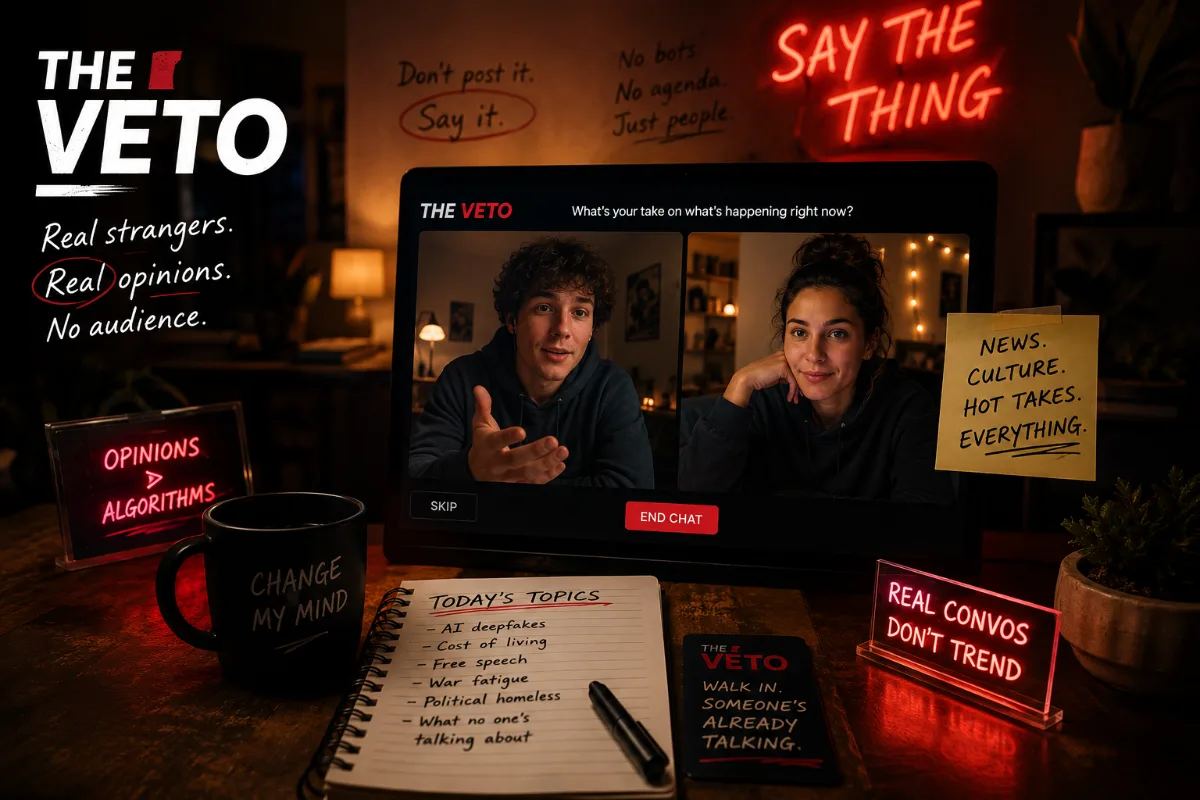
There's No Place You Can Just Walk In and Find Someone Mid-Opinion. Until Now.
The Veto isn't a debate platform. It's a door. You walk in. Someone's already talking.
Think about the last time something happened — in the news, in culture, in the world — and you just needed to talk about it with someone who wasn't already in your head.
Not post about it. Not text a friend who already knows exactly what you think. Not scroll through a comment section where everyone is performing for an audience.
Just talk. With someone real. Someone you haven't already sorted into a category.
That place doesn't really exist online.
There's no bar you can walk into at 9pm and find someone mid-thought about what happened today, someone who doesn't know you, who has no reason to manage your feelings about it, who just has their own take and is willing to share it.
The Veto is that place.
It's a video chat vibe on What's The Vibe where you get matched with a stranger who showed up the same way you did — with something on their mind about what's happening in the world right now. No agenda. No structure. No side you're supposed to be on. Just a real person, a real opinion, and a real conversation.
The Portal That Didn't Exist
Every other way of engaging with opinions online has a catch.
Social media requires an audience. You're not talking to someone — you're broadcasting at everyone, hoping the right person happens to catch it. The conversation, if it happens at all, is a byproduct of the performance.
Group chats and forums self-select. Everyone in them already knows roughly where everyone else lands. The range of perspectives is narrower than it looks.
News comment sections are chaos. The signal-to-noise ratio makes any real exchange almost impossible.
What's been missing is simple: a portal. Something you can step through and find yourself face-to-face with someone who walked in from the other side — carrying their own read on what's happening, ready to actually talk about it.
The Veto is that portal.
You don't need an account with a history. You don't need a following. You don't need to have the right take. You just need to have a take — and be willing to hear one back.
What "Right Now" Actually Means
The Veto isn't a politics channel. It's not a current events quiz. It doesn't care whether you're talking about something that broke this morning or something that's been slowly bothering you for months.
"What's happening" is whatever feels alive to you right now.
| What It Could Be | Why It Works on The Veto |
|---|---|
| Something in the news today | Fresh, unprocessed, no consensus yet |
| A cultural shift you've been watching | Takes time to form an opinion — worth saying out loud |
| Something at work or in your city | Hyper-local, real, rarely gets airtime |
| A trend you can't decide how you feel about | The stranger might help you figure it out |
| Something that happened to you that felt like it meant something bigger | Personal and universal at the same time |
The conversation doesn't have to be Important with a capital I. It just has to be real.
The Goal Isn't to Change Anyone's Mind
Let's be honest about what a four-minute conversation with a stranger can and can't do.
It probably won't change your mind. It probably won't change theirs. That's fine. That was never the point.
The point is something simpler and more honest:
To say the thing you actually think to a real person who didn't already know you were going to say it. To hear something back you weren't expecting. To leave the conversation having actually been somewhere — instead of having just generated noise.
Being heard is underrated. Getting perspective from someone outside your usual orbit is underrated. Being present in a conversation instead of managing one is underrated.
The Veto doesn't promise agreement. It promises contact.
Why It Has to Be Video
Text flattens everything.
Conviction reads as aggression. Uncertainty reads as weakness. Humor reads as sincerity. And the person on the other end fills in all the gaps with whatever they already assumed about someone who holds that opinion.
Video gives you back the signals that make a conversation feel like a conversation: tone, hesitation, the look on someone's face when something lands, the pause that means okay, I hadn't thought about it that way.
None of that survives in a comment section. All of it shows up in a video chat.
The Veto is built around the idea that opinions aren't just content — they're conversation. And conversation needs a face.
What Happens When You Match
You get matched with a stranger who also picked The Veto. That's all you know about them going in.
They have something on their mind. So do you. One of you starts.
Maybe you agree. Maybe you don't. Maybe the conversation goes somewhere neither of you expected. Maybe it ends in two minutes because it just doesn't click, and that's fine too — skip exists.
But more often than not, something happens. Because the frame is already there. You both showed up for the same reason. That shared intent does more work than people expect.
It's the difference between walking into a random chat with no direction and walking into a room where the conversation is already warm.
Conversation Starters for The Veto
If you need a spark to get going:
| Prompt | Why It Works |
|---|---|
| What's something happening right now that nobody's talking about right | Immediately surfaces something real |
| What's the take you keep almost posting but don't? | Gets to the honest opinion fast |
| What's something your own side gets wrong? | Cuts through performance immediately |
| What changed your mind about something recently? | Disarms. Creates actual exchange. |
| What's one thing you think people misunderstand about what you believe? | Gets to the real argument, not the caricature |
| What's the conversation you can't have in your actual life right now? | That's exactly what The Veto is for |
What People Are Actually Arguing About Right Now
The mistake is thinking The Veto is only for politics in the red-team, blue-team sense.
That's the boring version. The louder version. The version the internet already overdoes every single day.
The more interesting truth is that people are arguing about everything politics touches — which is basically everything now. Not just elections. Not just parties. Not just who is bad and who is worse.
People are arguing about what kind of world this is turning into and whether anyone else is seeing what they're seeing.
That's the real lane for The Veto. A stranger doesn't have to ask "so are you left or right?" They can ask: "What's the thing everyone is arguing about wrong?"
That's where the conversation starts getting good.
1. Political Homelessness
One of the loudest undercurrents online isn't loyalty. It's exhaustion.
A lot of people don't feel cleanly represented by either side. They agree with one camp on one issue, the other camp on another, and get treated like a traitor by both. That's not a fringe feeling anymore.
| The Surface Argument | The Real Conversation |
|---|---|
| "Which side are you on?" | "What if I don't fully belong anywhere?" |
| "Pick a party." | "Why does every option feel like a compromise with my own brain?" |
| "You must secretly be one of them." | "Can people hold mixed views without being exiled?" |
Veto prompt: What belief do you have that your own "side" would hate?
2. Free Speech vs. Platform Chaos
Everyone thinks they're defending speech. Everyone thinks the other side is abusing it.
Some people worry moderation becomes censorship. Others worry that no moderation turns every platform into a landfill with a search bar. Both fears are real enough to argue about.
| One Side Says | The Other Side Says |
|---|---|
| "People should be allowed to say what they think." | "Platforms become unusable if lies and harassment take over." |
| "Who gets to decide what misinformation is?" | "What happens when fake information gets people hurt?" |
| "Speech needs protection." | "Conversation needs conditions to survive." |
Veto prompt: Where is the line between free speech and ruining the room?
That's not a cheap politics question. It's a design question — and it's exactly what What's The Vibe is trying to solve in a different way.
3. AI, Deepfakes, and the Death of "I Saw It With My Own Eyes"
People aren't just arguing about whether AI is cool or scary. They're arguing about what happens when video, audio, screenshots, and "proof" stop feeling like proof.
If nobody knows what's real, every side gets to call everything fake.
| The Surface Argument | The Real Conversation |
|---|---|
| "Should AI deepfakes be banned?" | "What happens when reality becomes editable?" |
| "Label AI content." | "Will people care if it confirms what they already believe?" |
| "This is dangerous." | "Who controls the tools that decide what is real?" |
Veto prompt: If a political video looks real but is AI-generated, is sharing it speech, fraud, or something else?
Nobody fully knows where the line is yet. When nobody knows, people actually have to think out loud. That's the whole point.
4. Cost of Living vs. Culture War
People argue about culture constantly, but underneath a lot of the anger is something more basic: everything feels expensive. Housing, food, insurance, healthcare, having kids, leaving your parents' house, existing without feeling one emergency away from collapse.
That creates a real split. Some people want to talk about identity, rights, and culture. Others are screaming "can we talk about rent for five seconds?"
| Culture Argument | Kitchen Table Argument |
|---|---|
| "What values should society protect?" | "Can people afford to live in the society we're arguing about?" |
| "This issue defines the country." | "My grocery bill defines my mood." |
| "Politics is about identity." | "Politics is about whether I can breathe financially." |
Veto prompt: What issue gets too much attention, and what issue gets ignored because it's less entertaining?
The algorithm rewards what people will fight about. Life rewards what people actually have to pay for.
5. War Fatigue and Foreign Policy Distrust
A lot of people don't argue about foreign policy like experts. They argue like people who've watched the same movie too many times.
Another conflict. Another escalation. Another moral emergency. Another suspicion that regular people will pay the price while powerful people explain it on television.
This isn't a clean left/right divide either — anti-war conservatives, interventionist liberals, skeptical independents, people who just don't trust any official story anymore. That messiness is exactly why it belongs in The Veto.
Veto prompt: What foreign conflict do you think people around you are pretending to understand?
Most people have opinions. Fewer have confidence. That gap is where the real conversation lives.
6. When Politics Gets Personal
Not policy. Not elections. Relationships.
People are arguing about whether politics should change how you see your parents, friends, siblings, and neighbors. Some say values are values — if someone supports something harmful, you can't pretend it's a normal disagreement. Others say cutting off family over politics is part of why everyone is losing their mind.
Nobody walks into that conversation neutral.
| One Side Says | The Other Side Says |
|---|---|
| "Politics reveals character." | "People are more than their politics." |
| "I can't respect someone who supports that." | "You're destroying real relationships over politicians who don't know you exist." |
| "Boundaries matter." | "So does grace." |
Veto prompt: Has politics ever changed how you saw someone you loved?
That's not a debate question. That's a human question. And that's the difference.
7. AI Jobs and Who Gets Left Behind
One underrated political argument isn't about today's election. It's about what happens when work changes faster than people can adapt.
AI replacing white-collar jobs. Trade jobs getting romanticized again. College feeling less guaranteed. Young people wondering if the path they were sold still exists. Everyone trying to figure out whether the economy is "good" in the spreadsheet sense while feeling bad in the actual-life sense.
| Surface Topic | Deeper Fight |
|---|---|
| "AI will make work easier." | "What if it makes people disposable?" |
| "Learn new skills." | "How many times can one generation be told to reinvent itself?" |
| "The economy is growing." | "Why does life still feel unaffordable?" |
Veto prompt: What job do people think is safe that probably isn't?
Everyone has a take. Nobody really knows. Beautiful chaos.
8. Whether the System Still Feels Real
A lot of political arguments are actually arguments about trust. Trust in elections, courts, agencies, media, parties — whether anyone powerful faces the same rules as everyone else.
One person says institutions are under attack. Another says institutions lost trust because they earned the distrust. Both aren't having the same conversation, even when they use the same words.
| The Surface Argument | The Real Conversation |
|---|---|
| "Defend democracy." | "Which institutions still deserve trust?" |
| "The system is rigged." | "Rigged how, by who, and compared to what?" |
| "Respect the process." | "What if the process feels fake?" |
Veto prompt: What institution do you trust less than you used to, and what would it take to earn it back?
Not just outrage. A real question with a real answer hiding underneath it.
The Point Isn't Red vs. Blue. It's "Say the Thing."
The Veto shouldn't feel like walking into a cable news panel. Nobody needs another room where people recite talking points with better lighting.
The better version is stranger-to-stranger honesty.
Not "Are you liberal or conservative?" but "What are you seeing that people around you don't want to admit?"
Not "Who is right?" but "What conversation do you wish people could have without instantly turning it into a performance?"
The Veto is not where you go to win the internet. It's where you go when you're tired of the internet turning every opinion into a costume.
You walk in with a take. A stranger walks in with theirs. Maybe you agree. Maybe you don't. Maybe the whole thing gets weird in ninety seconds.
Good. That means something actually happened.
Most random video chat platforms drop you into a blank screen and hope something happens. The Veto gives you a reason to be there before you even say hello. And if you've looked at what's out there as an Omegle alternative and felt like nothing quite fit — it's because none of them were built for people who came with something to say.
Say the Thing. Find the Person Worth Saying It To.
There's no shortage of opinions in the world right now. There's a massive shortage of places to actually have them land.
The Veto is a door. Walk in. Someone's already on the other side.
*The Veto is live on What's The Vibe.
Frequently asked questions
What is The Veto on What's The Vibe?
The Veto is a random video chat vibe where you get matched with a stranger who showed up with opinions on what's happening in the world today. It's not a debate platform — it's a place to actually have the conversation.
What do people talk about on The Veto?
Anything that feels alive right now. News, culture, something in your city, a trend you can't decide how you feel about, or something that's been sitting with you. If you have a take, it belongs here.
Is What's The Vibe like Omegle?
What's The Vibe is random video chat, but built differently. Vibes like The Veto give the conversation a shared frame before it starts — so something actually happens instead of two people staring at each other until someone skips.
What if I get matched with someone I completely disagree with?
Good. That's the whole point.
Try it yourself
Start a vibe-matched video chat on What's The Vibe — free, no sign-up.